*UPDATE*

I have updated my review and giveaway policies page (now just titled Policies above). If you are entering a giveaway, please read and abide by the applicable policy.

Attention Authors! If you arrived here looking for information on the Two Sides to Every Story guest post series, see the tab at the top of the page for more info!


Search This Blog

Monday, May 16, 2016

TV Show Review: Outlander (Season 1)


Outlander (Season 1)
Tall Ship Productions
16 Episodes, 60 Minutes Each
2014
Rated: TV-MA

It took me quite a while to get around to reading Outlander, but finding out that it was coming out as a television series kicked that into high gear. I loved the novel and ate up every word, so how would the show fare in my eyes? I’m happy to say it blew me away! Excellent casting decisions, gorgeous everything (setting, costumes, people…just everything), and a brilliant interpretation of the novel to the screen!

When you read Outlander you create a very definite image in your mind of Jamie, Claire, and Jack Randal, among others. To take these characters that are well-loved and find actors to portray them was a monumental challenge. But they did it! Caitriona Balfe and Sam Heughan fully embodied Claire and Jamie. They not only met my expectations for how they should look, but the way they spoke and carried themselves brought those characters to life.

The show takes a roughly 900 page book and recreates all the important events in the 16 episodes: from the first time Claire travels through the standing stones to the beautiful wedding scene to the finale episode at the prison. They didn’t pull any punches – there is beauty, sex, violence, and some of it is rather explicit – this is your warning. Some people might find it too graphic (particularly the prison episode), and I can understand that, but it was SO well done – every cringe-worthy moment and it evoked the same emotions from me as the novel did, and maybe even more. They include all of these big moments but also pick up on a lot of the smaller, detail oriented moments. With so much of the book present in the show, you really don’t miss anything that might have been skipped.


Oh, and can we talk about the theme song? Now that is beautiful, haunting, and will get stuck in your head for days!

This show was everything that I hoped it would be and more! Onward to Season 2!

And a little bit of a side note – you HAVE to check out the Outlander Yule Log video during the holidays – that replaces any other yule log you watch. Scottish music, a roaring fire in a huge stone hearth, a couple of hounds – highly recommend.

Here is a trailer of this show for your enjoyment.


If you have seen the show, what did you think of the first season?


Copyright © 2016 by The Maiden’s Court

Sunday, May 15, 2016

A Couple Winners - 5/15/16

I have 2 winners to announce tonight, but before I do, I want to thank all of you for entering the giveaway and sharing about it everywhere! So without further ado, here are our winners!

The winner of the giveaway of The Girl from the Paradise Ballroom is...

Vicki G!!!

The winner of the giveaway of The Railwayman's Wife is...

Blythe J!!!

Congrats to both the winners!! I have emailed both already and if I don't hear back within 5 days, a new winner(s) will be selected.

There are 2 giveaways still open right now - check them out!

2 Book Giveaway - 1 signed paperback of Shadow on the Highway and an e-book of Spirit of the Highway both by Deborah Swift.  Open Internationally through May 31st.

Giveaway of an e-book of 1906 by James Dalessandro.  Open Internationally through May 22nd.


Copyright © 2016 by The Maiden’s Court

Thursday, May 12, 2016

Cover Crush: The Edge of the Empire

Cover Crush

We can all say that you should never judge a book by its cover, but I guarantee that we all have done so at least once! Cover Crush is designed to feature some of those covers that have caught the eye as a standout on the bookshelf.


I have been OBSESSED with this book cover since I first saw it show up on Netgalley.  The colors are gorgeous and the lighting is soft.  I think that it well represents the title and the concept of the book - it is desolate and rural as I would believe the edge of the world to be and it gives off the feeling of the Romans in England.  Just love everything about this cover and can't wait to read it.

What do you think about this cover?


Check out the covers that my blogger friends at A Bookaholic Swede, 2 Kids and Tired Books, and Flashlight Commentary are crushing on today!


Copyright © 2016 by The Maiden’s Court

Tuesday, May 10, 2016

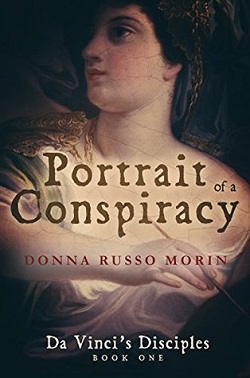
Book Review: Portrait of a Conspiracy by Donna Russo Morin


Portrait of a Conspiracy by Donna Russo Morin
Book 1 in the Da Vinci’s Disciples Trilogy
ARC, Paperback, 290 pages
Diversion Books
May 10, 2016
★★★★☆

Genre: Historical Fiction/Mystery

Source: Received from the publisher for review with Historical Fiction Virtual Book Tours
One murder ignites the powderkeg that threatens to consume the Medici’s Florence. Amidst the chaos, five women and one legendary artist weave together a plot that could bring peace, or get them all killed. Seeking to wrest power from the Medici family in 15th Century Florence, members of the Pazzi family drew their blades in a church and slew Giuliano. But Lorenzo de Medici survives, and seeks revenge on everyone involved, plunging the city into a murderous chaos that takes dozens of lives. Bodies are dragged through the streets, and no one is safe.

Five women steal away to a church to ply their craft in secret. Viviana, Fiammetta, Isabetta, Natasia, and Mattea are painters, not allowed to be public with their skill, but freed from the restrictions in their lives by their art. When a sixth member of their group, Lapaccia, goes missing, and is rumored to have stolen a much sought after painting as she vanished, the women must venture out into the dangerous streets to find their friend and see her safe. They will have help from one of the most renowned painters of their era the peaceful and kind Leonardo Da Vinci. It is under his tutelage that they will flourish as artists, and with his access that they will infiltrate some of the highest, most secretive places in Florence, unraveling one conspiracy as they build another in its place. Historical fiction at its finest, Donna Russo Morin begins a series of Da Vinci’s disciples with a novel both vibrant and absorbing, perfect for the readers of Sarah Dunant.
The story that Donna Russo Morin crafts in Portrait of a Conspiracy is a little bit of a mystery, a little bit of a women’s history lesson, and a little bit of a study of art. Immediately from the first pages of the novel you are sucked into the drama of an assassination and as the pages turn more of the plot behind the assassination unfolds. The five core women of this story get caught up in all of the drama not only because it is happening in their great city and it effects everyone to some extent, but also because one of their own is seemingly implicated in the plot in some manner and they are trying to find and protect their friend before the law does. At this time, women were not in power, so they must find her using the methods available to women, which makes things a little bit trickier. At the same time, they must work to keep their small art group a secret, which is a challenge when the people in power are turning over every stone looking for the perpetrators of the assassination. There is quite a lot going on here!

Overall, I feel that the plot of the novel was well thought-out and well-paced. There was never a sense of the objective being lost even though these characters endure some life events that run alongside the main story of the assassination plot and finding their missing friend. It imitated life in that you can never have a sole focus because life gets in the way – and especially when you are trying to coordinate a group of women it can become a challenge as personalities can get in the way!

There was certainly a lot of attention paid to learning about and detailing the creation of art. These women have their own art studio and we are privy to their creation of their works. In their quest they also study and witness other art being created. It is clear that the author spent a lot of time researching methods of painting and it make the novel that much richer in detail.

Morin is an expert at bringing the setting to life, in this case the city of Florence. I have never been to Florence, or even Italy for that matter, but I felt like I was living and breathing it right along with the characters – from the grimy walls a dark alley, to the smells of death and decay in the plaza, to the plush luxury of the upper class homes.

There is a large cast of characters here – at the very least there are 6 women, their husbands/children, Leonardo da Vinci, and several people of power and influence. Although a dramatis personae is included in the front of the novel, I forgot about this and struggled through most of the novel to remember which name belonged to which woman and from what walk of life she was from. Various sections of the book are told from different perspectives and I found it hard to keep track of who was who – so I recommend you keep the character profiles in front of you! Morin well fleshes out her characters and each is a unique character – I just couldn’t keep them all straight.

There was one thing that kept me from rating this novel higher and this was that at times the narrative became a little bit dense, especially in the first half of it. The most glaring example of this was the inclusion of practically every street that the women covered during their treks around the city; it was something that I began to frequently notice and it slowed down my pace. While I think the author wanted to give a detailed description of their paths through the city I think that it became a little too much and would have benefited from a lighter hand at the street name dropping.

I’m looking forward to seeing how the rest of this series plays out. I am curious if there will be another mystery/thriller angle in the next book or if it will be more focused on their quest to bring women’s art to the fore.

Reviews of this book by other bloggers:
 
Buy the Book: Amazon | Barnes & Noble | RJ Julia

 
Also by Donna Russo Morin:


The Secret of the Glass
[My Review]


The King’s Agent
[My Review]


To Serve a King
[My Review]


The Courtier’s Secret

 
Find Donna Russo Morin: Website | Facebook | Twitter

 
Follow the Tour!

On Twitter: #PortraitofaConspiracyBlogTour


Copyright © 2016 by The Maiden’s Court

Two Sides to Every Story: The Wicked Lady is Innocent & Giveaway


Today I have the wonderful opportunity to welcome Deborah Swift, author of the upcoming Lady of the Highway, book 3 of her Highway Series, to The Maiden's Court with an awesome contribution to the Two Sides to Every Story series.  Swift treats us to the story behind the highwaywoman legend of Katherine Fanshawe.  I hope you will enjoy it!

The Wicked Lady is Innocent

The Legend of The Wicked Lady, Lady Katherine Fanshawe vs. The Real Life of Lady Katherine Fanshawe.
The wind was a torrent of darkness among the gusty trees.The moon was a ghostly galleon tossed upon cloudy seas…’

Alfred Noyes, The Highwayman
As far as I know, there has only ever been one female highwayman, and she was known as The Wicked Lady.  She has long been a legend in Hertfordshire, England, but was made a sensation by the 1945 film The Wicked Lady. The film starred Margaret Lockwood in the title role as a nobleman's wife who secretly becomes a highwayman to relieve her life of boredom. The mystery of why she would take such an extreme action was the talk of its day –and the film had one of the biggest audiences ever for a film of its period, $18.4 million – a staggering number. I can remember my mother talking about it as one of her favorite films.

The Wicked Lady - 1945
It was such a hit that the film was re-made in 1983 and starred Faye Dunaway in the lead role, but that version was a disaster and earned Faye Dunaway an award for the Worst Actress. The film itself was based on a book by Magdalen King Hall, The Life and Death of the Wicked Lady Skelton, but the novel was only loosely based on the real Katherine’s life. I have a copy and it is exciting reading, though rather long-winded in the telling by today’s standards.

The Popular Legend of the Wicked Lady

A beautiful lady of the manor, Lady Katherine Fanshawe, is bored with her humdrum life, and begins riding out secretly, dressed in men’s attire, as a highwaywoman. Her husband, meanwhile, is completely unaware of her perilous night-time exploits, because she creeps out from Markyate Cell (the Manor house) through a secret passageway. Katherine eventually meets another dashing gentleman of the road, a handsome farmer called Ralph Chaplin, and falls in love, but their affair must remain hidden. The pair perform a series of ‘Bonnie and Clyde’ type robberies, until eventually Ralph is caught during a failed hold-up, and subsequently hanged on Finchley Common. Mad with grief at his death, the ‘wicked lady’ terrorizes the villagers in the area, burning down houses, and shooting the local constable on his doorstep.

The ‘wicked’ Lady Katherine is eventually caught when a trap is set for her, and a wagon that she holds up on the highway contains a group of armed men. She is shot, and fatally wounded. She rides back to Markyate Cell, but dies of her injuries before reaching the front door.

Many ghostly sightings have added to the legend. Her ghost has been seen riding her horse at full gallop on dark nights, and in 1840 when part of the manor was destroyed by fire, the blaze was blamed on Lady Katherine.  Whilst helping to put out the fire several locals said that they felt an eerie presence and feared they were being spied on by her unquiet ghost.

Lady Katherine Fanshawe is Innocent – The Research

Despite the romance of the legend, there is actually nothing of substance to link the real Lady Katherine Fanshawe with any sort of highway robbery, although it is likely that there was robbery and plunder on the roads at this period because it was a period of civil unrest. Many Royalists had been uprooted from their estates by the English Civil Wars, and in order to survive, took to the road and committed crimes that could have been attributed to her. The events of the English Civil War caused confusion and massive social unrest, and formed a plausible background for disenfranchised aristocrats.

Lady Katherine Fanshawe
Investigation of Anne Fanshawe’s diary, written at the time, has little of note to say on Katherine, her relation by marriage, and certainly nothing pertaining to robbery on the highway.

And nowhere in the real historical records is Katherine’s lover, Ralph Chaplin, traceable, although he always features in the retelling of the legend as the person who persuaded her to robbery in the first place.

Markyate Cell certainly existed though. It was called a ‘cell’ because the original site was a hermitage, which housed the nun Christina of Markyate, and eventually became a priory. The priory did not fare well during the Dissolution and was demolished in 1537, and the much more elaborate Markyate Manor was built on its footprint, although it is still sometimes known as Markyate Cell - the cell being the original hermitage. George Ferrers retained the name ‘Cell’ when he bought the land in 1548. The Ferrers family controlled this land when Markyate Manor was supposedly the home of Katherine Ferrers, the Wicked Lady.

Markyate Manor - Photo Credit
Born 4th May 1634, Katherine was the daughter of Knighton Ferrers of Bayfordbury, and his wife Katherine Walter. After the death of her husband, George Ferrers, Katherine’s mother re-married Sir Simon Fanshawe, a neighboring landowner. When her mother died, Markyate Manor was soon in the iron control of Katherine’s step-father. Worse, at only twelve years old, Katherine was forced into an arranged marriage with his nephew, Thomas Fanshawe, so that The Fanshawes could retain control of the estate, thus Katherine Ferrers became Katherine Fanshawe.

However – although the house belonged to her husband, it has never been proved that Katherine Fanshawe actually lived at Markyate Manor during the time she was supposed to have been a highwaywoman, and evidence shows the manor was sold well before her death. After Cromwell came to power, Markyate Manor was sold by her husband to ‘three Londoners’ in 1655.

Nomansland Common, where she was thought to hold up the highway, is a long way from Markyate Manor – half a day’s ride, surely impractical for hit and run robberies?

Records show that Katherine Fanshawe died aged 26, and was not recorded as having any children, which was highly unusual for a married woman her age in those times, although can be explained by the war. Her husband and stepfather actually spent much of the war exiled in France or Ireland.

Katherine was buried not in the Fanshawe family vault, as might be expected, but at St Mary’s Church, Ware, so perhaps the real Lady Katherine Fanshawe was residing close to there when she died. So with Katherine’s probably undramatic death, the Ferrers line died out.

John Barber, on his excellent website on Lady Katherine, poses the idea that her life may have been confused with the story of ‘Maude of Allinghame’ (1833), a Victorian ballad that tells the story of a noblewoman who robs the Mayor of Redbourne. She too has an illicit affair, and she too dies on the steps of her manor house, Allingham Hall. Coincidentally Katherine’s mother was related to a family called Allinghame.

This seems to be the most likely explanation, although parts of Katherine’s legend are undoubtedly true. She was forced to marry tragically early; her stepfather did squander her fortune; the real Markyate Manor does have a secret passage, because in the 1820’s builders discovered a secret passageway at Markyate Manor.  It ran from the kitchen to a chamber above, and was most likely a priest hole – as both the Ferrers and the Fanshawes were closet Catholics.  Also possible as a source of the legend is Wicked Lord Ferrers, who was hanged at Tyburn in 1760 for the murder of his servant. His name and his story could easily have been grafted on to Katherine’s history.

So, was Katherine a wicked lady? Probably not. But the legend is still irresistible, and my three books for young adults have made full use of the known history, along with selected elements of the legend.

 
Deborah Swift is the author of three previous historical novels for adults, The Lady’s Slipper, The Gilded Lily, and A Divided Inheritance, all published by Macmillan/St Martin’s Press, as well as the Highway Trilogy for teens (and anyone young at heart!) Shadow on the Highway and Spirit of the Highway are available now.  The third novel in the Highway Trilogy, Lady of the Highway is out soon. Her first novel was shortlisted for the Impress prize for new novelists.

She lives on the edge of the beautiful and literary English Lake District – a place made famous by the poets Wordsworth and Coleridge. 

You can find Deborah on the following social media sites: WEBSITE | BLOG | FACEBOOK | TWITTER | GOODREADS | GOOGLE+ |PINTEREST


Buy the Books: Amazon | Barnes & Noble | RJ Julia


Book Blurb:

England 1652
Seventeen-year-old Lady Katherine Fanshawe (Kate) has lost everything in the civil war that has torn England apart. Determined to build a community of friends, she invites Owen Whistler and the radical Diggers sect to make their home in her manor house.

When her stepfather unexpectedly returns, he evicts the Diggers with no pay, despite their months of labour on his land. Wilful, and determined to regain Owen’s trust, Kate has to repay her friends the only way she can – by turning to secret highway robbery.

But Kate is not the only one riding the highway at night, and her rival for the road is intent on bloodshed and murder. When he unleashes a reign of terror, Kate gets the blame. Will she be able to clear her name, and save the one person she loves from his lust for revenge?


Giveaway!!

I have an excellent giveaway that is open internationally. It is for a signed Paperback Copy of Shadow on the Highway and an Ebook Copy of Spirit on the Highway, both books so far published in Swift's Highway series. Entries thru Rafflecopter below. Open thru May 31st!

a Rafflecopter giveaway


Copyright © 2016 by The Maiden’s Court

Monday, May 9, 2016

Audiobook Review: The Witches by Stacy Schiff


The Witches: Salem, 1692 by Stacy Schiff
Unabridged, 18 hr. 22 min.
Hachette Audio
Eliza Foss (Narrator)
October 27, 2015
★★★☆☆
 
Genre: Non-Fiction

Source: Downloaded from Audible
The Pulitzer Prize-winning author of Cleopatra, the #1 national bestseller, unpacks the mystery of the Salem Witch Trials.
It began in 1692, over an exceptionally raw Massachusetts winter, when a minister's daughter began to scream and convulse. It ended less than a year later, but not before 19 men and women had been hanged and an elderly man crushed to death.
The panic spread quickly, involving the most educated men and prominent politicians in the colony. Neighbors accused neighbors, parents and children each other. Aside from suffrage, the Salem Witch Trials represent the only moment when women played the central role in American history. In curious ways, the trials would shape the future republic.
As psychologically thrilling as it is historically seminal, THE WITCHES is Stacy Schiff's account of this fantastical story-the first great American mystery unveiled fully for the first time by one of our most acclaimed historians.
I’ve held off writing this review for a little while because I really wanted to love this book. So much has been made of Schiff’s Cleopatra and that the Salem Witch Trials took place on my home turf, I was extremely excited to read this one and see what light Schiff could shine on those dark days. In some ways, she did just that, but at the same time made it less accessible to readers.

There are a plethora of books that have been written about the Salem Witch Trials, it’s not a new and unique subject, but Schiff brings an all-encompassing approach to this history. Her strength is that she doesn’t just focus on the key witches and accusers, but looks at a wide range of players, the intricacies of the witch trials, the backstory of the Salem region, Cotton & Increase Mather, and the families whose lives were torn apart during this time. You can get a true sense of how expansive this event was for the region. One angle that I thought was unique to The Witches was the focus and depth of coverage on the Mathers, Increase and Cotton. Both were extremely integral to the trials and I think that a discussion on them brings a lot to the complete understanding of how the events unfolded.

That being said however, there is such a thing as too much detail. While this is a bit of exaggeration, it felt like Schiff covered every witch trial in excruciating detail. There is a reason most books on the subject focus on the big names; they are the most interesting! Many of the trials covered were, quite frankly, extremely boring and I found myself tuning out; the names blended together and I lost interest and didn’t pick it back up for days. The other area that I believe suffered from too much attention was the Mathers. The detail just bogged down the forward progression of the book, there was just too much to digest it all. Even if you were working on a dissertation I think you would quickly lose interest in this book.

I really can’t recommend this book to my everyday reader friends – I struggled through the whole thing and really would have put it down earlier if I hadn’t been listening to it on audio. If you are going to be writing on the time period, the witch trials, or some of the names, then you might find this book helpful.

★★★½☆☆

I tend to prefer to read non-fiction books on audio because a narrator can help bypass some of the density of fact bombs. While the narrator was very good here, even she couldn’t help too much in getting through the slog of details here. I would listen to this narrator again, don’t get me wrong there – I liked her voice and the way she read, it was just dense reading.

You can listen to a sample of the audio production here:


Reviews of this book by other bloggers:

Buy the Book: Amazon | Barnes & Noble | RJ Julia

You can watch/listen to a discussion of this book with the author as part of CSPAN's BookTV segment.

Also by Stacy Schiff:


Cleopatra: A Life


Vera: Mrs. Vladimir Nabokov


Saint-Exupery: A Biography


A Great Improvisation: Franklin, France, and the Birth of America

 
Find Stacy Schiff: Website | Facebook | Twitter

Find Eliza Foss: Website |


Copyright © 2016 by The Maiden’s Court

Friday, May 6, 2016

Interview with James Dalessandro & Giveaway!

Good morning everyone!  Today I have the opportunity to introduce you to James Dalessandro, author of 1906, a novel that I fell in love with when I read it a couple years ago.  You can read my review here.  Check out this interview to find out more from the author about what went into the writing of this novel.


Hi James and welcome to The Maiden’s Court! I am so excited to have you here today as I inhaled your book, 1906, right after it came out and I LOVED it.

Heather: The world that you create in 1906 is as realistic as if you experienced it.  Did you do a lot of research before writing this book? What type of research?

James Dalessandro: I am a fanatic for research. I love history, we just don’t make characters like they once did. It’s also the best excuse I know to avoid writing. I spent seven years researching and writing 1906. I tracked every minute of the earthquake and the activities of the real characters involved – the city’s mayor, it’s political boss, the great Enrico Caruso – who sang at our opera house five hours before the temblor hit.
I wanted people to know about the great city – I called it “part Paris and part Dodge City,” the wildest, wickedest and most colorful city in North America – a city that was wiped from the face of the earth. Nearly 29,000 buildings were destroyed, 100 theaters, three opera houses, 17 cable car lines. Every town along the San Andreas Fault over its 300 mile path was destroyed – Santa Rosa north of us and San Jose to the south.

I read military reports that were released under the Freedom of Information Act in the 1970s. I made friends with an army of historians, particularly Gladys Hansen, whose book Denial of Disaster destroyed many of the lies and cover-ups. City officials claimed the death count was 478 – it was actually more than 3,000. They claimed the Army marched in and kept order. What they really did was get drunk on the job, shoot a few hundred innocent people as suspected looters – while looting dozens of stores themselves. They used dynamite on wood framed buildings to try to stop the fire: the flaming debris started a dozens of fires and spread the conflagration. The city burned for three days.

I had automobile catalogues from 1906, and catalogues on women’s fashions. Another on horse carriages, food and recipes. I had more than 200 books and magazine articles.

Most of all, I wanted to destroy the “official record.” If history is the lie most commonly agreed upon, what happened in San Francisco in April of 1906 might take the brass ring. In 2005, the resolution I wrote on behalf of Gladys Hansen and myself was passed unanimously by our Board of Supervisors, setting aside the century old death count of 478 people and recognizing a count of “3,000 plus.” It made national and world wide news, to my great surprise. How is that for irony: a work of fiction that changed history?

H: That is phenomenal! I am a fan of research too; I never want to get to the actual writing part, I just want to learn more!

To tag on to that previous question a little bit, are there any great databases or sites that you could recommend that a reader could go to learn more about this time period and event?

JD: Gladys Hansen’s “The Virtual Museum of the City of San Francisco.” We are right now digitizing her entire collection. She worked on the 1906 earthquake story, and compiled a registry of all who died, for more than 50 years. I’ve been the Chairman of the Board of that museum for over a decade. And please see “The Damnedest, Finest Ruins” on Youtube. It’s the documentary I wrote and directed on the disaster. It sports restored photos and silent film footage, and the restored voice of Enrico Caruso.

H: I will have to go check out the Virtual Museum!

This great earthquake of San Francisco in 1906 was a terrible disaster and one that is remembered in history of California.  Could you explain some of the elements that contributed to make this such a notable event?

JD: Nature’s wrath, human folly and rampant urban corruption. The earthquake was the most destructive in North American history – a 7.9 on the Richter scale that lasted 53 seconds with an average ground movement of 15 feet along the entire 300 mile rupture. But that was probably one quarter of the damage. The day the earthquake struck, its visionary fire chief, Dennis Sullivan, was scheduled to meet with a Federal Judge to force the city’s corrupt officials to build his massive fire suppression system. He wanted huge water tanks on the city’s hills to feed into specially designed hydrants. He wanted fireboats and manifolds along the city’s perimeter – we’re surrounded by salt water – with diesel pumps to supply unlimited water. Dennis Sullivan never made it to the meeting. At 5:12 a.m. his fire station was ripped in half by falling debris. The great chief lay in a coma for the next four days. He was likely the first victim pulled from the rubble, and the one man who might have altered the city’s fate at the hands of the Army.

H: History is full of such irony!

What led you to choose to write about this event?  Do you have any personal connections to it?

JD: It was just the greatest untold story I had ever seen. I love big, sweeping historical epics full of colorful characters – East of Eden, Gone with the Wind. And I love keeping the little guy in the story – the people often left out of history. My personal connection is a 45-year love affair with my adopted home of San Francisco.

H: For those who have not read your work, how would you describe your writing style in this book?

JD: I took a risk. The great Nellie Bly, who worked for Joseph Pulitzer’s New York World, was the most influential writer of her time and the most important American journalist ever, in my opinion. She got herself confined to mental institutions, infiltrated baby peddling rings and sexual slavery rings at the turn of the century. And she pioneered a unique writing style: in the middle of her third person reporting, she’d add her first person insights and experiences. She was a worldwide sensation who was often denounced for putting herself in the story and changing perspective from third person to first. My narrator, Annalisa Passarrelli, does the same in 1906. Though I had Annalisa explain that many observations were provided by others’ first hand accounts, including letters and diaries by both the living and dead, et al; not everyone liked it. A huge percentage did, thankfully. If you take risks, you’ll never bat a thousand. You won’t anyway, so you might as well have fun.

H: Well, you can count me among the many that loved it!

Last question, and I always have to ask, do you have any future writing plans?

Always. I’m writing a television series on the life of Joseph Petrosino, a former New York shoeshine boy who was drafted into the NYPD to combat an epidemic of crime in the Italian neighborhoods. Over a 26-year career, he perfected undercover work, created the New York Bomb Squad and nearly wiped out the New York Mafia before they got a stranglehold on the entire city and much of the country. His best pal and partner was a squeaky voiced police commissioner named Theodore Roosevelt. They were best of friends for all their lives and fought to end crime and corruption in American cities. Petrosino was the most famous detective in America at the time: the highest award in the NYPD is named for him. And then there’s the Nellie Bly project. I’m on a campaign to bring American history to life. And fortunately, TV has caught up with me: I’ve been trying to do this for years.

I did a Movie of the Week on one of my other books, Citizen Jane – the true story of a woman who spent 13 years tracking down and convicting the man who murdered her aunt. Jane Alexander is her name. By her death at 86, she had solved 20 cold case murders and helped hundreds of victims’ families fight for justice. I’m hoping to bring the remainder of her story to television, which has now picked up the slack for good story telling that once belonged to movies. The latter is now obsessed with special effects and films based on theme park rides.

I believe in historical fiction, not historical fraud. I take what liberties I take based on the facts I see, and just try to imagine what happened in those moments, bridging those gaps. E.L. Doctorow said a journalist will tell you what happened, a novelist how it felt. I try to do both. I’m not in the cartoon business. I’m in the good story, accurately told business, with all the heart, drama and color I can find.

H: I have to agree with you about television picking up the slack and featuring very good historical shows. Can’t wait to see what you do! Thanks for stopping by today, it was wonderful to pick your brain about this book I loved.


James Dalessandro was born in Cleveland Ohio, and educated at Ohio University and UCLA film school. In 1973 he founded the Santa Cruz Poetry Festival with Lawrence Ferlinghetti and Ken Kesey, the nation’s largest literary event. He has written for Playboy, the Examiner newspapers, San Francisco magazine. He was writer of the House of Blues Radio Hour and created the nationally syndicated program “Rock On” with Doors keyboardist Ray Manzarek. He has published four books: Canary in a Coal Mine (poetry); Bohemian Heart (noir detective fiction); Citizen Jane (True Crime); and 1906: A Novel (Historical Fiction). He is award winning writer/director/producer of the documentary film THE DAMNEDEST, FINEST RUINS (PBS/KQED), and writer/producer of the Hallmark Movie “Citizen Jane,” based on his book. He is screenwriter of “1906” the upcoming Pixar/Warner Brothers live action film based on his novel of the same name. He lives in San Francisco with his wife Katie and best pal Giacomo Poochini.

Find James Dalessandro: Website | Facebook | Google + | Goodreads


Book Blurb:
Set during the great San Francisco earthquake and fire, this page-turning historical novel reveals recently uncovered facts that forever change our understanding of what really happened. Narrated by a feisty young reporter, Annalisa Passarelli, the novel paints a vivid picture of the Post-Victorian city, from the mansions of Nob Hill to the underbelly of the Barbary Coast to the arrival of tenor Enrico Caruso and the Metropolitan Opera. Central to the story is the ongoing battle—fought even as the city burns—that pits incompetent and unscrupulous politicians against a coalition of honest police officers, newspaper editors, citizens, and a lone federal prosecutor. James Dalessandro weaves unforgettable characters and actual events into a compelling epic.
Buy the Book: Amazon | Barnes & Noble | RJ Julia

 
Giveaway!

I have 1 ebook copy of 1906 available to an international entrant!  The rules are simple:

– All entries are made via the Rafflecopter widget below.
– Giveaway is open from today (5/6/16) through 5/22/16
– Must be 18 or older to enter.
– Only one entry per household.
– All giveaway entrants agree to be honest and not cheat the systems; any suspect of fraud is decided upon by blog/site owner and the sponsor, and entrants may be disqualified at our discretion.
 
Follow the Tour!

On Twitter: #1906BlogTour  #HistoricalFiction  #JamesDalessandro


Copyright © 2016 by The Maiden’s Court

Thursday, May 5, 2016

Cover Crush - Leila Meacham

Cover Crush

We can all say that you should never judge a book by its cover, but I guarantee that we all have done so at least once! Cover Crush is designed to feature some of those covers that have caught the eye as a standout on the bookshelf.


I have always LOVED Leila Meacham’s book covers (check out her prior titles toward the end of this post). Her covers always feature flowers and the cover of Titans is a bit of a departure from the others in that it is more than just flowers. Titans features a beautiful atmospheric plantation home set amongst some field flowers. Knowing Meacham’s storytelling style from reading all her prior novels, I have a feeling this is a good representation of her setting.


What do you think about this cover?


Check out the covers that my blogger friends at Flashlight Commentary, 2 Kids and Tired Books, and A Bookaholic Swede are crushing on today!


Copyright © 2016 by The Maiden’s Court

Wednesday, May 4, 2016

New Book Alert: American Tumbleweeds by Marta Elva


American Tumbleweeds by Marta Elva
Paperback & e-book, 298 pages
Circling Rivers
Published: May 10, 2016
ISBN: 1939530016
Genre: Historical Fiction
 
Book Blurb:
Set along the border between El Paso, Texas, and Juárez, Mexico, American Tumbleweeds tells the bittersweet story of a Mexican-American family’s struggle to stay together as tradition collides with the social upheaval of 1960s America.
Inez’s family threatens to fly apart when her father gets arrested smuggling marijuana into the U.S. Inez finds refuge from the turmoil in the old ways cherished by her beloved Mexican grandmother. But life in El Paso is far more exciting, as the explosion of rock music and new personal freedom shatter traditions on both sides of the border.
American Tumbleweeds captures poignantly the growing pains of a young girl and of all immigrant families whose dual cultural identities lend them both strength and strife. From Amalia, the matriarchal grandmother, to Inez, woman-child of the 1960s, these “American tumbleweeds” portray every family: loving and clinging, wounding each other deeply while comforting each other in the soul-deep ways that only families can reach.
Buy the Book: Amazon | Barnes & Noble | RJ Julia
 
Praise for American Tumbleweeds:

"With AMERICAN TUMBLEWEEDS Marta Elva pulls us into the minds of a half-dozen members of a border family in crisis, dramatizing the state of living ni aqui, ni alla—neither here nor there geographically and emotionally. A moving first novel." — John Sayles, film director, author, and MacArthur fellow

"The aptly named AMERICAN TUMBLEWEEDS depicts the balancing act some bi-cultural families must undertake to live in America. The characters indeed “tumble” back and forth over our southernmost border, forced to live in two worlds at once. This is an experience all Americans should know about." — Sonia Manzano, author of Becoming Maria: Love and Chaos in the South Bronx

"AMERICAN TUMBLEWEEDS is an engrossing, enlightening portrayal of life along the Mexican–American border in the late 1960s. Marta Elva’s sensitive insights draw a straight line to family and societal issues in today’s headlines."   — Annamaria Alfieri, author of the critically-acclaimedStrange Gods

"Marta Elva’s debut novel, AMERICAN TUMBLEWEEDS, provides an engaging look at the human cost of the turbulent 1960s along the Mexican-American border. Deftly conveyed through the eyes of an innocent and vulnerable fourteen-year-old girl and her family, this well-written saga could just as easily reflect contemporary times. It is insightful, timely, and rich with meaning." ­  — Pam Webber, author of The Wiregrass 

"Marta Elva has written a coming-of-age novel that perfectly captures the feel, fear, fun and uncertainty of the late 1960s.  I was hooked on this delightful story from the very first page. And the characters stayed with me long after the final word."  — Melanie Payne, columnist “Tell Mel,” The News-Press, Ft. Myers, FL

"Marta Elva’s AMERICAN TUMBLEWEEDS is both a moving coming-of-age story and a compelling tale of border intrigue that goes back in time to give a human face to some of the most divisive and hotly debated issues facing contemporary America. Elva shows an uncanny knack for dialogue and plot as in each chapter she moves back and forth among her characters, unrolling the narrative through each individual’s unique point of view." — Michael Winship, senior writer, Moyers & Company, PBS

 
About Marta Elva:
Marta Elva was born in Ciudad Juárez, Mexico, and raised in El Paso, Texas. Her career as a writer, producer, editor, and camera operator in television and independent film spans over three decades and includes several Emmy-nominated shows, notably PBS WNET New York’s Setting the Stage. She and her husband live on Florida’s Gulf Coast.


Copyright © 2016 by The Maiden’s Court

Monday, May 2, 2016

Book Review: The Railwayman's Wife by Ashley Hay & Giveaway


The Railwayman’s Wife by Ashley Hay
ARC, e-book, 288 pages
Atria Books
April 5, 2016
★★★½☆☆


Genre: Historical Fiction, Literary Fiction

Source: Received for Review for tour with HFVBT
Amidst the strange, silent aftermath of World War II, a widow, a poet, and a doctor search for lasting peace and fresh beginnings in this internationally acclaimed, award-winning novel.
When Anikka Lachlan’s husband, Mac, is killed in a railway accident, she is offered—and accepts—a job at the Railway Institute’s library and searches there for some solace in her unexpectedly new life. But in Thirroul, in 1948, she’s not the only person trying to chase dreams through books. There’s Roy McKinnon, who found poetry in the mess of war, but who has now lost his words and his hope. There’s Frank Draper, trapped by the guilt of those his medical treatment and care failed on their first day of freedom. All three struggle to find their own peace, and their own new story.
But along with the firming of this triangle of friendship and a sense of lives inching towards renewal come other extremities—and misunderstandings. In the end, love and freedom can have unexpected ways of expressing themselves.
The Railwayman’s Wife explores the power of beginnings and endings, and how hard it can sometimes be to tell them apart. Most of all, it celebrates love in all its forms, and the beauty of discovering that loving someone can be as extraordinary as being loved yourself.
I feel the need to preface this review with the fact that I seem to find myself always in a state of being conflicted to not enjoying literary fiction books. This is something I never seem to know about prior to starting the book, but rapidly figure it out. It was this way with Wolf Hall by Hilary Mantel and it was the same here with The Railwayman’s Wife by Ashley Hay.

I was initially intrigued by this novel primarily based on the setting. I have read extremely few novels set in Australia and the idea of this location just following the end of WWII had a lot of promise. As I am very unfamiliar with this locale, I was pleased with how brilliantly Hay is able to bring it to life. The descriptions of the mountains, the sea, the beach and more are just beautifully illuminated and if I closed my eyes I could absolutely picture myself right there with the characters.

The novel focuses on how life changes essentially following loss or grief. For Ani, she has lost her husband; for Roy and Frank, they have lost a sense of themselves after the horrors that they experienced during the war. They are now in this idyllic location and trying to come to terms with what their lives mean and how to go on. I found Ani’s loss hard to connect to for quite some time as I didn’t feel her relationship to Mac was well established prior to his death, but that does develop overtime through various remembrances. Roy and Frank’s loss was easier to connect with because I already had the preconceived ideas of what they had experienced, even though we spend less time with them than with Ani. To this end, I think that Hay reasonably supported the theme. I appreciated seeing how these three people from different life places and having different experiences prior to their grief coped with that loss.

The problem I have typically with literary fiction, and again in The Railwayman’s Wife, is that nothing really happens. Mac’s death, which happens off screen, is at the very beginning of the novel and we really just see Ani coping with that, and she comes off as very wooden. There is one other major event that comes in the last few pages of the book that also felt as a bit of a letdown because nothing had happened throughout the middle 150 pages to build me up for it. I wasn’t emotionally invested in these characters and had no real concern for how their lives panned out. There was one plot point that I was banking on seeing and it was never to be, which was a little disappointing.

Huge props to the author for coming up with the poems features throughout the novel as created by our resident poet, Roy. I have always struggled with poetry, so I’m always in awe of those that can write it.

My opinion is certainly not the only one, so if you find that you tend to enjoy literary novels, I would go ahead and pick up this book. For me, it wasn’t my favorite simply because I like more action in my novels.

Reviews of this book by other bloggers:
Try out this book excerpt to see if this book is for you!

 
Buy the Book: Amazon | Barnes & Noble | RJ Julia

 
Also by Ashley Hay:


The Body in the Clouds


The Secret


Gum

 
Find Ashley Hay: Website

Giveaway!

I have the opportunity to give away 1 paperback copy of The Railwayman’s Wife by Ashley Hay and it is open to the USA only. Entries are made via the Rafflecopter below. Please review the below rules as put forth by HFVBT:

– Must be 18 or older to enter.
– Only one entry per household.
– All giveaway entrants agree to be honest and not cheat the systems; any suspect of fraud is decided upon by blog/site owner and the sponsor, and entrants may be disqualified at our discretion.


a Rafflecopter giveaway
 
 Follow the Tour!


On Twitter: #TheRailwaymansWifeBlogTour  #AshleyHay
At the HFVBT Website


Copyright © 2016 by The Maiden’s Court