*UPDATE*

I have updated my review and giveaway policies page (now just titled Policies above). If you are entering a giveaway, please read and abide by the applicable policy.

Attention Authors! If you arrived here looking for information on the Two Sides to Every Story guest post series, see the tab at the top of the page for more info!


Search This Blog

Showing posts with label Disaster Event. Show all posts

Wednesday, February 28, 2018

Audiobook Review: In Harm’s Way by Doug Stanton

in harms way
In Harms Way: The Sinking of the U.S.S. Indianapolis and the Extraordinary Story of Its Survivors
by Doug Stanton
Unabridged, 8 hr. 12 min.
Audible Studios
Mark Boyett (Narrator)
September 27, 2016
★★★★★
goodreads button

Genre: Non-Fiction, Military History

Source: Personal collection from Audible

On July 30, 1945, the USS Indianapolis was torpedoed in the South Pacific by a Japanese submarine. An estimated three hundred men were killed upon impact; close to nine hundred sailors were cast into the Pacific Ocean, where they struggled to stay alive, battered by a savage sea and fighting off sharks, hypothermia, and dementia. By the time help arrived—nearly four days and nights later—all but 317 men had died. How did the navy fail to realize the Indianapolis was missing? Why was the cruiser traveling unescorted in enemy waters? And how did these 317 men manage to survive? Interweaving the stories of three survivors—the captain, the ship’s doctor, and a young marine—journalist Doug Stanton has brought this astonishing human drama to life in a narrative that is at once immediate and timeless.

The definitive account of this harrowing chapter of World War II history—already a bestseller in its hardcover and mass market editions—In Harm’s Way is a classic tale of war, survival, and extraordinary courage.

I am not someone who is a huge military history buff, so the tragedy of the U.S.S. Indianapolis was not something that had ever been on my radar before. And unlike apparently every reviewer on Goodreads, I have never seen the movie Jaws and therefore not heard the story of the Indianapolis in that film. So for me, a passing mention about it in the Pearl Harbor book I had read some months back piqued my interest to look into it a bit further and then I stumbled across In Harm’s Way. I am always drawn to stories of people in incredible situations because their bravery and ability to stare death in the face and survive absolutely inspire me and at the same time you often see some of society at its worst. These things keep me riveted time and again.

While this is a solid work of non-fiction it reads so quickly and will not for one moment lose your attention. Stanton interviewed survivors extensively and that is clear in how he brings life into the accounts of the different men in this book. While there are 3 main men whose circumstances are followed throughout the ordeal, we encounter many other men during their stories and are witnesses to how wildly different people handle traumatic events. Stanton seats you right there with the survivors, whether it is clinging to a raft while sharks circle or struggling to stave of dehydration and the draw to drink the salt water. There are LOTS of details, but they never feel overwhelming.

One thing that was clear to me while reading this book and so incredibly striking was just how many lives could have been spared horrible death at sea if a small handful of people had done their jobs to note if the U.S.S. Indianapolis had arrived in the port as expected or passed on the SOS message they had received from the ship. Instead, no one knew where they were or where they were even expected to be for DAYS until a pilot just happened to pass over their location. Then to put the whole thing on the Captain, the only one to have EVER been court martialed for their ship sinking during wartime was just unforgivable. These men survived a trying ordeal and their service let them down. This is a story that will stick with me for quite some time to come and I am very glad to have had the chance to read it.

audiobookimpressions

★★★★★

There is good reason why this audiobook one a 2017 Audie Award for best history/biography audiobook. Mark Boyett competently handled the gravity of the situation as well as the human drama of it. He has an excellent cadence to his narration that gives the listener a perfect understanding of when a new thought is being brought forward, or just a pause in the moment. Boyett seems to typically narrate sci-fi/fantasy novels which probably helps him bring some of the figures from In Harm’s Way to life and pull at the heart-strings during the most dramatic of moments.

You can listen to a sample from the audiobook below:


Reviews of this book by other bloggers:


Buy the Book:
Amazon | Barnes & Noble | RJ Julia


Also by Doug Stanton:

Horse Soldiers
Horse Soldiers

odyssey
Odyssey


Find Doug Stanton:
Website | Facebook


Copyright © 2018 by The Maiden’s Court

Monday, February 19, 2018

Wish List 5: Disaster Events–Non-Fiction

IMG_20161004_224228_696000

Once a month I am planning on sharing with you all 5 of my biggest wish list books broken up by theme.  I know that you all need more on your TBR!!!  I’ve spoken before about my fascination with reading novels and non-fiction that revolve around disaster events.  Not only do I find these events to be more soul-touching, but they lend themselves to good drama as well.  Here are 5 non-fiction books about some new events on my radar.

Firestorm at Peshtigo: A Town, Its People, and the Deadliest Fire in American History by Denise Gess and William Lutz

firestorm"Novelist Denise Gess and historian William Lutz brilliantly restore the event to its rightful place in the forefront of American historical imagination." —Chicago Sun-Times

On October 8, 1871—the same night as the Great Chicago Fire—the lumber town of Peshtigo, Wisconsin, was struck with a five-mile-wide wall of flames, borne on tornado-force winds of one hundred miles per hour that tore across more than 2,400 square miles of land, obliterating the town in less than one hour and killing more than two thousand people.

At the center of the blowout were politically driven newsmen Luther Noyes and Franklin Tilton, money-seeking lumber baron Isaac Stephenson, parish priest Father Peter Pernin, and meteorologist Increase Lapham. In Firestorm at Peshtigo, Denise Gess and William Lutz vividly re-create the personal and political battles leading to this monumental natural disaster, and deliver it from the lost annals of American history.

Curse of the Narrows: The Halifax Explosion 1917 by Laura M. MacDonald

curse of the narrowsThe events of the horrific Halifax explosion are well documented: on December 6, 1917, the French munitions ship Mont Blanc and the Belgian relief ship Imo collide in the Halifax harbour. Nearly 2,000 people are killed; over 9,000 more are injured. The story of one of the world’s worst non-natural disasters has been told before, but never like this.

In a sweeping narrative, Curse of the Narrows tells a tale of ordinary people in an extraordinary situation, retracing the steps of survivors through the wreckage of a city destroyed. Laura M. MacDonald weaves a panoramic chronicle of the astonishing international response to the explosion, telling of the generous donations of money and medical specialists made by the city of Boston, of how the number of horrific injuries to Halifax’s children inspired startling developments in pediatric medicine, and exploring the disaster’s chilling link to the creation of the atomic bomb.

Filled with archival photos, defined by meticulous research andi nfused with a storyteller’s sensibility, Curse of the Narrows is a compelling and powerful book.


Krakatoa: The Day the World Exploded by Simon Winchester

krakatoaThe bestselling author of The Professor and the Madman and The Map That Changed the World examines the enduring and world-changing effects of the catastrophic eruption off the coast of Java of the earth's most dangerous volcano -- Krakatoa.

The legendary annihilation in 1883 of the volcano-island of Krakatoa -- the name has since become a byword for a cataclysmic disaster -- was followed by an immense tsunami that killed nearly forty thousand people. Beyond the purely physical horrors of an event that has only very recently been properly understood, the eruption changed the world in more ways than could possibly be imagined. Dust swirled round the planet for years, causing temperatures to plummet and sunsets to turn vivid with lurid and unsettling displays of light. The effects of the immense waves were felt as far away as France. Barometers in Bogotá and Washington, D.C., went haywire. Bodies were washed up in Zanzibar. The sound of the island's destruction was heard in Australia and India and on islands thousands of miles away. Most significant of all -- in view of today's new political climate -- the eruption helped to trigger in Java a wave of murderous anti-Western militancy among fundamentalist Muslims: one of the first outbreaks of Islamic-inspired killings anywhere.

Simon Winchester's long experience in the world wandering as well as his knowledge of history and geology give us an entirely new perspective on this fascinating and iconic event as he brings it telling back to life.

Washed Away: How the Great Flood of 1913, America's Most Widespread Natural Disaster, Terrorized a Nation and Changed It Forever by Geoff Williams

washed awayThe storm began March 23, 1913, with a series of tornadoes that killed 150 people and injured 400.  Then the freezing rains started and the flooding began. It continued for days.  Some people drowned in their attics, others on the roads when the tried to flee. It was the nation's most widespread flood ever -- more than 700 people died, hundreds of thousands of homes and buildings were destroyed, and millions were left homeless. The destruction extended far beyond the Ohio valley to Illinois, Indiana, Michigan, Nebraska, Pennsylvania, Tennessee, Arkansas, Louisiana, Kentucky, West Virginia, New York, New Jersey, and Vermont. Fourteen states in all, and every major and minor river east of the Mississippi.

In the aftermath, flaws in America's natural disaster response system were exposed, echoing today's outrage over Katrina.  People demanded change. Laws were passed, and dams were built.  Teams of experts vowed to develop flood control techniques for the region and stop flooding for good. So far those efforts have succeeded. It is estimated that in the Miami Valley alone, nearly 2,000 floods have been prevented, and the same methods have been used as a model for flood control nationwide and around the world.


Close to Shore: The Terrifying Shark Attacks of 1916 by Michael Capuzzo

close to shoreCombining rich historical detail and a harrowing, pulse-pounding narrative, Close to Shore brilliantly re-creates the summer of 1916, when a rogue Great White shark attacked swimmers along the New Jersey shore, triggering mass hysteria and launching the most extensive shark hunt in history.

During the summer before the United States entered World War I, when ocean swimming was just becoming popular and luxurious Jersey Shore resorts were thriving as a chic playland for an opulent yet still innocent era's new leisure class, Americans were abruptly introduced to the terror of sharks. In July 1916 a lone Great White left its usual deep-ocean habitat and headed in the direction of the New Jersey shoreline. There, near the towns of Beach Haven and Spring Lake-and, incredibly, a farming community eleven miles inland-the most ferocious and unpredictable of predators began a deadly rampage: the first shark attacks on swimmers in U.S. history.

For Americans celebrating an astoundingly prosperous epoch much like our own, fueled by the wizardry of revolutionary inventions, the arrival of this violent predator symbolized the limits of mankind's power against nature.

Interweaving a vivid portrait of the era and meticulously drawn characters with chilling accounts of the shark's five attacks and the frenzied hunt that ensued, Michael Capuzzo has created a nonfiction historical thriller with the texture of Ragtime and the tension of Jaws. From the unnerving inevitability of the first attack on the esteemed son of a prosperous Philadelphia physician to the spine-tingling moment when a farm boy swimming in Matawan Creek feels the sandpaper-like skin of the passing shark, Close to Shore is an undeniably gripping saga.

Heightening the drama are stories of the resulting panic in the citizenry, press and politicians, and of colorful personalities such as Herman Oelrichs, a flamboyant millionaire who made a bet that a shark was no match for a man (and set out to prove it); Museum of Natural History ichthyologist John Treadwell Nichols, faced with the challenge of stopping a mythic sea creature about which little was known; and, most memorable, the rogue Great White itself moving through a world that couldn't conceive of either its destructive power or its moral right to destroy.

Scrupulously researched and superbly written, Close to Shore brings to life a breathtaking, pivotal moment in American history. Masterfully written and suffused with fascinating period detail and insights into the science and behavior of sharks, Close to Shore recounts a breathtaking, pivotal moment in American history with startling immediacy.


Wish List 5

In the Heart of the Sea     Denali’s Howl         The Johnstown Flood
★★★★ ½☆                ★★★★☆                     ★★★★☆      


If you are looking to add more books to your list, here are some of the wishlists from a few of my friends this month: (to be updated as they go live)

keep calm and support book bloggers


Copyright © 2018 by The Maiden’s Court

Friday, September 1, 2017

Book Review: Denali’s Howl by Andy Hall

denalis howl
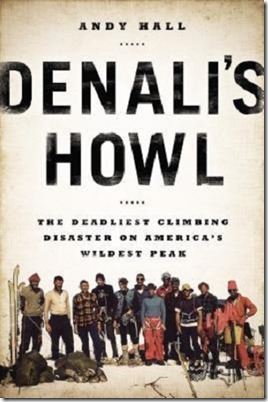
Denali’s Howl: The Deadliest Climbing Disaster on America’s Wildest Peak
by Andy Hall
Paperback, 272 pages
Plume
April 28, 2015
★★★★☆
goodreads button

Genre: Non-Fiction

Source: Personal collection

Denali’s Howl is the white-knuckle account of one of the most deadly climbing disasters of all time.

In 1967, twelve young men attempted to climb Alaska’s Mount McKinley—known to the locals as Denali—one of the most popular and deadly mountaineering destinations in the world. Only five survived.

Journalist Andy Hall, son of the park superintendent at the time, investigates the tragedy. He spent years tracking down survivors, lost documents, and recordings of radio communications. In Denali’s Howl, Hall reveals the full story of an expedition facing conditions conclusively established here for the first time: At an elevation of nearly 20,000 feet, these young men endured an “arctic super blizzard,” with howling winds of up to 300 miles an hour and wind chill that freezes flesh solid in minutes. All this without the high-tech gear and equipment climbers use today.

As well as the story of the men caught inside the storm, Denali’s Howl is the story of those caught outside it trying to save them—Hall’s father among them. The book gives readers a detailed look at the culture of climbing then and now and raises uncomfortable questions about each player in this tragedy. Was enough done to rescue the climbers, or were their fates sealed when they ascended into the path of this unprecedented storm?

Denali’s Howl was one of the books that I picked up while on my vacation in Alaska. I had just spent the day touring through the beautiful Denali National Park and was browsing through the gift shop. I knew I wanted to pick up something about the mountain itself because we had been unable to see it due to weather (did you know only about 30% of visitors to the park actually see the peak because of the weather?). As you may know from having read some of my other reviews, I’m drawn to books, particularly non-fiction, about disasters. Denali is a dangerous mountain to climb and there have been a few disastrous moments in the life of the park, however, none is more notorious than the 1967 Wilcox Expedition where 7 of the 12 men died up on that peak and have never been recovered.

Andy Hall brings a unique perspective to this book that isn’t present in others about this event – he grew up in Denali National Park and his father was the Superintendent of the Park at that time. While he was only 5 years old, so he didn’t know the gravity of the events unfolding at the time, he has an “on the ground” connection to the story in a way that most others don’t. He can speak to what stresses it took on his father or why he made the choices he did. However, the book never came off as feeling like he was trying to whitewash over the culpability of everyone involved despite his close association with it.

Although the book is shorter in length than most on this subject, I found that it had enough information to meet my needs. It covered everything from the history of climbing of this mountain, the meteorology of the storm that hit it, the difficulties of climbing any mountain (but especially Denali) at that time, the backstory of each man in the Wilcox Expedition, the climb and attempts to save the men, and the fallout from this disaster. I didn’t feel that there was any glaring gap that I wished to have had filled. There were a few moments that felt bogged down a little bit with information that I didn’t understand about climbing in general, and a couple moments that felt repetitive, but neither of these elements changed how I raced through the pages. While not exactly a narrative work of non-fiction, there were certainly moments that felt that way, particularly the climb and the rescue. The details that are known are sometimes sparse or sketchy, they have only the recollections of the men who survived and sometimes their stories didn’t align possibly due to the impact of the event or just the weather and nature of the climb on them. Additionally, they don’t have any idea what actually happened to the men that were lost because none of the survivors were with them at that time and some of the men were never located; at best they can speculate.

This book would appeal to a lot of different audiences: those who want to read about disaster or natural events, those who are avid outdoorsmen/women or climbers, those who want to know more about Alaskan history. The book reads quickly, but packs a punch in those few pages and leaves the reader with an impression of how dangerous mountain climbing in general, and Denali in particular, can be. Oh, and lest I forget, the paperback book includes pages of photographs, some from the climbers of the Wilcox Expedition which show some of their progress. These were chilling at times to think that these were the last photos of some of the men that were lost, but I was grateful to be able to have a visual experience as well.

Reviews of this book by other bloggers:


Buy the Book:
Amazon | Barnes & Noble | RJ Julia


Find Andy Hall:
Website


Copyright © 2017 by The Maiden’s Court

Wednesday, August 24, 2016

Movie Review: In the Heart of the Sea


In the Heart of the Sea
Village Roadshow Pictures
122 mins.
Released: December 11, 2015
Rated: PG-13

In the Heart of the Sea is a movie production of the book by the same name by Nathaniel Philbrick. I was super excited to see this film as I very much enjoyed the book and there is never anything wrong with looking at Chris Hemsworth for two hours! However, I was a little concerned with how well he would be able to pull of some sort of acting that didn’t rely on just his good looks to get by. I was also excited to see it on the big screen which would make the experience more powerful and the gigantic nature of the whale.

For those of you that don’t know, In the Heart of the Sea follows the story of the Whaleship Essex and the fate of the men after their ship was struck by a whale. There were moments that worked for me and some of those that didn’t. I really enjoyed how the story was framed, which wasn’t something that was in the book; a young Herman Melville has sought out Thomas Nickerson, one of the survivors of the wreck, and wants him to tell his story. The actual story of the wreck plays out as Nickerson retells it, and there are a few times throughout when it cuts back to the “present” day which keeps you connected to both stories. I thought the film well captured the crucial parts of the tale and did a good job of keeping the story forward moving. Additionally, the setting of Nantucket looked amazingly real. We had just been there a couple months before and honestly the skyline, while aged, looked a lot like the actual houses and buildings that remain there today, to include what is now the Nantucket Whaling Museum. Really, I thought everything looked beautiful, the colors, the atmosphere, etc.

However, there were some parts that I felt were unnecessarily overdramatized. So, in the film, the whale appears to be following the sailors throughout their plight after the initial incident. Having read the book, I knew this wasn’t what happened, but beyond that it seemed ridiculous that an animal would follow these men slowly across the space of the whole ocean just to continue to harass them after the initial incident was over. I got that it was for the drama and maybe was more psychological than reality, but it killed that for me. The performances were good, nothing spectacular or that expressly stands out either way.

Ultimately, I think this film suffered some because of the timing of the theatrical release, but I would watch it again for sure.

As I have shared the trailer for the movie before, I’m going to share a series of clips from the film to give you a better feel for it.


As a side note, if you are interested in reading a firsthand account of the sinking, there is Beneath the Heart of the Sea by Owen Chase (who was portrayed by Chris Hemsworth).


Copyright © 2016 by The Maiden’s Court

Friday, August 12, 2016

Audiobook Review: My Last Continent by Midge Raymond

My Last Continent by Midge Raymond
Unabridged, 8 hr. 55 min.
Simon & Schuster Audio
Cassandra Campbell (Narrator)
June 21, 2016
★★★★★
 
Genre: General Fiction, Contemporary Romance

Source: Received download code for review from publisher
It is only at the end of the world—among the glacial mountains, cleaving icebergs, and frigid waters of Antarctica—where Deb Gardner and Keller Sullivan feel at home. For the few blissful weeks they spend each year studying the habits of emperor and Adélie penguins, Deb and Keller can escape the frustrations and sorrows of their separate lives and find solace in their work and in each other. But Antarctica, like their fleeting romance, is tenuous, imperiled by the world to the north. 
A new travel and research season has just begun, and Deb and Keller are ready to play tour guide to the passengers on the small expedition ship that ferries them to their research destination. But this year, Keller fails to appear on board. Then, shortly into the journey, Deb’s ship receives an emergency signal from the Australis, a cruise liner that has hit desperate trouble in the ice-choked waters of the Southern Ocean. Soon Deb’s role will change from researcher to rescuer; among the crew of that sinking ship, Deb learns, is Keller.
As Deb and Keller’s troubled histories collide with this catastrophic present, Midge Raymond’s phenomenal novel takes us on a voyage deep into the wonders of the Antarctic and the mysteries of the human heart. My Last Continent is packed with emotional intelligence and high stakes—a harrowing, searching novel of love and loss in one of the most remote places on earth, a land of harsh beauty where even the smallest missteps have tragic consequences.
I know this isn’t my usual reviewing genre, but I just loved this book SO much that I just had to try to put it into words and share with you all so you can enjoy it yourself. This is a contemporary set story with romantic elements, and while the greater story arc does revolve around the relationship between two characters, it didn’t read like your typical romance – you know where you know there will be a happily ever after no matter what and the wooing and pursuit of the other person. I didn’t even realize it was categorized as a romance when I selected this title, I was simply excited about the vastly different setting of Antarctica and was drawn in by the prospect of the looming disaster of a ship sinking.

One of the things you will notice right from the start is that it is not told in a linear nature, but rather each chapter is a point in time relative to the sinking of the Australis (ie. 5 months before the sinking, 3 days before the sinking). You may jump for a point in Deb’s life 10 years before the sinking to 5 hours before the sinking in the next chapter and then back to 2 years before. While I can sometimes find this style of jumping all over the timeline to be confusing, especially if they just title the chapters with dates, this worked here. I was easily able to follow where Deb was in her life and how it built upon what she would be experiencing the closer be get to the crash or why she made certain choices that she did.

For a place that I have certainly never been anywhere near (and not experienced on the page either), Raymond brought the continent of Antarctica to vivid life. It is not a friendly place to be at all; the weather changes in an instant and you are taking your life in your hands simply traveling there. The descriptions of glacial ice, snow storms, and the frigid nature of just daily life were palpable and I was transported there within just a few pages. If the author has never travelled there I would tell you that I didn’t believe it. I think part of the intrigue for this story was simply just how exotic the setting was for me.

As to what this book is about, it’s about so many different things that it is hard to describe. The overarching story arc is the relationship between Deb and Keller and how that’s affected by their work in Antarctica and when they are apart, and don’t have that place to connect them, how their relationship changes. Scaled down a bit is the story of the changing environment of Antarctica seen through the perspective of the wildlife that lives there. Deb and Keller are researchers and are studying penguin colonies that call this frigid land home. You get a lot of information about the wildlife, but it never felt like an infodump or being too preachy about protecting the environment (even though that is there too). There are also some smaller storylines involving some of the passengers and crewmembers on the ship that Deb works from, which become important at times.

I’m going to warn you that this story will pull at your heartstrings and probably require a tissue or two. It’s one of the best books I have read recently and I would recommend it far and wide.

★★★★★

Cassandra Campbell is a top rated narrator and loved by many audiobook listeners. This is the first title I have read from her, although I have picked up several more titles she has narrated since reading this. Not only is the narrative excellent, but the way Campbell reads the story amps up everything: the passion, the fear, and the adrenaline pumping action moments. I believed her as the voice of Deb. She pulled me through this novel and made me never want to put it down.

You can listen to a sample of this awesome narration below:


Reviews of this book by other bloggers:


Buy the Book:
Amazon | Barnes & Noble | RJ Julia


Also by Midge Raymond:


Forgetting English (short story collection)


Find Midge Raymond: Website | Facebook | Twitter | Goodreads

Find Cassandra Campbell: Twitter | Goodreads


Copyright © 2016 by The Maiden’s Court

Wednesday, June 1, 2016

Audiobook Review: In Sunlight, In A Beautiful Garden by Kathleen Cambor


In Sunlight, In a Beautiful Garden by Kathleen Cambor
Unabridged, 10 hr. 27 min.
Brilliance Audio
James Daniels (Narrator)
October 24, 2008
★★★½☆☆
 
Genre: Historical Fiction

Source: Downloaded from Audible (personal purchase)
An Elegantly Crafted Love Story Set in Post-Civil War America. In Sunlight, In a Beautiful Garden tells of a bittersweet romance set against the backdrop of the greatest industrial disaster in American history: the construction and subsequent collapse in 1889 of the Johnstown, Pennsylvania, dam. It was a tragedy that cost 2,200 lives, implicated some of the most illustrious financiers of the day - Andrew Carnegie, Henry Clay Frick, and Andrew Mellon - whose carelessness contributed to the disaster, and irreparably changed the lives of those who survived it. This is the story of these men and of the families who lived in the shadow of the dam: the daughter of the lawyer who filed the charter for an exclusive club on the shore of the artificially created lake; the Quaker steel mill owner who tried to stop the dam's construction; a librarian, escaping to a bustling mountain city from a loveless life in Boston; a young man determined to expose and undermine the greed and carelessness that shaped the last years of the nineteenth century. A cautionary tale for our new century, In Sunlight, In a Beautiful Garden is a story of youthful promise and devastating loss, of power and its misuse, and of greed and the philanthropy that is too often a guilty by-product.
 
Before I properly start this review, I wanted to point out that I am posting this today because it is the day after the 127th anniversary of the Johnstown Flood - May 31, 1889 - and I wanted to share something relevant.  I also previously reviewed, The Johnstown Flood, by David McCullough which is a very good non-fiction account of the Flood, which you can read if you are interested in a factual accounting of the disaster itself.  One of these days I will get around to visiting the national memorial and museum.  Now back to the review!

 
This novel was a little bit different from what I expected of it; instead of being acutely focused on the events that transpired during and after the Johnstown Flood, it is a character driven novel based primarily on the lead up to the flood (although the aftermath is considered in lesser detail). While reading the book, I remember thinking that it didn’t feel like a book about a disaster at all, and I have read my fair share; the events of the flood itself come just a few pages prior to the end of the book. Primarily, it’s a story of life in rural/suburban Pennsylvania during a time when real wealth was being complied by the oil, steel, and railroad tycoons, which the everyman toiled, and went on strike, and lived day to day. This is very clearly evoked by the prose of this novel. There is also a thread about growing up and young summer love that twists throughout the plot.

As a reader, you become committed to these characters whose lives are destroyed following the flood, which inevitably occurs in the late pages of the book. These characters represent two essentially distinct groups: those of privilege who enjoy the country club that the South Fork Dam was built to please during the summer months, and the common man living their everyday life in the town below the Dam. The author doesn’t make the wealthy a clear cut bad guy, but she does depict them as careless (which they were) for not being worried about the reports about the safety of the Dam, because it didn’t affect them. I found the storyline relating to those from the town, particularly Frank Fallon and his family, to be more interesting than the laconic life above the Dam because there appeared to be more happening in their lives.

I would have liked more of a resolution to the novel. As the flood occurs so late in the novel, I was looking for more of the aftermath, but what I got was more of a dropped thread. Being that these characters were the focus of the story, rather than the event, I would have liked to have more about the effect on those who did live through it. You don’t need all the grisly details in an emotionally evocative book like this, but I needed a little more than I got. While this book might not have been what I expected going in to it, I did enjoy the experience of reading it.

Also, as a side note, I’m still confused by the title.

★★★★☆

James Daniels does a very good job with the narration here. He enunciates very clearly with a comfortable pause between sentences. It doesn’t feel rushed, but his pacing does help to speed up the flow of the narrative that could sometimes feel a little bogged down otherwise. Beyond that, there isn’t much to say about the narration. It wasn’t a particularly memorable performance, but not bad either.

You can listen to a sample of the audiobook below (press the play button):

Play symbol 85x85

Reviews of this book by other bloggers:


Buy the Book:
Amazon | Barnes & Noble | RJ Julia

 
Also by Kathleen Cambor:


The Book of Mercy

Find Kathleen Cambor: Agency Website


Copyright © 2016 by The Maiden’s Court

Tuesday, May 24, 2016

Book Review: Beneath the Heart of the Sea by Owen Chase


Beneath the Heart of the Sea by Owen Chase
ARC, e-book, 112 pages
Hesperous Press
April 1, 2015
★★★☆☆

Genre: Memoir

Source: Received from Publisher via Netgalley
A tragic yet riveting narration of life and death and man against the elements, this is an extreme account of shipwreck survival. On the morning of November 20, 1820, in the Pacific Ocean 2,000 miles from the coast of South America, an enraged sperm whale rammed the Nantucket whaleship Essex. As the boat began to sink, her crew of 20, including first mate Owen Chase, grabbed what little they could before piling into frail boats and taking to the open seas. So began their four-month ordeal and struggle for survival. This is a bleak story, only eight men survived having endured starvation and dehydration, giving in to cannibalism, murder, and insanity. Owen Chase recorded the extraordinary account in his autobiography, originally published in 1821.
When I read on a subject, especially if it is about some type of disaster, I like to try to read books that approach the subject from different angles if possible: non-fiction, fiction, memoir, film, etc. I had my eye on reading In the Heart of the Sea by Nathaniel Philbrick and knew that there was a film of the same name that was being released – but until seeing this one while browsing the Netgalley shelves, I had no idea that anyone who had survived wrote about the events surrounding the wreck (there are actually 2, the other is Thomas Nickerson a survivor in the same boat with Owen Chase).

I approach this review in the same manner that I approach one of the classics because they share the similarity that they were written in another time and in a very different style than we expect today. Additionally, it being a memoir, I do not feel comfortable judging the style of the retelling as this is a man recounting what was the worst experience of his life – it just doesn’t feel proper. However, I do have a few thoughts.

This book cuts right to the chase – there are two short chapters about the events of the trip leading up to the sinking of the ship and their subsequent struggle for survival. Even during the chapter of the sinking and survival, there are no frills or tangents – just the facts, so it can be a little dry at times. Even when he recounts how afraid or ecstatic the crew were, you don’t feel the emotion. But I got through this with the fact that it was a man of the 19th century writing this and of course wanting to show himself in a certain way – however it never felt like he was trying to paint himself the hero.

The one thing that did bug me throughout the read was how he recounted what happened on each day and recounted the longitude and latitude measurements of certain things happening when they were at sea. Chase tells the reader early on after they escaped in the whale boats that he had paper and pen, but did not record the events because it would have been too difficult with the nature of the sea and that the paper and ink would have been ruined by the water. I’m sure that there would have had to have been a loss of track of time during 90+ days being stranded at sea with the effects of hunger/thirst/and exposure constantly upon them. So I think the inclusion of the dates and measurements was a little overstepping and I took them all with a grain of salt.

I found this to be a well detailed account of the events that these men experienced without added flourishes or color commentary. A quick, straightforward, read if you are looking to round out your experience before or after reading In the Heart of the Sea. Also, for the record, if you are interested in the account by Thomas Nickerson, it is titled The Loss of the Ship Essex, Sunk by a Whale published by Penguin Books. It would have been interesting to see the ordeal told from a man in one of the other rescued boats, since the two had been separated, but at least this way you can compare how two people who had the same experience saw the events.

Reviews of this book by other bloggers:
 
Buy the Book: Amazon | Barnes & Noble | RJ Julia


Copyright © 2016 by The Maiden’s Court

Monday, May 23, 2016

Book Review: In the Heart of the Sea by Nathaniel Philbrick


In the Heart of the Sea: The Tragedy of the Whaleship Essex
by Nathaniel Philbrick
Unabridged, 10 hr. 3 min.
Penguin Audio
Scott Brick (Narrator)
June 20, 2005
★★★★ ½☆

Genre: Non-Fiction, History

Source: Purchased the audiobook through Audible
In the Heart of the Sea brings to new life the incredible story of the wreck of the whaleship Essex—an event as mythic in its own century as the Titanic disaster in ours, and the inspiration for the climax of Moby-Dick. In a harrowing page-turner, Nathaniel Philbrick restores this epic story to its rightful place in American history.
In 1820, the 240-ton Essex set sail from Nantucket on a routine voyage for whales. Fifteen months later, in the farthest reaches of the South Pacific, it was repeatedly rammed and sunk by an eighty-ton bull sperm whale. Its twenty-man crew, fearing cannibals on the islands to the west, made for the 3,000-mile-distant coast of South America in three tiny boats. During ninety days at sea under horrendous conditions, the survivors clung to life as one by one, they succumbed to hunger, thirst, disease, and fear.
In the Heart of the Sea tells perhaps the greatest sea story ever. Philbrick interweaves his account of this extraordinary ordeal of ordinary men with a wealth of whale lore and with a brilliantly detailed portrait of the lost, unique community of Nantucket whalers. Impeccably researched and beautifully told, the book delivers the ultimate portrait of man against nature, drawing on a remarkable range of archival and modern sources, including a long-lost account by the ship's cabin boy. At once a literary companion and a page-turner that speaks to the same issues of class, race, and man's relationship to nature that permeate the works of Melville, In the Heart of the Sea will endure as a vital work of American history.
I have had several of Nathaniel Philbrick’s books on my TBR for quite some time and have not had the chance to get to any of them until recently. I’m really happy that I chose In the Heart of the Sea as my first book of his to read for a few reasons (none of these were reasons that I actually chose to pick up the book, however):
  1. It was coming out as a film in December 2015 (a few months after the time I started the book) starring Chris Hemsworth and I have this thing about reading a book before seeing a film
  2. I was traveling to Nantucket later during the month in which I was reading it and this book provides a lot of history of the island. I had no idea that this tiny island was so important in whaling history
  3. It reads like an adventure story
Like many today, I had never heard about the attack on the whaleship Essex, so that was one of the things that caught my attention right away. Of all of the subjects Philbrick writes on, this was the one that I had absolutely no experience with before, so I figured it would be interesting to learn something new. Spending my entire life in New England, the history of the whaling industry is not something new to me. We learned about it in school during all those history lessons on the state (Connecticut’s state animal is even the sperm whale because of its historical importance) and I have been to Mystic Seaport many times where I have climbed aboard historic whaleships. So, while not familiar with the actual event, I was familiar with the subject matter and had adequate context.

Philbrick did a phenomenal job with this tale of epic disaster. While it is non-fiction and reads almost like a narrative, I hesitate to outright call it narrative non-fiction, because it doesn’t quite fit. It is not entirely storytelling, but you get more into what is going on beyond the straight text of who did what and when. He has the ability to more accurately get into the minds of many of his characters because there are several accounts that exist from survivors of the actual shipwreck for him to work with. I think this plays heavily into why this book felt so real. Philbrick also spends time building up the context for the reader on the whaling industry as well as the history of Nantucket, where the Essex was out of (in case you are not from New England and do not have as much background on the whaling industry). As the ship was on a whaling voyage in the far South Pacific Ocean, we get background on many of the islands that they encountered and the eco-systems that they affected (some that are still struggling from those encounters).

There are some pretty gross moments in this book in the description of the processing of whales after being caught as well as in some of the descriptions of cannibalism that happened while the men were afloat at sea. Don’t be listening to the book while eating lunch like I was, just a warning!! I was very curious as to how much of this they were going to include into the film version. I would certainly not want to be shipwrecked, Philbrick makes their plight so real to the reader.

A note on the cover: I don’t like it. I think they were going for the somber, desolation of the open ocean on the minds of the shipwrecked crew, but in terms of drawing in a reader on a subject they are likely entirely unfamiliar with, it leaves something to be desired. I think it would be much better served with the inclusion of a whale or ship or something on the cover to clue the casual observer in to the fact that this is a book that has something to do with whaling or a shipwreck. If you just read the title (without the subtitle) and see the cover, you could easily mistake it for a mystery, love story, anything other than non-fiction about a whale attack in the 1800s.

Overall, I think Philbrick really hit this one (his first book) out of the park and I am looking forward to reading more from him as well as seeing the movie adaptation.

★★★★★
I have to put the narrator, Scott Brick, among my top tier of audio narrators. I have now listened to him read two books, In the Heart of the Sea and Salt by Mark Kerlansky, and he also happens to be the narrator of quite a few other books that just happen to be on my TBR. While in my previous review of Salt I described the audio production as “middling”, my issue was more with the book itself not being a good one to listen to because of the type of subject matter and way the book is written, rather than having any real issue with the narration itself. I found Brick’s narration during In the Heart of the Sea to be quite excellent. This is the type of non-fiction that lends itself well to the audio format because it reads like an action/adventure, which happens to be the type of book that Brick narrates more often (Cussler and Clancy are just a few of the author’s he has extensive work with). I thought that he had great pacing and tone to fit the needs of each passage and it kept me engaged with the material. His narration made the event even more dramatic (but not in a corny way) which I appreciated. I very much look forward to encountering his narration again in the future.

For more about narrator Scott Brick and his works, you can visit his website.

If you would like to preview In the Heart of the Sea before reading it, why not try out this excerpt of the book?

You can watch a segment from BookTV of the author discussing In the Heart of the Sea as well.

Reviews of this book by other bloggers:
Buy the Book: Amazon | Barnes & Noble | RJ Julia

Also by Nathaniel Philbrick:


Mayflower: A Story of Courage, Community, and War


The Last Stand: Custer, Sitting Bull, and the Battle of the Little Bighorn


Bunker Hill: A City, a Siege, a Revolution


Sea of Glory: America’s Voyage of Discovery, the US Exploring Expedition, 1838-1842


Valiant Ambition: George Washington, Benedict Arnold, and the Fate of the American Revolution


Why Read Moby Dick?


Find Nathaniel Philbrick: Website | Blog | Facebook | Twitter

 
Stay tuned for more Whaleship Essex related posts this week!


Copyright © 2016 by The Maiden’s Court

Friday, May 6, 2016

Interview with James Dalessandro & Giveaway!

Good morning everyone!  Today I have the opportunity to introduce you to James Dalessandro, author of 1906, a novel that I fell in love with when I read it a couple years ago.  You can read my review here.  Check out this interview to find out more from the author about what went into the writing of this novel.


Hi James and welcome to The Maiden’s Court! I am so excited to have you here today as I inhaled your book, 1906, right after it came out and I LOVED it.

Heather: The world that you create in 1906 is as realistic as if you experienced it.  Did you do a lot of research before writing this book? What type of research?

James Dalessandro: I am a fanatic for research. I love history, we just don’t make characters like they once did. It’s also the best excuse I know to avoid writing. I spent seven years researching and writing 1906. I tracked every minute of the earthquake and the activities of the real characters involved – the city’s mayor, it’s political boss, the great Enrico Caruso – who sang at our opera house five hours before the temblor hit.
I wanted people to know about the great city – I called it “part Paris and part Dodge City,” the wildest, wickedest and most colorful city in North America – a city that was wiped from the face of the earth. Nearly 29,000 buildings were destroyed, 100 theaters, three opera houses, 17 cable car lines. Every town along the San Andreas Fault over its 300 mile path was destroyed – Santa Rosa north of us and San Jose to the south.

I read military reports that were released under the Freedom of Information Act in the 1970s. I made friends with an army of historians, particularly Gladys Hansen, whose book Denial of Disaster destroyed many of the lies and cover-ups. City officials claimed the death count was 478 – it was actually more than 3,000. They claimed the Army marched in and kept order. What they really did was get drunk on the job, shoot a few hundred innocent people as suspected looters – while looting dozens of stores themselves. They used dynamite on wood framed buildings to try to stop the fire: the flaming debris started a dozens of fires and spread the conflagration. The city burned for three days.

I had automobile catalogues from 1906, and catalogues on women’s fashions. Another on horse carriages, food and recipes. I had more than 200 books and magazine articles.

Most of all, I wanted to destroy the “official record.” If history is the lie most commonly agreed upon, what happened in San Francisco in April of 1906 might take the brass ring. In 2005, the resolution I wrote on behalf of Gladys Hansen and myself was passed unanimously by our Board of Supervisors, setting aside the century old death count of 478 people and recognizing a count of “3,000 plus.” It made national and world wide news, to my great surprise. How is that for irony: a work of fiction that changed history?

H: That is phenomenal! I am a fan of research too; I never want to get to the actual writing part, I just want to learn more!

To tag on to that previous question a little bit, are there any great databases or sites that you could recommend that a reader could go to learn more about this time period and event?

JD: Gladys Hansen’s “The Virtual Museum of the City of San Francisco.” We are right now digitizing her entire collection. She worked on the 1906 earthquake story, and compiled a registry of all who died, for more than 50 years. I’ve been the Chairman of the Board of that museum for over a decade. And please see “The Damnedest, Finest Ruins” on Youtube. It’s the documentary I wrote and directed on the disaster. It sports restored photos and silent film footage, and the restored voice of Enrico Caruso.

H: I will have to go check out the Virtual Museum!

This great earthquake of San Francisco in 1906 was a terrible disaster and one that is remembered in history of California.  Could you explain some of the elements that contributed to make this such a notable event?

JD: Nature’s wrath, human folly and rampant urban corruption. The earthquake was the most destructive in North American history – a 7.9 on the Richter scale that lasted 53 seconds with an average ground movement of 15 feet along the entire 300 mile rupture. But that was probably one quarter of the damage. The day the earthquake struck, its visionary fire chief, Dennis Sullivan, was scheduled to meet with a Federal Judge to force the city’s corrupt officials to build his massive fire suppression system. He wanted huge water tanks on the city’s hills to feed into specially designed hydrants. He wanted fireboats and manifolds along the city’s perimeter – we’re surrounded by salt water – with diesel pumps to supply unlimited water. Dennis Sullivan never made it to the meeting. At 5:12 a.m. his fire station was ripped in half by falling debris. The great chief lay in a coma for the next four days. He was likely the first victim pulled from the rubble, and the one man who might have altered the city’s fate at the hands of the Army.

H: History is full of such irony!

What led you to choose to write about this event?  Do you have any personal connections to it?

JD: It was just the greatest untold story I had ever seen. I love big, sweeping historical epics full of colorful characters – East of Eden, Gone with the Wind. And I love keeping the little guy in the story – the people often left out of history. My personal connection is a 45-year love affair with my adopted home of San Francisco.

H: For those who have not read your work, how would you describe your writing style in this book?

JD: I took a risk. The great Nellie Bly, who worked for Joseph Pulitzer’s New York World, was the most influential writer of her time and the most important American journalist ever, in my opinion. She got herself confined to mental institutions, infiltrated baby peddling rings and sexual slavery rings at the turn of the century. And she pioneered a unique writing style: in the middle of her third person reporting, she’d add her first person insights and experiences. She was a worldwide sensation who was often denounced for putting herself in the story and changing perspective from third person to first. My narrator, Annalisa Passarrelli, does the same in 1906. Though I had Annalisa explain that many observations were provided by others’ first hand accounts, including letters and diaries by both the living and dead, et al; not everyone liked it. A huge percentage did, thankfully. If you take risks, you’ll never bat a thousand. You won’t anyway, so you might as well have fun.

H: Well, you can count me among the many that loved it!

Last question, and I always have to ask, do you have any future writing plans?

Always. I’m writing a television series on the life of Joseph Petrosino, a former New York shoeshine boy who was drafted into the NYPD to combat an epidemic of crime in the Italian neighborhoods. Over a 26-year career, he perfected undercover work, created the New York Bomb Squad and nearly wiped out the New York Mafia before they got a stranglehold on the entire city and much of the country. His best pal and partner was a squeaky voiced police commissioner named Theodore Roosevelt. They were best of friends for all their lives and fought to end crime and corruption in American cities. Petrosino was the most famous detective in America at the time: the highest award in the NYPD is named for him. And then there’s the Nellie Bly project. I’m on a campaign to bring American history to life. And fortunately, TV has caught up with me: I’ve been trying to do this for years.

I did a Movie of the Week on one of my other books, Citizen Jane – the true story of a woman who spent 13 years tracking down and convicting the man who murdered her aunt. Jane Alexander is her name. By her death at 86, she had solved 20 cold case murders and helped hundreds of victims’ families fight for justice. I’m hoping to bring the remainder of her story to television, which has now picked up the slack for good story telling that once belonged to movies. The latter is now obsessed with special effects and films based on theme park rides.

I believe in historical fiction, not historical fraud. I take what liberties I take based on the facts I see, and just try to imagine what happened in those moments, bridging those gaps. E.L. Doctorow said a journalist will tell you what happened, a novelist how it felt. I try to do both. I’m not in the cartoon business. I’m in the good story, accurately told business, with all the heart, drama and color I can find.

H: I have to agree with you about television picking up the slack and featuring very good historical shows. Can’t wait to see what you do! Thanks for stopping by today, it was wonderful to pick your brain about this book I loved.


James Dalessandro was born in Cleveland Ohio, and educated at Ohio University and UCLA film school. In 1973 he founded the Santa Cruz Poetry Festival with Lawrence Ferlinghetti and Ken Kesey, the nation’s largest literary event. He has written for Playboy, the Examiner newspapers, San Francisco magazine. He was writer of the House of Blues Radio Hour and created the nationally syndicated program “Rock On” with Doors keyboardist Ray Manzarek. He has published four books: Canary in a Coal Mine (poetry); Bohemian Heart (noir detective fiction); Citizen Jane (True Crime); and 1906: A Novel (Historical Fiction). He is award winning writer/director/producer of the documentary film THE DAMNEDEST, FINEST RUINS (PBS/KQED), and writer/producer of the Hallmark Movie “Citizen Jane,” based on his book. He is screenwriter of “1906” the upcoming Pixar/Warner Brothers live action film based on his novel of the same name. He lives in San Francisco with his wife Katie and best pal Giacomo Poochini.

Find James Dalessandro: Website | Facebook | Google + | Goodreads


Book Blurb:
Set during the great San Francisco earthquake and fire, this page-turning historical novel reveals recently uncovered facts that forever change our understanding of what really happened. Narrated by a feisty young reporter, Annalisa Passarelli, the novel paints a vivid picture of the Post-Victorian city, from the mansions of Nob Hill to the underbelly of the Barbary Coast to the arrival of tenor Enrico Caruso and the Metropolitan Opera. Central to the story is the ongoing battle—fought even as the city burns—that pits incompetent and unscrupulous politicians against a coalition of honest police officers, newspaper editors, citizens, and a lone federal prosecutor. James Dalessandro weaves unforgettable characters and actual events into a compelling epic.
Buy the Book: Amazon | Barnes & Noble | RJ Julia

 
Giveaway!

I have 1 ebook copy of 1906 available to an international entrant!  The rules are simple:

– All entries are made via the Rafflecopter widget below.
– Giveaway is open from today (5/6/16) through 5/22/16
– Must be 18 or older to enter.
– Only one entry per household.
– All giveaway entrants agree to be honest and not cheat the systems; any suspect of fraud is decided upon by blog/site owner and the sponsor, and entrants may be disqualified at our discretion.
 
Follow the Tour!

On Twitter: #1906BlogTour  #HistoricalFiction  #JamesDalessandro


Copyright © 2016 by The Maiden’s Court