*UPDATE*

I have updated my review and giveaway policies page (now just titled Policies above). If you are entering a giveaway, please read and abide by the applicable policy.

Attention Authors! If you arrived here looking for information on the Two Sides to Every Story guest post series, see the tab at the top of the page for more info!


Search This Blog

Showing posts with label Alaska. Show all posts

Wednesday, November 29, 2017

Audiobook Review: In the Shadow of Denali by Tracie Peterson and Kimberley Woodhouse

denali

In the Shadow of Denali by Tracie Peterson and Kimberley Woodhouse
Unabridged, 8 hr. 28 min.
Recorded Books
Christina Moore (Narrator)
January 3, 2017
★★★½☆☆
goodreads button

Genre: Historical Fiction; Christian Fiction

Source: Received from the publisher for review

Cassidy Ivanoff and her father, John, work at the new and prestigious Curry Hotel outside Mt. McKinley. While John will be an expedition and wilderness exploration guide for the wealthy tourists, Cassidy has signed on as a cook's assistant. Both are busy as the hotel prepares to welcome the president of the United States on his way to drive in the golden spike to officially complete the railroad.

Allan Brennan travels to the Curry Hotel to be an apprentice of a seasoned Alaska mountain guide. Ever since his father's death climbing Mt. McKinley, he's worked to earn enough money to make the trek to the Alaska territory himself. His father's partner blames their guide for the death of his father, but Allan wants to find the truth for himself. He finds an unlikely ally in Cassidy, and as the two begin to look into the mystery, they suddenly find that things are much less clear, and much more dangerous, than either could ever imagine.

I was so excited to get my hands on this book because when I saw the opportunity to read it I was getting ready to head out on my adventure to Alaska with my own family. I wanted to see how much Alaska actually factored into the novel versus just being a backdrop. It is such a unique setting and truly brings a life of its own that you won’t experience elsewhere. So I was excited but also hesitant about diving into the novel.

I can happily say that the authors truly did their research, and I would hazard to guess that one or both of them have been to Alaska because it felt so true to my experience. The land of Alaska just vividly came to life, from the plants and animals to the way people would have encountered and engaged with a still relatively untouched environment. Denali had just become a National Park and the Curry Hotel was the only hotel in the area. There was also a great interplay between the native perspective and the perspective of outsiders streaming in to the area on the new railroad. But the one thing that I feel that they hit squarely on was the experience of climbing Denali. Of course, I haven’t done this myself, few have, but after having read Denali’s Howl, which explores in great detail the dangers of climbing that mountain, I feel comfortable saying they did an excellent job with that aspect of the story.

The plot here follows the death of Allan’s father early on and how it affects the main characters throughout and how they grow and change. It’s definitely a story of characters finding themselves in the wake of tragedy and it affects each of them differently. That being said, there is one character who really never changes and it very, very clearly, the bad guy and you will know that from the moment you meet him. It almost felt a little comical how explicitly evil he is, especially when compared with the other main characters who are complex and interesting. This is a work of Christian fiction, so the majority of the characters encounter religious evolution or crises of conscience and it was interesting to see how these moments affected their decisions. It didn’t feel heavy-handed at all, even for someone who isn’t all that religious.

While I loved the atmospheric nature of the novel and the character development, I did have a couple issues with it that affected my enjoyment. First was that there were a few obvious “info dumps”, even if some of them were interestingly concealed. There were clear details that the authors wanted to utilize that delineated the differences between life in Alaska and life in the lower US, and I appreciated that instead of literally just describing them, they had them be revealed while a character read a newspaper or magazine, but it still felt like minute details just being listed to me for the benefit of listing them. I don’t tend to notice these things unless they are strikingly obvious, so I feel the need to point it out. The other thing that was a little bit of an issue was that I felt the plot was a little long-winded. There was a lot crammed into this novel and I got a little lost from the objective about halfway through only to be brought back to the realization at the end. There were a few of the more minor storylines that I feel like could have been eliminated to make it flow better.

audiobookimpressions

★★★★☆

Christina Moore did an excellent job narrating this novel. She kept the pacing moving forward; even when I felt that the plot was bogged down a little bit, the narrator kept it from feeling slow, which I think would have been more obvious in print format. She imbued the characters with a patience and contemplation that they needed, especially when grappling with their faith. While she didn’t have a plethora of distinct voices for all the characters, there was enough differentiation that you were never confused while reading.

You can check out a sample of the audiobook below (links to Audible):

Play symbol 85x85

Reviews of this book by other bloggers:

Buy the Book: Amazon | Barnes & Noble | RJ Julia


Also by Tracie Peterson and Kimberley Woodhouse:

out of the ashes
Out of the Ashes
(Heart of Alaska #2)


Find Tracie Peterson:
Website | Facebook

Find Kimberley Woodhouse: Website | Facebook


Copyright © 2017 by The Maiden’s Court

Friday, September 1, 2017

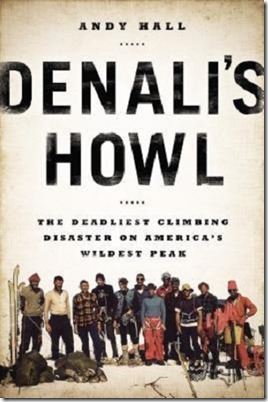
Book Review: Denali’s Howl by Andy Hall

denalis howl
Denali’s Howl: The Deadliest Climbing Disaster on America’s Wildest Peak
by Andy Hall
Paperback, 272 pages
Plume
April 28, 2015
★★★★☆
goodreads button

Genre: Non-Fiction

Source: Personal collection

Denali’s Howl is the white-knuckle account of one of the most deadly climbing disasters of all time.

In 1967, twelve young men attempted to climb Alaska’s Mount McKinley—known to the locals as Denali—one of the most popular and deadly mountaineering destinations in the world. Only five survived.

Journalist Andy Hall, son of the park superintendent at the time, investigates the tragedy. He spent years tracking down survivors, lost documents, and recordings of radio communications. In Denali’s Howl, Hall reveals the full story of an expedition facing conditions conclusively established here for the first time: At an elevation of nearly 20,000 feet, these young men endured an “arctic super blizzard,” with howling winds of up to 300 miles an hour and wind chill that freezes flesh solid in minutes. All this without the high-tech gear and equipment climbers use today.

As well as the story of the men caught inside the storm, Denali’s Howl is the story of those caught outside it trying to save them—Hall’s father among them. The book gives readers a detailed look at the culture of climbing then and now and raises uncomfortable questions about each player in this tragedy. Was enough done to rescue the climbers, or were their fates sealed when they ascended into the path of this unprecedented storm?

Denali’s Howl was one of the books that I picked up while on my vacation in Alaska. I had just spent the day touring through the beautiful Denali National Park and was browsing through the gift shop. I knew I wanted to pick up something about the mountain itself because we had been unable to see it due to weather (did you know only about 30% of visitors to the park actually see the peak because of the weather?). As you may know from having read some of my other reviews, I’m drawn to books, particularly non-fiction, about disasters. Denali is a dangerous mountain to climb and there have been a few disastrous moments in the life of the park, however, none is more notorious than the 1967 Wilcox Expedition where 7 of the 12 men died up on that peak and have never been recovered.

Andy Hall brings a unique perspective to this book that isn’t present in others about this event – he grew up in Denali National Park and his father was the Superintendent of the Park at that time. While he was only 5 years old, so he didn’t know the gravity of the events unfolding at the time, he has an “on the ground” connection to the story in a way that most others don’t. He can speak to what stresses it took on his father or why he made the choices he did. However, the book never came off as feeling like he was trying to whitewash over the culpability of everyone involved despite his close association with it.

Although the book is shorter in length than most on this subject, I found that it had enough information to meet my needs. It covered everything from the history of climbing of this mountain, the meteorology of the storm that hit it, the difficulties of climbing any mountain (but especially Denali) at that time, the backstory of each man in the Wilcox Expedition, the climb and attempts to save the men, and the fallout from this disaster. I didn’t feel that there was any glaring gap that I wished to have had filled. There were a few moments that felt bogged down a little bit with information that I didn’t understand about climbing in general, and a couple moments that felt repetitive, but neither of these elements changed how I raced through the pages. While not exactly a narrative work of non-fiction, there were certainly moments that felt that way, particularly the climb and the rescue. The details that are known are sometimes sparse or sketchy, they have only the recollections of the men who survived and sometimes their stories didn’t align possibly due to the impact of the event or just the weather and nature of the climb on them. Additionally, they don’t have any idea what actually happened to the men that were lost because none of the survivors were with them at that time and some of the men were never located; at best they can speculate.

This book would appeal to a lot of different audiences: those who want to read about disaster or natural events, those who are avid outdoorsmen/women or climbers, those who want to know more about Alaskan history. The book reads quickly, but packs a punch in those few pages and leaves the reader with an impression of how dangerous mountain climbing in general, and Denali in particular, can be. Oh, and lest I forget, the paperback book includes pages of photographs, some from the climbers of the Wilcox Expedition which show some of their progress. These were chilling at times to think that these were the last photos of some of the men that were lost, but I was grateful to be able to have a visual experience as well.

Reviews of this book by other bloggers:


Buy the Book:
Amazon | Barnes & Noble | RJ Julia


Find Andy Hall:
Website


Copyright © 2017 by The Maiden’s Court

Friday, August 25, 2017

Wish List 5: Inspired by My Trip to Alaska

IMG_20161004_224228_696000

Once a month I am planning on sharing with you all 5 of my biggest wish list books broken up by theme.  I know that you all need more on your TBR!!!  This month’s theme is books based on my trip to Alaska in the month of July.  I had to be careful about how much I bought in order to not go over the weight limit on my flight back, so I just made lists of the books that I saw in all the gift shops (although between my husband and I we did buy 4 books).  So these books are all non-fiction based on Alaskan history.

The Cruelest Miles: The Heroic Story of Dogs and Men in a Race Against an Epidemic by Gay Salisbury and Laney Salisbury

the cruelest milesWhen a deadly diphtheria epidemic swept through Nome, Alaska, in 1925, the local doctor knew that without a fresh batch of antitoxin, his patients would die. The lifesaving serum was a thousand miles away, the port was icebound, and planes couldn't fly in blizzard conditions—only the dogs could make it. The heroic dash of dog teams across the Alaskan wilderness to Nome inspired the annual Iditarod Trail Sled Dog Race and immortalized Balto, the lead dog of the last team whose bronze statue still stands in New York City's Central Park. This is the greatest dog story, never fully told until now.

The Floor of Heaven: A True Tale of the Last Frontier and the Yukon Gold Rush by Howard Blum

the floor of heavenNew York Times bestselling author Howard Blum expertly weaves together three narratives to tell the true story of the 1897 Klondike Gold Rush.

It is the last decade of the 19th century. The Wild West has been tamed and its fierce, independent and often violent larger-than-life figures--gun-toting wanderers, trappers, prospectors, Indian fighters, cowboys, and lawmen--are now victims of their own success. But then gold is discovered in Alaska and the adjacent Canadian Klondike and a new frontier suddenly looms: an immense unexplored territory filled with frozen waterways, dark spruce forests, and towering mountains capped by glistening layers of snow and ice.

In a true-life tale that rivets from the first page, we meet Charlie Siringo, a top-hand sharp-shooting cowboy who becomes one of the Pinkerton Detective Agency's shrewdest; George Carmack, a California-born American Marine who's adopted by an Indian tribe, raises a family with a Taglish squaw, and makes the discovery that starts off the Yukon Gold Rush; and Jefferson "Soapy" Smith, a sly and inventive conman who rules a vast criminal empire. As we follow this trio's lives, we're led inexorably into a perplexing mystery: a fortune in gold bars has somehow been stolen from the fortress-like Treadwell Mine in Juneau, Alaska. Charlie Siringo discovers that to run the thieves to ground, he must embark on a rugged cross-territory odyssey that will lead him across frigid waters and through a frozen wilderness to face down "Soapy" Smith and his gang of 300 cutthroats. Hanging in the balance: George Carmack's fortune in gold.

At once a compelling true-life mystery and an unforgettable portrait of a time in America's history, The Floor of Heaven is also an exhilarating tribute to the courage and undaunted spirit of the men and women who helped shape America.

“That Fiend in Hell”: Soapy Smith in Legend by Catherine Holder Spude

that fiend in hellAs the Klondike gold rush peaked in spring 1898, adventurers and gamblers rubbed shoulders with town-builders and gold-panners in Skagway, Alaska. The flow of riches lured confidence men, too—among them Jefferson Randolph “Soapy” Smith (1860–98), who with an entourage of “bunco-men” conned and robbed the stampeders. Soapy, though, a common enough criminal, would go down in legend as the Robin Hood of Alaska, the “uncrowned king of Skagway,” remembered for his charm and generosity, even for calming a lynch mob. When the Fourth of July was celebrated in ’98, he supposedly led the parade. Then, a few days later, he was dead, killed in a shootout over a card game.

With Smith’s death, Skagway rid itself of crime forever. Or at least, so the story goes. Journalists immediately cast him as a martyr whose death redeemed a violent town. In fact, he was just a petty criminal and card shark, as Catherine Holder Spude proves definitively in “That Fiend in Hell”: Soapy Smith in Legend, a tour de force of historical debunking that documents Smith’s elevation to western hero. In sorting out the facts about this man and his death from fiction, Spude concludes that the actual Soapy was not the legendary “boss of Skagway,” nor was he killed by Frank Reid, as early historians supposed. She shows that even eyewitnesses who knew the truth later changed their stories to fit the myth.

But why? Tracking down some hundred retellings of the Soapy Smith story, Spude traces the efforts of Skagway’s boosters to reinforce a morality tale at the expense of a complex story of town-building and government formation. The idea that Smith’s death had made a lawless town safe served Skagway’s economic interests. Spude’s engaging deconstruction of Soapy’s story models deep research and skepticism crucial to understanding the history of the American frontier.

The Klondike Fever: The Life and Death of the Last Great Gold Rush by Pierre Berton

klondike feverIn 1897 a grimy steamer docked in Seattle and set into epic motion the incredible succession of events that Pierre Berton's exhilarating The Klondike Fever chronicles in all its splendid and astonishing folly. For the steamer Portland bore two tons of pure Klondike gold. And immediately, the stampede north to Alaska began. Easily as many as 100,000 adventurers, dreamers, and would-be miners from all over the world struck out for the remote, isolated gold fields in the Klondike Valley, most of them in total ignorance of the long, harsh Alaskan winters and the territory's indomitable terrain. Less than a third of that number would complete the enormously arduous mountain journey to their destination. Some would strike gold. Berton's story belongs less to the few who would make their fortunes than to the many swept up in the gold mania, to often unfortunate effects and tragic ends. It is a story of cold skies and avalanches, of con men and gamblers and dance hall girls, of sunken ships, of suicides, of dead horses and desperate men, of grizzly old miners and millionaires, of the land — its exploitation and revenge. It is a story of the human capacity to dream, and to endure.

Alaska: Saga of a Bold Land by Walter R. Borneman

Alaska Saga of a Bold LandAmerican History. The history of Alaska is filled with stories of new land and new riches---and ever present are new people with competing views over how these resources should be used: Russians exploiting a fur empire; explorers checking rival advances; prospectors stampeding to the clarion call of "Gold!"; soldiers battling out a decisive chapter in world war; oil wildcatters looking for a different kind of mineral wealth; and always at the core of these disputes is the question of how the land is to be used and by whom.


If you are looking to add more books to your list, here are some of the wishlists from a few of my friends this month: (to be updated as they go live)

keep calm and support book bloggers


Copyright © 2017 by The Maiden’s Court