
*UPDATE*

I have updated my review and giveaway policies page (now just titled Policies above). If you are entering a giveaway, please read and abide by the applicable policy.

Attention Authors! If you arrived here looking for information on the Two Sides to Every Story guest post series, see the tab at the top of the page for more info!


Search This Blog

Showing posts with label Westward Expansion. Show all posts

Monday, October 16, 2017

Wish List 5: Westward Expansion

IMG_20161004_224228_696000

Once a month I am planning on sharing with you all 5 of my biggest wish list books broken up by theme.  I know that you all need more on your TBR!!!  I have always been intrigued by the push westward in the United States.  From grade school when we played the original Oregon Trail during computer lab, to reading the Little House series, to the Dust Bowl of the 1930s, the movement westward was a hardscrabble existence that many were too little prepared for.  These are their stories … (sorry for the Law & Order reference, I couldn’t resist!).


Jacksonland: President Andrew Jackson, Cherokee Chief John Ross, and a Great American Land Grab by Steve Inskeep

jacksonlandJacksonland is the thrilling narrative history of two men—President Andrew Jackson and Cherokee chief John Ross—who led their respective nations at a crossroads of American history. Five decades after the Revolutionary War, the United States approached a constitutional crisis. At its center stood two former military comrades locked in a struggle that tested the boundaries of our fledgling democracy. Jacksonland is their story.

One man we recognize: Andrew Jackson—war hero, populist, and exemplar of the expanding South—whose first major initiative as president instigated the massive expulsion of Native Americans known as the Trail of Tears. The other is a half-forgotten figure: John Ross—a mixed-race Cherokee politician and diplomat—who used the United States’ own legal system and democratic ideals to oppose Jackson. Representing one of the Five Civilized Tribes who had adopted the ways of white settlers—cultivating farms, publishing a newspaper in their own language, and sending children to school—Ross championed the tribes’ cause all the way to the Supreme Court. He gained allies like Senator Henry Clay, Chief Justice John Marshall, and even Davy Crockett. In a fight that seems at once distant and familiar, Ross and his allies made their case in the media, committed civil disobedience, and benefited from the first mass political action by American women. Their struggle contained ominous overtures of later events like the Civil War and set the pattern for modern-day politics.

At stake in this struggle was the land of the Five Civilized Tribes. In shocking detail, Jacksonland reveals how Jackson, as a general, extracted immense wealth from his own armies’ conquest of native lands. Later, as president, Jackson set in motion the seizure of tens of millions of acres—“Jacksonland”—in today’s Deep South.

Jacksonland is the work of renowned journalist Steve Inskeep, cohost of NPR’s Morning Edition, who offers here a heart-stopping narrative masterpiece, a tragedy of American history that feels ripped from the headlines in its immediacy, drama, and relevance to our lives.

Harrowing, inspiring, and deeply moving, Inskeep’s Jacksonlandis the story of America at a moment of transition, when the fate of states and nations was decided by the actions of two heroic yet tragically opposed men.

Jefferson’s America: The President, the Purchase, and the Explorers Who Transformed a Nation by Julie M. Fenster
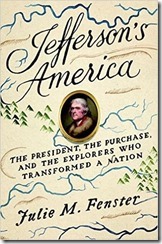
jeffersons americaThe surprising story of how Thomas Jefferson commanded an unrivaled age of American exploration—and in presiding over that era of discovery, forged a great nation.

At the dawn of the nineteenth century, as Britain, France, Spain, and the United States all jockeyed for control of the vast expanses west of the Mississippi River, the stakes for American expansion were incalculably high. Even after the American purchase of the Louisiana Territory, Spain still coveted that land and was prepared to employ any means to retain it. With war expected at any moment, Jefferson played a game of strategy, putting on the ground the only Americans he could: a cadre of explorers who finally annexed it through courageous investigation.

Responsible for orchestrating the American push into the continent was President Thomas Jefferson. He most famously recruited Meriwether Lewis and William Clark, who led the Corps of Discovery to the Pacific, but at the same time there were other teams who did the same work, in places where it was even more crucial. William Dunbar, George Hunter, Thomas Freeman, Peter Custis, and the dauntless Zebulon Pike—all were dispatched on urgent missions to map the frontier and keep up a steady correspondence with Washington about their findings.

But they weren’t always well-matched—with each other and certainly not with a Spanish army of a thousand soldiers or more. These tensions threatened to undermine Jefferson’s goals for the nascent country, leaving the United States in danger of losing its foothold in the West. Deeply researched and inspiringly told, Jefferson’s America rediscovers the robust and often harrowing action from these seminal expeditions and illuminates the president’s vision for a continental America.

Locust: The Devastating Rise and Mysterious Disappearance of the Insect that Shaped the American Frontier by Jeffrey A. Lockwood

locustsIn 1876, the U.S. Congress declared the locust “the single greatest impediment to the settlement of the country between Mississippi and the Rocky Mountains.” Throughout the nineteenth century, swarms of locusts regularly swept across the American continent, turning noon into dusk, devastating farm communities, and bringing trains to a halt. The outbreaks subsided in the 1890s, and then, suddenly—and mysteriously—the Rocky Mountain locust vanished. A century later, entomologist Jeffrey Lockwood vowed to discover why.Locust is the story of how one insect shaped the history of the western United States. A compelling personal narrative drawing on historical accounts and modern science, this beautifully written book brings to life the cultural, economic, and political forces at work in America in the late nineteenth century, even as it solves one of the greatest extinction mysteries of our time.

A Country of Vast Designs: James K. Polk, the Mexican War, and the Conquest of the American Continent by Robert W. Merry

a county of vast designWhen James K. Polk was elected president in 1844, the United States was locked in a bitter diplomatic struggle with Britain over the rich lands of the Oregon Territory, which included what is now Washington, Oregon, and Idaho. Texas, not yet part of the Union, was threatened by a more powerful Mexico. And the territories north and west of Texas -- what would become California, Nevada, Utah, Arizona, New Mexico, and part of Colorado -- belonged to Mexico. When Polk relinquished office four years later, the country had grown by more than a third as all these lands were added. The continental United States, as we know it today, was established -- facing two oceans and positioned to dominate both.

In a one-term presidency, Polk completed the story of America's Manifest Destiny -- extending its territory across the continent, from sea to sea, by threatening England and manufacturing a controversial and unpopular two-year war with Mexico that Abraham Lincoln, in Congress at the time, opposed as preemptive.

Robert Merry tells this story through powerful debates and towering figures -- the outgoing President John Tyler and Polk's great mentor, Andrew Jackson; his defeated Whig opponent, Henry Clay; two famous generals, Zachary Taylor and Winfield Scott; Secretary of State James Buchanan (who would precede Lincoln as president); Senate giants Thomas Hart Benton and Lewis Cass; Daniel Webster and John C. Calhoun; and ex-president Martin Van Buren, like Polk a Jackson protégé but now a Polk rival.

This was a time of tremendous clashing forces. A surging antislavery sentiment was at the center of the territorial fight. The struggle between a slave-owning South and an opposing North was leading inexorably to Civil War. In a gripping narrative, Robert Merry illuminates a crucial epoch in U.S. history.

Lions of the West: Heroes and Villains of Westward Expansion by Robert Morgan
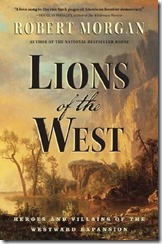
lions of the wesstFrom Thomas Jefferson’s birth in 1743 to the California Gold Rush in 1849, America’s Manifest Destiny comes to life in Robert Morgan’s skilled hands.

Jefferson, a naturalist and visionary, dreamed that the United States would stretch across the continent from ocean to ocean. The account of how that dream became reality unfolds in the stories of Jefferson and nine other Americans whose adventurous spirits and lust for land pushed the westward boundaries: Andrew Jackson, John “Johnny Appleseed” Chapman, David Crockett, Sam Houston, James K. Polk, Winfield Scott, Kit Carson, Nicholas Trist, and John Quincy Adams. Their tenacity was matched only by that of their enemies—the Mexican army under Santa Anna at the Alamo, the Comanche and Apache Indians, and the forbidding geography itself.

Known also for his powerful fiction (Gap Creek, The Truest Pleasure, Brave Enemies), Morgan uses his skill at characterization to give life to the personalities of these ten Americans without whom the United States might well have ended at the Arkansas border. Their stories — and those of the nameless thousands who risked their lives to settle on the frontier, displacing thousands of Native Americans—form an extraordinary chapter in American history that led directly to the cataclysm of the Civil War.

With illustrations, portraits, maps, battle plans, appendixes, notes, and time lines, Lions of the West is a richly authoritative biography of America as compelling as a grand novel.


Looking for some recommended reads set during the time of westward expansion that I have read before?

empire of the summer moon
Empire of the Summer Moon
★★★½☆☆

If you are looking to add more books to your list, here are some of the wishlists from a few of my friends this month: (to be updated as they go live)

keep calm and support book bloggers


Copyright © 2017 by The Maiden’s Court

Tuesday, October 3, 2017

Two Sides to Every Story: The Women Who “Settled” The West

two sides

Today I have the opportunity to welcome not one, but two authors to the Two Sides to Every Story series!  I don’t get to do that every day!  I have had the great pleasure of working with M.K. McClintock several times in the past with her Montana Gallagher series and she brought Samantha St. Claire with her to discuss the two sides to the women who settled the western United States.  I hope you will enjoy it as much as I have!

The Women Who “Settled” The West: For Good or Bad

Samantha St. Claire ~ The Good

Putting the morality of prostitution to the side, I’d like to consider how the institution made positive contributions to frontier development. Yes, positive contributions, by soiled doves and working girls.

Working camps brought the men first; the women followed. Scattered shacks and tents transformed to towns upon arrival of the fairer sex. Money became the common denominator as both sexes came seeking fortune. The women, especially those serving as madams, often succeeded where the men did not. Many were shrewd business women investing their earnings in land and new businesses in these boom towns. Some even acted as loan agents, providing banking services.

However, it is their charitable acts that make these women noteworthy. Let’s start by considering Annie who as a young girl traveled west with her family in search of a better life. Both parents died of cholera, leaving the orphan to find a way to survive. With her tall, slender body and flaming red hair, she thrived the working girl life in a variety of camps. Moving to San Francisco, she came into the employ of the celebrated Madam Mina Hayman. The young woman, showing an aptitude for finances, soon became Madam Hayman’s protégé. Taking over the business years later, Annie, now calling herself Jessie Hayman, expands the business. When the San Francisco fire of 1906 ravages the city, she provides the victims food and clothing.

“Diamond” Jessie Hayman was not alone in her charitable deeds. Laura Evans of Leadville, Colorado fame was reputed to be “tough as nails” but stories abound testifying to her generous heart. She provided food to families of injured or out-of-work fathers. Most remarkable was how she disguised her girls in nurses uniforms during the flu pandemic of 1918, sending them to care for the sick.

Often, our obituaries say much about how we used our days. When Virginia City’s Madam Julia Bulette was murdered, all the mines and saloons closed out of respect and her funeral was attended by thousands. Like others, she was remembered best for nursing victims of influenza and donating to miners suffering hardship.

Julia Bulette
Julia Bulette, Virginia City Madam
Credit: Public Domain

MK McClintock ~ The Bad

Mary Katharine Haroney, Mattie Blaylock, and Molly Hall all sound like the names of respectable women, but names—and appearances—can be deceiving. These were the fallen women, soiled doves, and sportin' women in what we commonly call the “Wild West.”

Sure, some of these women who braved the west went onto become millionaires and national heroes, building towns and helping others, but at what cost? Some were outlaws and thieves like Laura Bullion, who joined the Wild Bunch gang. Many others died from childbirth and disease, plying their trade from the back of wagons, shacks, or grubby tents for little more than $0.25. If they were lucky, they might pull in up to a dollar or more. Many died violently, became addicted to drugs, or committed suicide, preferring that to a slow and miserable death.

Maggie Hall, a young beauty from Dublin, arrived in America and found it difficult to secure a job. She became a saloon girl then fell and love and married a wealthy man whose father cut him off when he found out. At her husband’s behest, Maggie started to entertain men so they could bring in more money. When she finally left her husband and became a high-priced prostitute, there are some who would say she was redeemed by helping a small town through a small-pox epidemic. Soon after, she died from consumption.

Molly_B'Damn
Maggie Hall
Credit: Public Domain

Most of these women were young and illiterate, though not all, and while it’s optimistic to think of the grand madams being respected and praised for their contributions to building the west, those powerful and wealthy were far and few between. Then there were the poor souls forced into the sex trade by family, captors, or husbands, with little choice to spend their short lives as working girls, addicted to opium.

The more populated the West became, the more respectable the women who arrived. With them came more close-knit communities, families, churches, and more respectable men. And criticism toward prostitution grew.

Would the “Wild West” have boomed and built up if these ladies of the night found another way to earn a living? There’s no denying that some of these women were in it for business and knew how to make a lot of money, earn respect, and become prominent citizens. But what about the young women who worked for them? Who searched for a better life out west, and instead of being told they were too good for that way of life, started on a path of misery from which few escape.

No matter which side of the story you choose to believe, there’s no doubt that the working women contributed a great deal to “settling” the West.


Samantha St. Claire is the alter-ego and pen name of an author of YA historical fiction. Kat's Law was her first venture into romantic historical fiction. With residences in both Washington and Idaho, she's spent long hours traveling the route of the old Oregon Trail, gathering inspiration for her novels along the way. The second book in The Sawtooth Range Series, High Valley Promise, released in 2017. She is currently at work on her next story.  Learn more at https://samanthastclaire.net/

High Valley Promise_SamanthaSt.Claire
goodreads button

In this thrilling and romantic conclusion to Kat's Law, Dr. Kathryn Meriwether must deal with a Cholera outbreak threatening the residents she cares for in Snowberry, Idaho, a killer not armed with a gun as the one whom ex-Texas Ranger Jonathan Winthrop pursues into the Sawtooth Range, but just as deadly and unpredictable. Once again, each will handle the crisis with the skills they've been given, but ultimately will find a greater strength in facing their future together. A high valley promise will unite them as an undeniable force to meet the challenges of their frontier home.

Buy the Book: Amazon


MK McClintock is an award-winning author who has written several books and short stories, including the popular "Montana Gallagher" series, the "Crooked Creek" series set in post-Civil War Montana, and the "British Agent" series. She spins tales of romance, adventure, and mystery set in bygone times. MK enjoys a quiet life in the Rocky Mountains. Learn more at www.mkmcclintock.com.

Journey to Hawks Peak_MK McClintock
goodreads button

One woman's desperation to escape would become the greatest journey of her life.

Amanda Warren arrived in Briarwood, Montana with one satchel and a dream. After death destroyed her happiness, she fled, unwillingly to believe that was the end, yet her weary spirit thought only of survival.
Then she met the Gallaghers.

They took a chance and gave her a home and a family, but is she strong enough to make a new start?

Ben Stuart has seen more of life than he wants to remember, but with the Gallaghers he had found a place where he could forget times gone by and live the life he always wanted. When Amanda arrived at Hawk's Peak, Ben saw a woman hiding from secrets and running from her past. Will he be able to convince her that the journey is over?

Buy the Book: Amazon


Copyright © 2017  by The Maiden’s Court

Wednesday, February 15, 2017

Audiobook Review: Empire of the Summer Moon by S.C. Gwynne

empire of the summer moon

Empire of the Summer Moon by S.C. Gwynne
Unabridged, 15 hrs. 9 mins.
Simon & Schuster Audio
David Drummond (Narrator)
September 20, 2016
★★★½☆☆

goodreads button 

Genre: Non Fiction

Source: Received audio download from the publisher for review

In the tradition of Bury My Heart at Wounded Knee, a stunningly vivid historical account of the forty-year battle between Comanche Indians and white settlers for control of the American West, centering on Quanah, the greatest Comanche chief of them all.

S. C. Gwynne’s Empire of the Summer Moon spans two astonishing stories. The first traces the rise and fall of the Comanches, the most powerful Indian tribe in American history. The second entails one of the most remarkable narratives ever to come out of the Old West: the epic saga of the pioneer woman Cynthia Ann Parker and her mixed-blood son Quanah, who became the last and greatest chief of the Comanches.

Although readers may be more familiar with the tribal names Apache and Sioux, it was in fact the legendary fighting ability of the Comanches that determined just how and when the American West opened up. Comanche boys became adept bareback riders by age six; full Comanche braves were considered the best horsemen who ever rode. They were so masterful at war and so skillful with their arrows and lances that they stopped the northern drive of colonial Spain from Mexico and halted the French expansion westward from Louisiana. White settlers arriving in Texas from the eastern United States were surprised to find the frontier being rolled backward by Comanches incensed by the invasion of their tribal lands. So effective were the Comanches that they forced the creation of the Texas Rangers and account for the advent of the new weapon specifically designed to fight them: the six-gun.

The war with the Comanches lasted four decades, in effect holding up the development of the new American nation. Gwynne’s exhilarating account delivers a sweeping narrative that encompasses Spanish colonialism, the Civil War, the destruction of the buffalo herds, and the arrival of the railroads—a historical feast for anyone interested in how the United States came into being.

Against this backdrop Gwynne presents the compelling drama of Cynthia Ann Parker, a lovely nine-year-old girl with cornflower-blue eyes who was kidnapped by Comanches from the far Texas frontier in 1836. She grew to love her captors and became infamous as the "White Squaw" who refused to return until her tragic capture by Texas Rangers in 1860. More famous still was her son Quanah, a warrior who was never defeated and whose guerrilla wars in the Texas Panhandle made him a legend.

S. C. Gwynne’s account of these events is meticulously researched, intellectually provocative, and, above all, thrillingly told.

I have been a huge fan of S.C. Gwynne’s since reading Rebel Yell a year or so ago. He took a controversial subject, and someone that I had really no interest in, and made me fascinated with his intelligence and battlefield strategy (something else I am not interested in). When an author can do that for me, they fall into a special category of people whose books I need to pick up ASAP. While Empire of the Summer Moon was released prior to Rebel Yell, when I saw that Simon & Schuster was releasing the audio version, I knew I needed to read/listen to this one.

Empire of the Summer Moon takes an interesting look at the late Comanche culture. It explores the later part of the American westward migration and how they interacted with the native peoples. It also explores how the Comanche, and to a lesser extent other nations, pushed back against these incursions of their land and ways of life. The most interesting part for me was the extensive time spent on the people taken captive by natives during raids and how life was like for them. The most time was spent on the story of Cynthia Parker who was taken captive, bore three children to her native husband, and when reclaimed by her white family, struggled to reacquaint herself with her own culture. A few other capture stories are explored to some extent as well. Cynthia Parker was also the mother of Quanah Parker, who would become one of the last powerful Comanche leaders and would wrap around the time where the Comanche would go from a plains people to a reservation people. He was a fascinating person, but I felt that even though he is a titular figure, much less time was spent on his story than that of his mother or the Comanche people in general, which I think was a missed opportunity.

The structure of the novel was a little divided to me, which felt almost like two separate threads rather than a cohesive thread that spans all the way through the book. Cynthia Parker is technically the element that connects the two: she connects the old style native life with the new style life and she is the mother of Quanah. However, I really felt like these were two separate elements and would have liked them to be better integrated.

Despite my qualms with the structure, I learned A LOT from this book. I had taken classes on native American peoples during college, but none of these elements from this book were explored in them.  I definitely think that Rebel Yell was better executed but this was well done as well. 

audiobookimpressions

★★★★☆

The narration was strong for this book. It was never boring or dry and kept my attention. I can’t say that it was exciting or engaging as some are wont to be, but for a non-fiction book, I felt that it did enough to serve the topic. 

You can check out a sample of the audio production below:


Reviews of this book by other bloggers:

Buy the Book: Amazon | Barnes & Noble | RJ Julia

Also by S.C. Gwynne:

rebel yell
Rebel Yell

[My Review]

the perfect pass
The Perfect Pass

Find S.C. Gwynne: Website | Facebook | Twitter


Copyright © 2017 by The Maiden’s Court
Monday, August 10, 2015

Book Review: Three Links of Chain by Dennis Maley

three links of chain

Three Links of Chain by Dennis Maley
ARC, Paperback, 250 pages
Jublio
July 7, 2015
★★★½☆☆

goodreads button

Genre: Historical Fiction, Young Adult

Source: Received a copy from the publisher for review

Blanche thinks he has it good. He has risen above the field hands to a position helping run a printing press. He's well fed, never physically mistreated, and he has taught himself to read, though he keeps the illicit skill a secret. Most importantly, he has been promised a chance at emancipation. Then, in a single bloody morning, his world is overturned, his master lies dead, and the widow has no intention of following through with her husband's promise to free Blanche.

Blanche would never have considered running away from his old life, but faced with the prospect of being sold as a laborer or worse, he forges his free papers and flees north, a fugitive, to create his own future. Only a few steps ahead of the slave catchers, he travels hundreds of miles across the violent backdrop of “bleeding Kansas” in the 1850s, a land torn by apart by two very different visions of humanity.

This richly researched work of fiction weaves actual historical characters and institutions into the gripping story of a young man born into slavery but resolute in his quest for freedom.

Although American history is my favorite location/period to read, the time surrounding the Civil War has never been one of particular interest to me. I was interested in Three Links of Chain because I wanted to see how an issue as heavy and dark as slavery and the Underground Railroad would be handled in a novel aimed at a young adult audience. And overall, I was rather impressed with this book.

One of the aspects that caught and held my attention was that despite the short length of 250 pages, it had the feel of a much longer epic journey. I will compare it in many ways to the travails that Odysseus faces in the Odyssey. Every time Blanche escapes one hardship he lands square in the middle of another, even worse, situation. He has to keep persevering in an attempt to attain his ultimate goal. At many times he questions if he is taking the right action or if he should turn back to some easier end point. I think that the epic adventure quality will be quite successful with younger readers as they get caught up in Blanche’s journey.

The history of the time period (Underground Railroad, Bleeding Kansas, life of slaves on the western frontier) was well integrated into the narrative. The Underground Railroad portion of the story highlights how dangerous it was, whereas I think a lot of novels make it feel a little more glamorous. There was the dangers of trying to walk that line between questioning and trusting the folklore, signs, and people whose hands they were putting their lives. That balance was well achieved as Blanch moved forward; he grew from complete naiveté to someone with a little more experience under his belt. In the early chapters there is the juxtaposition of how Blanche holds himself above those of the field hands because he knows how to read and then how little he really understands about the workings of the greater world.

There was only one place the fell a little flat for me and that was the opening chapter. This was a little unfortunate because it almost made me put it down. The first chapter is set in and around an outhouse. And while I have no issues with that per se, and it was an interesting gimmick, it felt very weird to me. It was more like you shouldn’t be there and I’m pretty sure that wasn’t the feel the author was going for because you were very distinctly supposed to be there. It just felt out of place and it pulled me out of the narrative. If the chapter had been a little further into the narrative, I don’t think I would have had as much issue with it, but as an introduction I found it awkward. However, it might grab the attention of young adults better than adults, I don’t know.

If you would like to preview the story before reading it, why not try out this excerpt of the book?

Reviews of this book by other bloggers:


Buy the Book: Amazon | Barnes & Noble | RJ Julia


Find Dennis Maley: Website | Facebook | Blog


Copyright © 2015 by The Maiden’s Court

Thursday, August 15, 2013

Book Review: The Little Bride by Anna Solomon

the little bride

The Little Bride by Anna Solomon
Paperback, 320 pages
Riverhead Trade
September 6, 2011
★★★½☆☆

Genre: Historical Fiction

Source: Received from author for review

When 16-year-old Minna Losk journeys from Odessa to America as a mail-order bride, she dreams of a young, wealthy husband, a handsome townhouse, and freedom from physical labor and pogroms. But her husband Max turns out to be twice her age, rigidly Orthodox, and living in a one-room sod hut in South Dakota with his two teenage sons. The country is desolate, the work treacherous. Most troubling, Minna finds herself increasingly attracted to her older stepson. As a brutal winter closes in, the family's limits are tested, and Minna, drawing on strengths she barely knows she has, is forced to confront her despair, as well as her desire.

I was really interested in this book because of two things: the concept of mail-order brides and the theme of settling the West. The book did pull through on both of these promises; however I found I was very disconnected with the book. Let me explain.

First, what I liked. The early portion of the novel, when Minna, is still in Odessa, was probably the most interesting to me. I didn’t know anything about the real concept of mail-order brides – you only typically hear people speaking jokingly about them. In this novel, Minna, is trying to escape from the familial and societal hard times she is facing and makes the choice that trying to get to America is what she needs to do. We experience what it was like to go through the physical examination to determine if Minna meets the needs to the man looking to marry her. Here, you feel her fear of answering “incorrectly” and being excluded from being chosen. You also are privy to her hopes and fears regarding a better life. I even enjoyed the packed-in-a-sardine-can boat trip to America. The Western experience was also very enlightening. To see just how hard it was to cut you way into a small parcel of semi-successful land was so inspiring.

I did however have some issues with the book – mostly because it was slow moving. There were many times where it felt like it was just dragging on and the story wasn’t moving forward. It was more of a character driven novel rather than an events driven novel. It is building the Western American immigrant experience – particularly focusing on the Jewish immigrant experience. I realized that I would have NEVER survived out there. By the end of the novel – I found that I didn’t really like Minna. She seemed like a complainer and I didn’t like the choices she made toward the end of the book. Overall, it was something I learned from, but maybe wouldn’t choose to read again.

This is author Anna Solomon’s debut novel. You can visit her website or blog for additional information about the book. The website provides really nice add on information about The Little Bride – you can explore the different aspects of Minna’s trip or check out the reader’s guide.

You can also watch the book trailer below.

Reviews of this book by other bloggers:

Here are some choices for purchasing the book: Amazon, B&N, RJ Julia (my fav indie bookstore).


Copyright © 2013 by The Maiden’s Court

Wednesday, December 15, 2010

Book Review: Impatient with Desire by Gabrielle Burton

Impatient with Desire by Gabrielle Burton
Hardcover, 256 pages
Voice
March 9, 2010
★★★★☆
goodreads button

Genre: Historical Fiction

Source: Received from Author for Review

In the spring of 1846, Tamsen Donner, her husband, George, their five daughters, and eighty other pioneers headed to California in eager anticipation of new lives out West. Everything that could go wrong did, and an American legend was born.

The Donner Party. We think we know their story--starving pioneers trapped in the mountains performing an unspeakable act to survive--but we know only that one harrowing part of it. Impatient with Desire brings us answers to the unanswerable question: What really happened in the four months the Donners were trapped in the Sierra Nevadas And it brings to stunning life a woman--and a love story--behind the myth.

Tamsen Eustis Donner, born in 1801, taught school, wrote poetry, painted, botanized, and was fluent in French. At twenty-three, she sailed alone from Massachusetts to North Carolina when respectable women didn't travel alone. Years after losing her first husband, Tully, she married again for love, this time to George Donner, a prosperous farmer, and in 1846, they set out for California with their five youngest children. Unlike many women who embarked reluctantly on the California-Oregon Trail, Tamsen was eager to go. Later, trapped in the mountains by early snows, she had plenty of time to contemplate the wisdom of her decision and the cost of her wanderlust.

Historians have long known that Tamsen kept a journal, though it was never found. In Impatient with Desire, Burton draws on years of historical research to vividly imagine this lost journal--and paints a picture of a remarkable heroine in an extraordinary situation. Tamsen's unforgettable journey takes us from the cornfields of Illinois to the dusty Oregon Trail to the freezing Sierra Nevada Mountains, where she was forced to confront an impossible choice.

Impatient with Desire is a passionate, heart-wrenching story of courage, hope, and love in hardship, all told at a breathless pace. Intimate in tone and epic in scope, Impatient with Desire is absolutely hypnotic.

Gabrielle Burton’s writing evokes the true passion behind the movement westward as well as the disappointment and utter feeling of loss of being trapped in the Sierra Nevada Mountains for 4 months. We are allowed to look at the world from the perspective of Tamsen Donner through a fictional journal that she writes. Tamsen was known to have kept a journal, which has never been found, so this sets the book in a realistic setting. Not only do you learn about what the 87 travelers endured while being trapped in the snow, but you experience the excitement of the planned trip as well as the trail experiences themselves.

This journal reads very quickly and you really felt like you were right there with Tamsen as she wrote her journal entries and created her letters to her sister. This story seriously puts a face to the legendary American tale that everyone learns. It certainly connects the reader to the real people who suffered through this tough time.

Gabrielle Burton is also the author of a non-fiction book about Tamsen Donner called Searching for Tamsen Donner. This book chronicles the authors trek with her family to physically follow the trail that the Donner’s took. You can read an excerpt of Impatient with Desire here.

Reviews of this book by other bloggers:

Buy the Book: Amazon | Barnes & Noble | RJ Julia

Also by Gabrielle Burton

searching for tamsen donner
Searching for Tamsen Donner

Find Gabrielle Burton: Website


Copyright © 2010 by The Maiden’s Court