*UPDATE*

I have updated my review and giveaway policies page (now just titled Policies above). If you are entering a giveaway, please read and abide by the applicable policy.

Attention Authors! If you arrived here looking for information on the Two Sides to Every Story guest post series, see the tab at the top of the page for more info!


Search This Blog

Showing posts with label Wish List 5. Show all posts

Tuesday, April 17, 2018

Wish List 5: Historical Crime–Nonfiction

IMG_20161004_224228_696000

Once a month I am planning on sharing with you all 5 of my biggest wish list books broken up by theme.  I know that you all need more on your TBR!!!  This month’s wish list had a couple different sources of inspiration.  Growing up I was a much more devoted reader of modern day mysteries and crime dramas.  I haven’t read as much of this genre recently, but love catching them on TV.  My husband recently asked me to help him find non-fiction books about Victorian Era serial killers, based off of his reading of Devil in the White City by Erik Larson.  Finally, I have been inspired by Erin at Flashlight Commentary’s recent delve into high profile murder stories.  So this month’s feature is non-fiction on historical crimes – early 20th century or before.


Hell's Princess: The Mystery of Belle Gunness, Butcher of Men by Harold Schechter

hells princessIn the pantheon of serial killers, Belle Gunness stands alone. She was the rarest of female psychopaths, a woman who engaged in wholesale slaughter, partly out of greed but mostly for the sheer joy of it. Between 1902 and 1908, she lured a succession of unsuspecting victims to her Indiana “murder farm.” Some were hired hands. Others were well-to-do bachelors. All of them vanished without a trace. When their bodies were dug up, they hadn’t merely been poisoned, like victims of other female killers. They’d been butchered.

Hell’s Princess is a riveting account of one of the most sensational killing sprees in the annals of American crime: the shocking series of murders committed by the woman who came to be known as Lady Bluebeard. The only definitive book on this notorious case and the first to reveal previously unknown information about its subject, Harold Schechter’s gripping, suspenseful narrative has all the elements of a classic mystery—and all the gruesome twists of a nightmare.

Bestial: The Savage Trail of a True American Monster by Harold Schechter
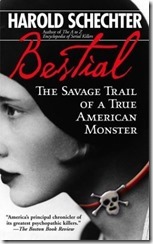
bestialFROM SOCIAL OUTCAST TO NECROPHILE AND MURDERER -- HIS APPALLING CRIMES STUNNED AN ERA.

San Francisco, the 1920s. In an age when nightmares were relegated to the fiction of Edgar Allan Poe and distant tales of the Whitechapel murders, a real-life monster terrorized America. His acts of butchery have proved him one of history's fiercest madmen.

As an infant, Earle Leonard Nelson possessed the power to unsettle his elders. As a child he was unnaturally obsessed with the Bible; before he reached puberty, he had an insatiable, aberrant sex drive. By his teens, even Earle's own family had reason to fear him. But no one in the bone-chilling winter of 1926 could have predicted that his degeneracy would erupt in a sixteen-month frenzy of savage rape, barbaric murder, and unimaginable defilement -- deeds that would become the hallmarks of one of the most notorious fiends of the twentieth century, whose blood-lust would not be equaled until the likes of Henry Lee Lucas, John Wayne Gacy, and Jeffrey Dahmer.

Drawing on the "gruesome, awesome, compelling reporting" (Ann Rule) that is his trademark, Harold Schechter takes a dark journey into the mind of an unrepentant sadist -- and brilliantly lays bare the myth of innocence that shrouded a bygone era.

The Thames Torso Murders by M.J. Trow

thames torso murdersDismembered corpses are discovered scattered along the banks of the river Thames, a calculating clinical multiple murderer is on the loose, and the London police have no inkling of the killer s identity and, more than a century later, they still don t. In this, M.J. Trow s latest reinvestigation of a bizarre and brutal serial killing, he delves deep into the appalling facts of the case, into the futile police investigations, and into the dark history of late Victorian London.The incredible criminal career of the Thames torso murderer has gripped readers and historians ever since he committed his crimes in the 1870s and 1880s. The case poses as many questions as the even more notorious killings of Jack the Ripper. How, over a period of fifteen years, did the Thames murderer get away with a succession of monstrous and sensational misdeeds? And what sort of perverted character was he, why did he take such risks, why did he kill again and again?

The Man from the Train: The Solving of a Century-Old Serial Killer Mystery by Bill James and Rachel McCarthy James
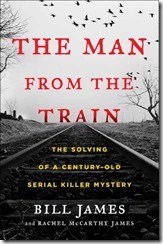
the man from the trainUsing unprecedented, dramatically compelling sleuthing techniques, legendary statistician and baseball writer Bill James applies his analytical acumen to crack an unsolved century-old mystery surrounding one of the deadliest serial killers in American history.

Between 1898 and 1912, families across the country were bludgeoned in their sleep with the blunt side of an axe. Jewelry and valuables were left in plain sight, bodies were piled together, faces covered with cloth. Some of these cases, like the infamous Villasca, Iowa, murders, received national attention. But few people believed the crimes were related. And fewer still would realize that all of these families lived within walking distance to a train station.

When celebrated baseball statistician and true crime expert Bill James first learned about these horrors, he began to investigate others that might fit the same pattern. Applying the same know-how he brings to his legendary baseball analysis, he empirically determined which crimes were committed by the same person. Then after sifting through thousands of local newspapers, court transcripts, and public records, he and his daughter Rachel made an astonishing discovery: they learned the true identity of this monstrous criminal. In turn, they uncovered one of the deadliest serial killers in America.

Riveting and immersive, with writing as sharp as the cold side of an axe, The Man from the Train paints a vivid, psychologically perceptive portrait of America at the dawn of the twentieth century, when crime was regarded as a local problem, and opportunistic private detectives exploited a dysfunctional judicial system. James shows how these cultural factors enabled such an unspeakable series of crimes to occur, and his groundbreaking approach to true crime will convince skeptics, amaze aficionados, and change the way we view criminal history.


The Murder of the Century: The Gilded Age Crime that Scandalized a City and Sparked the Tabloid Wars
by Paul Collins

the murder of the centuryOn Long Island, a farmer finds a duck pond turned red with blood. On the Lower East Side, two boys playing at a pier discover a floating human torso wrapped tightly in oilcloth. Blueberry pickers near Harlem stumble upon neatly severed limbs in an overgrown ditch. Clues to a horrifying crime are turning up all over New York, but the police are baffled: There are no witnesses, no motives, no suspects.

The grisly finds that began on the afternoon of June 26, 1897, plunged detectives headlong into the era's most baffling murder mystery. Seized upon by battling media moguls Joseph Pulitzer and William Randolph Hearst, the case became a publicity circus. Reenactments of the murder were staged in Times Square, armed reporters lurked in the streets of Hell's Kitchen in pursuit of suspects, and an unlikely trio — a hard-luck cop, a cub reporter, and an eccentric professor — all raced to solve the crime.

What emerged was a sensational love triangle and an even more sensational trial: an unprecedented capital case hinging on circumstantial evidence around a victim whom the police couldn't identify with certainty, and who the defense claimed wasn't even dead. The Murder of the Century is a rollicking tale — a rich evocation of America during the Gilded Age and a colorful re-creation of the tabloid wars that have dominated media to this day.


Here is another non-fiction historical crime book that I have read and enjoyed:

Wish List 5
Devil in the White City
★★★★ ½☆


If you are looking to add more books to your list, here are some of the wishlists from a few of my friends this month: (to be updated as they go live)

  • Magdalena @ A Bookaholic Swede -
  • Colleen @ A Literary Vacation –
  • Erin @ Flashlight Commentary – Author Backlists 
  • Holly @ 2 Kids and Tired Books –
  • Stephanie @ Layered Pages –

keep calm and support book bloggers


Copyright © 2018 by The Maiden’s Court

Monday, March 12, 2018

Wish List 5: The Modern British Monarchy

IMG_20161004_224228_696000

Once a month I am planning on sharing with you all 5 of my biggest wish list books broken up by theme.  I know that you all need more on your TBR!!!  With all the hype on all things royal lately (with Will and Kate’s 3rd baby on the way and Harry and Meghan’s engagement and upcoming nuptials) I thought I would features the non-fiction on the modern British monarchy.  I’m categorizing this as post-Queen Victoria.


Young Elizabeth: The Making of the Queen by Kate Williams

young elizabethWe can hardly imagine a Britain without Elizabeth II on the throne. It seems to be the job she was born for. And yet for much of her early life the young princess did not know the role that her future would hold. She was our accidental Queen.
Elizabeth's determination to share in the struggles of her people marked her out from a young age. Her father initially refused to let her volunteer as a nurse during the Blitz, but relented when she was 18 and allowed her to work as a mechanic and truck driver for the Women's Auxiliary Territorial Service. It was her forward-thinking approach that ensured that her coronation was televised, against the advice of politicians at the time.

Kate Williams reveals how the 25-year-old young queen carved out a lasting role for herself amid the changes of the 20th century. Her monarchy would be a very different one to that of her parents and grandparents, and its continuing popularity in the 21st century owes much to the intelligence and elusive personality of this remarkable woman.

Prince Philip: The Turbulent Early Life of the Man Who Married Queen Elizabeth II by Philip Eade

prince philip"Rich in drama and tragedy" (The Guardian), here is a mesmerizing account of the extraordinary formative years of the man married to the most famous woman in the world

Before he met the young girl who became Queen Elizabeth II, Prince Philip had a tumultuous upbringing in Greece, France, Nazi Germany, and Britain. His mother, Princess Alice of Battenberg, was born deaf; she was committed to a psychiatric clinic when Philip was eight. His father, Prince Andrew of Greece, already traumatized by his exile from his home country, promptly shut up the family home and went off to live with his mistress, effectively leaving his young son an orphan.

Remarkably, Philip emerged from his difficult childhood a character of singular vitality and dash—self-confident, opinionated, and devastatingly handsome. Girls fell at his feet, and the princess who would become his wife was smitten from the age of thirteen. Yet alongside his considerable charm and intelligence, the young prince was also prone to volcanic outbursts, which would have profound consequences for his family and the future of the monarchy.

In this authoritative and wonderfully compelling book, acclaimed biographer Philip Eade brings to vivid life the storm-tossed early years of one of the most fascinating and mysterious members of the royal family.


That Woman: The Life of Wallis Simpson, Duchess of Windsor by Anna Sebba

that womanOne of Britain's most distinguished biographers turns her focus on one of the most vilified woman of the last century. Historian Anne Sebba has written the first full biography of Wallis Simpson, Duchess of Windsor, by a woman which attempts to understand this fascinating and enigmatic American divorcee who nearly became Queen of England. 'That woman', as she was referred to by the Queen Mother, became a hate figure for allegedly ensnaring a British king. Born in 1895 in Baltimore, Bessiewallis Warfield endured an impoverished and comparatively obscure childhood which inflamed a burning desire to rise above her circumstances. Neither beautiful nor brilliant, and no longer young, she nevertheless became one of the most talked about women of her generation, and inspired such deep love and adoration in Edward VIII that even giving up a throne and an empire for her was not enough to prove his total devotion. Wallis lived by her wit and her wits, while both her apparent and alleged moral transgressions added to her aura and dazzle. Accused of Fascist sympathies, having Nazi lovers and learning bizarre sexual techniques in China, she was the subject of widespread gossip and fascination that has only increased with the years. In death, the Duchess became a symbol of empowerment and a style icon, a woman whose unequivocal aim was to win in the game of life. Based on new archives and material recently made available, this scrupulously researched biography re evaluates the role of politicians in the 1930s, sheds new light on the character and motivations of this powerful, charismatic and complex woman, and questions was this really the romantic love story of the century?

The King Who Had To Go: Edward Vlll, Mrs Simpson and the Hidden Politics of the Abdication Crisis by Adrian Phillips

the king who had to goIn 1936, a constitutional crisis in the British Empire arose when Edward VIII proposed to marry Wallis Simpson, an American socialite who was divorced from her first husband and was pursuing the divorce of her second. The crisis led to the King's abdication in December of that year. Adrian Phillips reveals the harsh realities of how government responds when a monarch steps out of line, and describes the battles in Westminster and Whitehall that settled the fate of King and Mrs. Simpson.

Unwilling to accept the idea of the twice-married American as future Queen of England, the government was determined to pressure the King into giving up Mrs. Simpson and, when that failed, into giving up his crown. The King's phone lines were tapped by his own government, dubious police reports poisoned Mrs Simpson's reputation, and threats to sabotage her divorce were deployed to edge the King towards abdication.

The hopeless attempts of the King's allies, particularly Winston Churchill, to keep him on the throne were dismissed as sinister conspiracy, whilst the King wrecked his own chances with wildly unrealistic goals and ill-thought-out schemes that served only to frame him as erratic and unreliable as a monarch. As each side was overwhelmed by desperation and distrust, Prime Minister Stanley Baldwin fought to steer events to a smooth conclusion.

In this fascinating behind-the-scenes account of the royal abdication crisis of 1936, Adrian Phillips reveals the previously untold story of the hidden political machinations and insidious battles in Westminster and Whitehall that settled the fate of the King and Mrs Simpson.


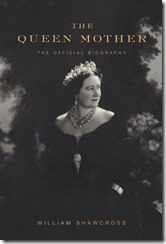
The Queen Mother: The Official Biography by William Shawcross

the queen motherThe official and definitive biography of Queen Elizabeth the Queen Mother: consort of King George VI, mother of Queen Elizabeth II, grandmother of Prince Charles—and the most beloved British monarch of the twentieth century.

Elizabeth Angela Marguerite Bowes-Lyon—the ninth of the Earl of Strathmore’s ten children—was born on August 4, 1900, and, certainly, no one could have imagined that her long life (she died in 2002) would come to reflect a changing nation over the ourse of an entire century. Now, William Shawcross—given unrestricted access to the Queen Mother’s personal papers, letters, and diaries—gives us a portrait of unprecedented vividness and detail. Here is the girl who helped convalescing soldiers during the First World War . . . the young Duchess of York helping her reluctant husband assume the throne when his brother abdicated . . . the Queen refusing to take refuge from the bombing of London, risking her own life to instill courage and hope in others who were living through the Blitz . . . the dowager Queen—the last Edwardian, the charming survivor of a long-lost era—representing her nation at home and abroad . . . the matriarch of the Royal Family and “the nation’s best-loved grandmother.”

A revelatory royal biography that is, as well, a singular history of Britain in the twentieth century.


If you are looking to add more books to your list, here are some of the wishlists from a few of my friends this month: (to be updated as they go live)


keep calm and support book bloggers


Copyright © 2018 by The Maiden’s Court

Monday, February 19, 2018

Wish List 5: Disaster Events–Non-Fiction

IMG_20161004_224228_696000

Once a month I am planning on sharing with you all 5 of my biggest wish list books broken up by theme.  I know that you all need more on your TBR!!!  I’ve spoken before about my fascination with reading novels and non-fiction that revolve around disaster events.  Not only do I find these events to be more soul-touching, but they lend themselves to good drama as well.  Here are 5 non-fiction books about some new events on my radar.

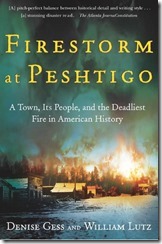
Firestorm at Peshtigo: A Town, Its People, and the Deadliest Fire in American History by Denise Gess and William Lutz

firestorm"Novelist Denise Gess and historian William Lutz brilliantly restore the event to its rightful place in the forefront of American historical imagination." —Chicago Sun-Times

On October 8, 1871—the same night as the Great Chicago Fire—the lumber town of Peshtigo, Wisconsin, was struck with a five-mile-wide wall of flames, borne on tornado-force winds of one hundred miles per hour that tore across more than 2,400 square miles of land, obliterating the town in less than one hour and killing more than two thousand people.

At the center of the blowout were politically driven newsmen Luther Noyes and Franklin Tilton, money-seeking lumber baron Isaac Stephenson, parish priest Father Peter Pernin, and meteorologist Increase Lapham. In Firestorm at Peshtigo, Denise Gess and William Lutz vividly re-create the personal and political battles leading to this monumental natural disaster, and deliver it from the lost annals of American history.

Curse of the Narrows: The Halifax Explosion 1917 by Laura M. MacDonald

curse of the narrowsThe events of the horrific Halifax explosion are well documented: on December 6, 1917, the French munitions ship Mont Blanc and the Belgian relief ship Imo collide in the Halifax harbour. Nearly 2,000 people are killed; over 9,000 more are injured. The story of one of the world’s worst non-natural disasters has been told before, but never like this.

In a sweeping narrative, Curse of the Narrows tells a tale of ordinary people in an extraordinary situation, retracing the steps of survivors through the wreckage of a city destroyed. Laura M. MacDonald weaves a panoramic chronicle of the astonishing international response to the explosion, telling of the generous donations of money and medical specialists made by the city of Boston, of how the number of horrific injuries to Halifax’s children inspired startling developments in pediatric medicine, and exploring the disaster’s chilling link to the creation of the atomic bomb.

Filled with archival photos, defined by meticulous research andi nfused with a storyteller’s sensibility, Curse of the Narrows is a compelling and powerful book.


Krakatoa: The Day the World Exploded by Simon Winchester

krakatoaThe bestselling author of The Professor and the Madman and The Map That Changed the World examines the enduring and world-changing effects of the catastrophic eruption off the coast of Java of the earth's most dangerous volcano -- Krakatoa.

The legendary annihilation in 1883 of the volcano-island of Krakatoa -- the name has since become a byword for a cataclysmic disaster -- was followed by an immense tsunami that killed nearly forty thousand people. Beyond the purely physical horrors of an event that has only very recently been properly understood, the eruption changed the world in more ways than could possibly be imagined. Dust swirled round the planet for years, causing temperatures to plummet and sunsets to turn vivid with lurid and unsettling displays of light. The effects of the immense waves were felt as far away as France. Barometers in Bogotá and Washington, D.C., went haywire. Bodies were washed up in Zanzibar. The sound of the island's destruction was heard in Australia and India and on islands thousands of miles away. Most significant of all -- in view of today's new political climate -- the eruption helped to trigger in Java a wave of murderous anti-Western militancy among fundamentalist Muslims: one of the first outbreaks of Islamic-inspired killings anywhere.

Simon Winchester's long experience in the world wandering as well as his knowledge of history and geology give us an entirely new perspective on this fascinating and iconic event as he brings it telling back to life.

Washed Away: How the Great Flood of 1913, America's Most Widespread Natural Disaster, Terrorized a Nation and Changed It Forever by Geoff Williams

washed awayThe storm began March 23, 1913, with a series of tornadoes that killed 150 people and injured 400.  Then the freezing rains started and the flooding began. It continued for days.  Some people drowned in their attics, others on the roads when the tried to flee. It was the nation's most widespread flood ever -- more than 700 people died, hundreds of thousands of homes and buildings were destroyed, and millions were left homeless. The destruction extended far beyond the Ohio valley to Illinois, Indiana, Michigan, Nebraska, Pennsylvania, Tennessee, Arkansas, Louisiana, Kentucky, West Virginia, New York, New Jersey, and Vermont. Fourteen states in all, and every major and minor river east of the Mississippi.

In the aftermath, flaws in America's natural disaster response system were exposed, echoing today's outrage over Katrina.  People demanded change. Laws were passed, and dams were built.  Teams of experts vowed to develop flood control techniques for the region and stop flooding for good. So far those efforts have succeeded. It is estimated that in the Miami Valley alone, nearly 2,000 floods have been prevented, and the same methods have been used as a model for flood control nationwide and around the world.


Close to Shore: The Terrifying Shark Attacks of 1916 by Michael Capuzzo

close to shoreCombining rich historical detail and a harrowing, pulse-pounding narrative, Close to Shore brilliantly re-creates the summer of 1916, when a rogue Great White shark attacked swimmers along the New Jersey shore, triggering mass hysteria and launching the most extensive shark hunt in history.

During the summer before the United States entered World War I, when ocean swimming was just becoming popular and luxurious Jersey Shore resorts were thriving as a chic playland for an opulent yet still innocent era's new leisure class, Americans were abruptly introduced to the terror of sharks. In July 1916 a lone Great White left its usual deep-ocean habitat and headed in the direction of the New Jersey shoreline. There, near the towns of Beach Haven and Spring Lake-and, incredibly, a farming community eleven miles inland-the most ferocious and unpredictable of predators began a deadly rampage: the first shark attacks on swimmers in U.S. history.

For Americans celebrating an astoundingly prosperous epoch much like our own, fueled by the wizardry of revolutionary inventions, the arrival of this violent predator symbolized the limits of mankind's power against nature.

Interweaving a vivid portrait of the era and meticulously drawn characters with chilling accounts of the shark's five attacks and the frenzied hunt that ensued, Michael Capuzzo has created a nonfiction historical thriller with the texture of Ragtime and the tension of Jaws. From the unnerving inevitability of the first attack on the esteemed son of a prosperous Philadelphia physician to the spine-tingling moment when a farm boy swimming in Matawan Creek feels the sandpaper-like skin of the passing shark, Close to Shore is an undeniably gripping saga.

Heightening the drama are stories of the resulting panic in the citizenry, press and politicians, and of colorful personalities such as Herman Oelrichs, a flamboyant millionaire who made a bet that a shark was no match for a man (and set out to prove it); Museum of Natural History ichthyologist John Treadwell Nichols, faced with the challenge of stopping a mythic sea creature about which little was known; and, most memorable, the rogue Great White itself moving through a world that couldn't conceive of either its destructive power or its moral right to destroy.

Scrupulously researched and superbly written, Close to Shore brings to life a breathtaking, pivotal moment in American history. Masterfully written and suffused with fascinating period detail and insights into the science and behavior of sharks, Close to Shore recounts a breathtaking, pivotal moment in American history with startling immediacy.


Wish List 5

In the Heart of the Sea     Denali’s Howl         The Johnstown Flood
★★★★ ½☆                ★★★★☆                     ★★★★☆      


If you are looking to add more books to your list, here are some of the wishlists from a few of my friends this month: (to be updated as they go live)

keep calm and support book bloggers


Copyright © 2018 by The Maiden’s Court

Monday, January 22, 2018

Wish List 5: Presidential Biographies

IMG_20161004_224228_696000

Once a month I am planning on sharing with you all 5 of my biggest wish list books broken up by theme.  I know that you all need more on your TBR!!!  I had a goal to read a non-fiction book on each President and First Lady (where they exist).  Each year more and more come out and go on my list (even for those I have already read books on).  Sadly, I’ve been REALLY slacking on my reading in this category.  Hopefully this will change that.

The President and the Assassin: McKinley, Terror, and Empire at the Dawn of the American Century by Scott Miller

the president and the assassinA SWEEPING TALE OF TURN-OF-THE-CENTURY AMERICA AND THE IRRESISTIBLE FORCES THAT BROUGHT TWO MEN TOGETHER ONE FATEFUL DAY

In 1901, as America tallied its gains from a period of unprecedented imperial expansion, an assassin’s bullet shattered the nation’s confidence. The shocking murder of President William McKinley threw into stark relief the emerging new world order of what would come to be known as the American Century. The President and the Assassin is the story of the momentous years leading up to that event, and of the very different paths that brought together two of the most compelling figures of the era: President William McKinley and Leon Czolgosz, the anarchist who murdered him.

The two men seemed to live in eerily parallel Americas. McKinley was to his contemporaries an enigma, a president whose conflicted feelings about imperialism reflected the country’s own. Under its popular Republican commander-in-chief, the United States was undergoing an uneasy transition from a simple agrarian society to an industrial powerhouse spreading its influence overseas by force of arms. Czolgosz was on the losing end of the economic changes taking place—a first-generation Polish immigrant and factory worker sickened by a government that seemed focused solely on making the rich richer. With a deft narrative hand, journalist Scott Miller chronicles how these two men, each pursuing what he considered the right and honorable path, collided in violence at the 1901 Pan-American Exposition in Buffalo, New York.

Along the way, readers meet a veritable who’s who of turn-of-the-century America: John Hay, McKinley’s visionary secretary of state, whose diplomatic efforts paved the way for a half century of Western exploitation of China; Emma Goldman, the radical anarchist whose incendiary rhetoric inspired Czolgosz to dare the unthinkable; and Theodore Roosevelt, the vainglorious vice president whose 1898 charge up San Juan Hill in Cuba is but one of many thrilling military adventures recounted here.

Rich with relevance to our own era, The President and the Assassin holds a mirror up to a fascinating period of upheaval when the titans of industry grew fat, speculators sought fortune abroad, and desperate souls turned to terrorism in a vain attempt to thwart the juggernaut of change.


Grant by Ron Chernow

grantPulitzer Prize-winner and biographer of Alexander Hamilton, George Washington, and John D. Rockefeller, Ron Chernow returns with a sweeping and dramatic portrait of one of our most complicated generals and presidents, Ulysses S. Grant.

Ulysses S. Grant's life has typically been misunderstood. All too often he is caricatured as a chronic loser and inept businessman, fond of drinking to excess; or as the triumphant but brutal Union general of the Civil War; or as a credulous and hapless president whose tenure came to symbolize the worst excesses of the Gilded Age. These stereotypes don't come close to capturing adequately his spirit and the sheer magnitude of his monumental accomplishments. A biographer at the height of his powers, Chernow has produced a portrait of Grant that is a masterpiece, the first to provide a complete understanding of the general and president whose fortunes rose and fell with dizzying speed and frequency.

Before the Civil War, Grant was flailing. His business ventures had been dismal, and despite distinguished service in the Mexican War, he ended up resigning from the army in disgrace amid recurring accusations of drunkenness. But in the Civil War, Grant began to realize his remarkable potential, soaring through the ranks of the Union army, prevailing at the Battle of Shiloh and in the Vicksburg campaign and ultimately defeating the legendary Confederate general Robert E. Lee after a series of unbelievably bloody battles in Virginia. Along the way Grant endeared himself to President Lincoln and became his most trusted general and the strategic genius of the war effort. His military fame translated into a two-term presidency, but one plagued by corruption scandals involving his closest staff. All the while Grant himself remained more or less above reproach. But, more importantly, he never failed to seek freedom and justice for black Americans, working to crush the Ku Klux Klan and earning the admiration of Frederick Douglass, who called him 'the vigilant, firm, impartial, and wise protector of my race." After his presidency, he was again brought low by a trusted colleague, this time a dashing young swindler on Wall Street, but he resuscitated his image by working with Mark Twain to publish his memoirs, which are recognized as a masterpiece of the genre.

With his famous lucidity, breadth, and meticulousness, Chernow finds the threads that bind these disparate stories together, shedding new light on the man whom Walt Whitman described as "nothing heroic... and yet the greatest hero." His probing portrait of Grant's lifelong struggle with alcoholism transforms our understanding of the man at the deepest level. This is America's greatest biographer, bringing movingly to life one of our finest but most underappreciated presidents. The definitive biography, Grant is a grand synthesis of painstaking research and literary brilliance that makes sense of all sides of Grant's life, explaining how this simple Midwesterner could at once be so ordinary and so extraordinary.


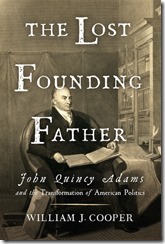
The Lost Founding Father: John Quincy Adams and the Transformation of American Politics by William J. Cooper Jr.

the lost founding fatherWhy has John Quincy Adams been largely written out of American history when he is, in fact, our lost Founding Father?

Overshadowed by both his brilliant father and the brash and bold Andrew Jackson, John Quincy Adams has long been dismissed as hyper-intellectual. Viciously assailed by Jackson and his populist mobs for being both slippery and effete, Adams nevertheless recovered from the malodorous 1828 presidential election to lead the nation as a lonely Massachusetts congressman in the fight against slavery. Now, award-winning historian William J. Cooper insightfully demonstrates that Adams should be considered our lost Founding Father, his moral and political vision the final link to the great visionaries who created our nation. With his heroic arguments in the Amistad trial forever memorialized, a fearless Adams stood strong against the Jacksonian tide, the Gag Rule, and the expansion of slavery that would send the nation hurtling into war. This game-changing biography reveals Adams to be one of the most battered but courageous and inspirational politicians in American history.

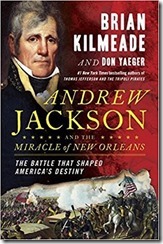
Andrew Jackson and the Miracle of New Orleans: The Battle That Shaped America's Destiny by Brian Kilmeade and Don Yeager

Andrew JacksonWhen the British fought the young United States during the War of 1812, they knew that taking the mouth of the Mississippi River was the key to crippling their former colony. Capturing the city of New Orleans and stopping trade up the river sounded like a simple task--New Orleans was far away from Washington, out of sight and out of mind for the politicians.

What the British didn't count on was the power of General Andrew Jackson. A formidable military leader with a grudge against the British and a heart for the common man, he rallied the divided inhabitants of New Orleans, bringing together Frenchmen, Native Americans, freed slaves, pirates, and Kentucky woodsmen.
In their now trademark fashion, Kilmeade and Yaeger will trace the development of Jackson's character and bring the reader to the scenes of one of the most pivotal--and surprising--battles in American history.


President McKinley: Architect of the American Century by Robert W. Merry

president mckinleyIn this great American story, acclaimed historian Robert Merry resurrects the presidential reputation of William McKinley, which loses out to the brilliant and flamboyant Theodore Roosevelt who succeeded him after his assassination. He portrays McKinley as a chief executive of consequence whose low place in the presidential rankings does not reflect his enduring accomplishments and the stamp he put on the country’s future role in the world.

Republican President William McKinley in his two terms as president (1897 – 1901) transformed America. He established the US as an imperial power. Although he does not register large in either public memory or in historians’ rankings, in this revealing account, Robert W. Merry unfolds the mystery of how this bland man managed so much powerful change.

McKinley settled decades of monetary controversy by taking the country to a strict gold standard; in the Spanish-American war he kicked Spain out of the Caribbean and liberated Cuba from Spain; in the Pacific he acquired Hawaii and the Philippines through war and diplomacy; he developed the doctrine of “fair trade”; forced the “Open Door” to China; forged our “special relationship” with Great Britain. In short, he established the non-colonial imperialism that took America into global preeminence. He expanded executive power and managed public opinion through his quiet manipulation of the press. McKinley paved the way for the bold and flamboyant leadership of his famous successor, Teddy Roosevelt, who built on his accomplishments (and got credit for them).

Merry writes movingly about McKinley’s admirable personal life, from his simple Midwestern upbringing to his Civil War heroism to his brave comportment just moments before his death by assassination (it was only six months into his second term when he was shot). Lively, definitive, and eye-opening, President McKinley resurrects this overlooked president and places him squarely on the list of one of the most important.


Are you interested in other Presidential biographies?

Wish List 5
Becoming George                 Lincoln                     Wilson              
Washington                 ★★★½☆☆                 ★★★★☆      
★★★★☆                                                                          


If you are looking to add more books to your list, here are some of the wishlists from a few of my friends this month: (to be updated as they go live)

keep calm and support book bloggers


Copyright © 2018 by The Maiden’s Court

Monday, December 18, 2017

Wish List 5: WWII Novels Volume II

IMG_20161004_224228_696000

Once a month I am planning on sharing with you all 5 of my biggest wish list books broken up by theme.  I know that you all need more on your TBR!!! WWII is a setting that sees A LOT of novels released each year, so even though I featured this category last year I have several new ones to add!

The Atomic City Girls by Janet Beard

the atomic city girlsIn the bestselling tradition of Hidden Figures and The Wives of Los Alamos, comes a riveting novel of the everyday women who worked on the Manhattan Project during World War II

“What you see here, what you hear here, what you do here, let it stay here.”

In November 1944, eighteen-year-old June Walker boards an unmarked bus, destined for a city that doesn’t officially exist. Oak Ridge, Tennessee has sprung up in a matter of months—a town of trailers and segregated houses, 24-hour cafeterias, and constant security checks. There, June joins hundreds of other young girls operating massive machines whose purpose is never explained. They know they are helping to win the war, but must ask no questions and reveal nothing to outsiders.

The girls spend their evenings socializing and flirting with soldiers, scientists, and workmen at dances and movies, bowling alleys and canteens. June longs to know more about their top-secret assignment and begins an affair with Sam Cantor, the young Jewish physicist from New York who oversees the lab where she works and understands the end goal only too well, while her beautiful roommate Cici is on her own mission: to find a wealthy husband and escape her sharecropper roots. Across town, African-American construction worker Joe Brewer knows nothing of the government’s plans, only that his new job pays enough to make it worth leaving his family behind, at least for now. But a breach in security will intertwine his fate with June’s search for answers.

When the bombing of Hiroshima brings the truth about Oak Ridge into devastating focus, June must confront her ideals about loyalty, patriotism, and war itself.


The Wives of Los Alamos by TaraShea Nesbit

the wives of los alamosTheir average age was twenty-five. They came from Berkeley, Cambridge, Paris, London, Chicago—and arrived in New Mexico ready for adventure, or at least resigned to it. But hope quickly turned to hardship as they were forced to adapt to a rugged military town where everything was a secret, including what their husbands were doing at the lab. They lived in barely finished houses with a P.O. box for an address in a town wreathed with barbed wire, all for the benefit of a project that didn’t exist as far as the public knew. Though they were strangers, they joined together—adapting to a landscape as fierce as it was absorbing, full of the banalities of everyday life and the drama of scientific discovery.

And while the bomb was being invented, babies were born, friendships were forged, children grew up, and Los Alamos gradually transformed from an abandoned school on a hill into a real community: one that was strained by the words they couldn’t say out loud, the letters they couldn’t send home, the freedom they didn’t have. But the end of the war would bring even bigger challenges to the people of Los Alamos, as the scientists and their families struggled with the burden of their contribution to the most destructive force in the history of mankind.

The Wives of Los Alamos is a novel that sheds light onto one of the strangest and most monumental research projects in modern history, and a testament to a remarkable group of women who carved out a life for themselves, in spite of the chaos of the war and the shroud of intense secrecy.


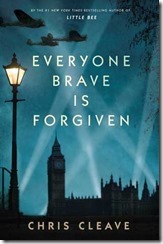
Everyone Brave is Forgiven by Chris Cleave

everyone brave is forgivenA spellbinding novel about three unforgettable individuals thrown together by war, love, and their search for belonging in the ever-changing landscape of WWII London.

It’s 1939 and Mary, a young socialite, is determined to shock her blueblood political family by volunteering for the war effort. She is assigned as a teacher to children who were evacuated from London and have been rejected by the countryside because they are infirm, mentally disabled, or—like Mary’s favorite student, Zachary—have colored skin.

Tom, an education administrator, is distraught when his best friend, Alastair, enlists. Alastair, an art restorer, has always seemed far removed from the violent life to which he has now condemned himself. But Tom finds distraction in Mary, first as her employer and then as their relationship quickly develops in the emotionally charged times. When Mary meets Alastair, the three are drawn into a tragic love triangle and—while war escalates and bombs begin falling around them—further into a new world unlike any they’ve ever known.

A sweeping epic with the kind of unforgettable characters, cultural insights, and indelible scenes that made Little Bee so incredible, Chris Cleave’s latest novel explores the disenfranchised, the bereaved, the elite, the embattled. Everyone Brave Is Forgiven is a heartbreakingly beautiful story of love, loss, and incredible courage.


The Way to London by Alix Rickloff

the way to londonFrom the author of Secrets of Nanreath Hall comes this gripping, beautifully written historical fiction novel set during World War II—the unforgettable story of a young woman who must leave Singapore and forge a new life in England.

On the eve of Pearl Harbor, impetuous and overindulged, Lucy Stanhope, the granddaughter of an earl, is living a life of pampered luxury in Singapore until one reckless act will change her life forever.

Exiled to England to stay with an aunt she barely remembers, Lucy never dreamed that she would be one of the last people to escape Singapore before war engulfs the entire island, and that her parents would disappear in the devastating aftermath. Now grief stricken and all alone, she must cope with the realities of a grim, battle-weary England.

Then she meets Bill, a young evacuee sent to the country to escape the Blitz, and in a moment of weakness, Lucy agrees to help him find his mother in London. The unlikely runaways take off on a seemingly simple journey across the country, but her world becomes even more complicated when she is reunited with an invalided soldier she knew in Singapore.

Now Lucy will be forced to finally confront the choices she has made if she ever hopes to have the future she yearns for.


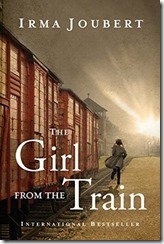
The Girl from the Train by Irma Joubert

the girl from the trainSix-year-old Gretl Schmidt is on a train bound for Auschwitz. Jakób Kowalski is planting a bomb on the tracks.

As World War II draws to a close, Jakób fights with the Polish resistance against the crushing forces of Germany and Russia. They intend to destroy a German troop transport, but Gretl’s unscheduled train reaches the bomb first.

Gretl is the only survivor. Though spared from the concentration camp, the orphaned German Jew finds herself lost in a country hostile to her people. When Jakób discovers her, guilt and fatherly compassion prompt him to take her in. For three years, the young man and little girl form a bond over the secrets they must hide from his Catholic family.

But she can’t stay with him forever. Jakób sends Gretl to South Africa, where German war orphans are promised bright futures with adoptive Protestant families—so long as Gretl’s Jewish roots, Catholic education, and connections to communist Poland are never discovered.

Separated by continents, politics, religion, language, and years, Jakób and Gretl will likely never see each other again. But the events they have both survived and their belief that the human spirit can triumph over the ravages of war have formed a bond of love that no circumstances can overcome.


Looking for some highly recommended WWII novels I have read?

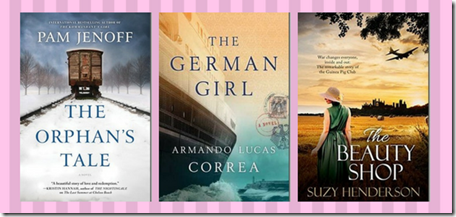
Wish List 5 (1)The Orphan’s Tale       The German Girl        The Beauty Shop
★★★★★                 ★★★★ ½☆                 ★★★★ ½☆

If you are looking to add more books to your list, here are some of the wishlists from a few of my friends this month: (to be updated as they go live)

keep calm and support book bloggers


Copyright © 2017 by The Maiden’s Court

Monday, November 27, 2017

Wish List 5: Non-Fiction November Volume II

IMG_20161004_224228_696000

Once a month I am planning on sharing with you all 5 of my biggest wish list books broken up by theme.  I know that you all need more on your TBR!!!  November is a month in which to celebrate non-fiction books – and I always forgot about this until the very end of the month (this happened last year too!).  So this month, I will be sharing another round of 5 non-fiction books that have made my TBR lately.

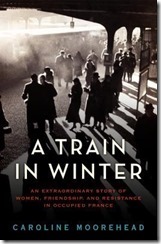
A Train in Winter: An Extraordinary Story of Women, Friendship, and Resistance in Occupied France by Caroline Moorehead

a train in winterThe New York Times bestseller, now available in paperback—the riveting and little-known story of a group of female members of the French resistance who were deported together to Auschwitz, a remarkable number of whom survived.

In January 1943, 230 women of the French Resistance were sent to the death camps by the Nazis who had invaded and occupied their country. This is their story, told in full for the first time—a searing and unforgettable chronicle of terror, courage, defiance, survival, and the power of friendship. Caroline Moorehead, a distinguished biographer, human rights journalist, and the author of Dancing to the Precipice and Human Cargo, brings to life an extraordinary story that readers of Mitchell Zuckoff’s Lost in Shangri-La, Erik Larson’s In the Garden of Beasts, and Laura Hillenbrand’s Unbroken will find an essential addition to our retelling of the history of World War II—a riveting, rediscovered story of courageous women who sacrificed everything to combat the march of evil across the world.

Village of Secrets: Defying the Nazis in Vichy France by Caroline Moorehead

village of secretsFrom the author of the runaway bestseller A Train in Winter comes the extraordinary story of a French village that helped save thousands, including many Jewish children, who were pursued by the Gestapo during World War II.

Le Chambon-sur-Lignon is a small village of scattered houses high in the mountains of the Ardèche. Surrounded by pastures and thick forests of oak and pine, the plateau Vivarais lies in one of the most remote and inaccessible parts of Eastern France, cut off for long stretches of the winter by snow.

During the Second World War, the inhabitants of the area saved thousands wanted by the Gestapo: resisters, freemasons, communists, downed Allied airmen and above all Jews. Many of these were children and babies, whose parents had been deported to the death camps in Poland. After the war, Le Chambon became the only village to be listed in its entirety in Yad Vashem's Dictionary of the Just.

Just why and how Le Chambon and its outlying parishes came to save so many people has never been fully told. Acclaimed biographer and historian Caroline Moorehead brings to life a story of outstanding courage and determination, and of what could be done when even a small group of people came together to oppose German rule. It is an extraordinary tale of silence and complicity. In a country infamous throughout the four years of occupation for the number of denunciations to the Gestapo of Jews, resisters and escaping prisoners of war, not one single inhabitant of Le Chambon ever broke silence. The story of Le Chambon is one of a village, bound together by a code of honour, born of centuries of religious oppression. And, though it took a conspiracy of silence by the entire population, it happened because of a small number of heroic individuals, many of them women, for whom saving those hunted by the Nazis became more important than their own lives.

A Bold and Dangerous Family: The Remarkable Story of an Italian Mother, Her Two Sons, and Their Fight Against Fascism by Caroline Moorehead

a bold and dangrous familyThe acclaimed author of A Train in Winter and Village of Secrets delivers the next chapter in "The Resistance Quartet": the astonishing story of the aristocratic Italian family who stood up to Mussolini's fascism, and whose efforts helped define the path of Italy in the years between the World Wars—a profile in courage that remains relevant today.

Members of the cosmopolitan, cultural aristocracy of Florence at the beginning of the twentieth century, the Rosselli family, led by their fierce matriarch, Amelia, were vocal anti-fascists. As populist, right-wing nationalism swept across Europe after World War I, and Italy’s Prime Minister, Benito Mussolini, began consolidating his power, Amelia’s sons Carlo and Nello led the opposition, taking a public stand against Il Duce that few others in their elite class dared risk. When Mussolini established a terrifying and brutal police state controlled by his Blackshirts—the squaddristi—the Rossellis and their anti-fascist circle were transformed into active resisters.

In retaliation, many of the anti-fascists were arrested and imprisoned; others left the country to escape a similar fate. Tragically, Carlo and Nello were eventually assassinated by Mussolini’s secret service. After Italy entered World War II in June 1940, Amelia, thanks to visas arranged by First Lady Eleanor Roosevelt herself, fled to New York City with the remaining members of her family.

Renowned historian Caroline Moorehead paints an indelible picture of Italy in the first half of the twentieth century, offering an intimate account of the rise of Il Duce and his squaddristi; life in Mussolini’s penal colonies; the shocking ambivalence and complicity of many prominent Italian families seduced by Mussolini’s promises; and the bold, fractured resistance movement whose associates sacrificed their lives to fight fascism. In A Bold and Dangerous Family, Moorehead once again pays tribute to heroes who fought to uphold our humanity during one of history’s darkest chapters.


Hero of the Empire: The Boer War, a Daring Escape, and the Making of Winston Churchill by Candice Millard

hero of the empireFrom New York Times bestselling author of Destiny of the Republicand The River of Doubt, a thrilling narrative of Winston Churchill's extraordinary and little-known exploits during the Boer War

At age twenty-four, Winston Churchill was utterly convinced it was his destiny to become prime minister of England one day, despite the fact he had just lost his first election campaign for Parliament. He believed that to achieve his goal he must do something spectacular on the battlefield. Despite deliberately putting himself in extreme danger as a British Army officer in colonial wars in India and Sudan, and as a journalist covering a Cuban uprising against the Spanish, glory and fame had eluded him.

Churchill arrived in South Africa in 1899, valet and crates of vintage wine in tow, there to cover the brutal colonial war the British were fighting with Boer rebels. But just two weeks after his arrival, the soldiers he was accompanying on an armored train were ambushed, and Churchill was taken prisoner. Remarkably, he pulled off a daring escape--but then had to traverse hundreds of miles of enemy territory, alone, with nothing but a crumpled wad of cash, four slabs of chocolate, and his wits to guide him.

The story of his escape is incredible enough, but then Churchill enlisted, returned to South Africa, fought in several battles, and ultimately liberated the men with whom he had been imprisoned.
Churchill would later remark that this period, "could I have seen my future, was to lay the foundations of my later life." Millard spins an epic story of bravery, savagery, and chance encounters with a cast of historical characters--including Rudyard Kipling, Lord Kitchener, and Mohandas Gandhi--with whom he would later share the world stage. But Hero of the Empire is more than an adventure story, for the lessons Churchill took from the Boer War would profoundly affect 20th century history.


Escape From Davao: The Forgotten Story of the Most Daring Prison Break of the Pacific War by John D. Lukacs

escape from davaoOne of the greatest Pacific war stories never told.

On April 4, 1943, ten American prisoners of war and two Filipino convicts executed a daring escape from one of Japan's most notorious prison camps. Called the "greatest story of the war in the Pacific" by the War Department in 1944, the full account has never been told until now. A product of years of in-depth research, John D. Lukacs's gripping description of the escape brings this remarkable tale to life, so a new generation can admire the resourcefulness and patriotism of the men who fought in the Pacific.


Looking for recommendations for non-fiction reads?

Wish List 5
The Jersey Brothers          Pearl Harbor          Irena’s Children       
  ★★★★★                  ★★★★☆                     ★★★★★

If you are looking to add more books to your list, here are some of the wishlists from a few of my friends this month: (to be updated as they go live)

keep calm and support book bloggers


Copyright © 2017 by The Maiden’s Court