*UPDATE*

I have updated my review and giveaway policies page (now just titled Policies above). If you are entering a giveaway, please read and abide by the applicable policy.

Attention Authors! If you arrived here looking for information on the Two Sides to Every Story guest post series, see the tab at the top of the page for more info!


Search This Blog

Showing posts with label 15th c. Show all posts

Wednesday, December 6, 2017

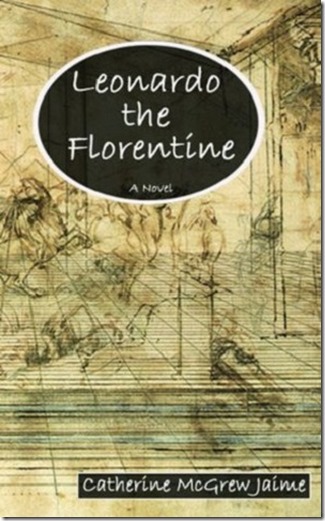
Audiobook Review: Leonardo the Florentine by Catherine McGrew Jaime

leonardo the florentine
Leonardo the Florentine
by Catherine McGrew Jaime
Book 1 in The Life and Travels of Leonardo da Vinci
Unabridged, 2 hr. 55 min.
Catherine Jaime
David Winograd (Narrator)
May 3, 2017
★★★½☆☆
goodreads button

Genre: Historical Fiction; Young Adult

Source: Received audio download via Audible from author for review

Who are the Medici brothers? And who is trying to assassinate them? Why was the Pitti Palace never completed? And what part did Leonardo play in all of this? Leonardo da Vinci is remembered as an artist and inventor. But who was he before anyone knew his name? This family-friendly novel explores the history and the legends of his early years in Florence. It also weaves a mystery of politics and power. This novel is the first in the series of historically based novels

I love that this book introduces a younger audience to the world of Renaissance Italy and a younger Leonardo da Vinci when he was apprenticed to the great Verrocchio. First of all, this is not a da Vinci that many adult novels even explore and novels that explore the life of an apprentice in an art studio are few and far between. Jaime does a fabulous job of creating a breathing world of Florence that feels real. Young Leonardo in his role as an apprentice to Verrocchio is able to be all over Florence and explore so many different areas of the world it is believable that he could experience all these different areas of Renaissance life. The novel touches on politics, humanism, art, architecture, and more in ways that are accessible to a younger audience, but also adults that are not familiar with that time and place. It can certainly be enjoyed by both age audiences. There were times where the novel occasionally felt dense. There was a lot of information that the author offers and it sometimes slowed down the pace of the plot. I do think that this will make a fascinating series for young readers, I just hope that the plot moves a little faster and doesn’t get weighed down by the details.

audiobookimpressions

★★★☆☆

It took a lot of getting used to this narrator to become comfortable with him. He has a sort of strange cadence to his speech. That being said, however, he has a very steady pacing to his narration. For an adult it might feel a touch on the slower side, but as this is aimed at a younger audience, the pacing might be proper so that they can digest all the information presented. I am unsure if this pacing might contribute to my feeling of the text being slightly dense.

You can check out a sample of the audiobook below:

Play symbol 85x85

Reviews of this book by other bloggers:


Buy the Book:
Amazon | Barnes & Noble | RJ Julia

Find Catherine McGrew Jaime: Website | Blog


Copyright © 2017 by The Maiden’s Court

Tuesday, May 10, 2016

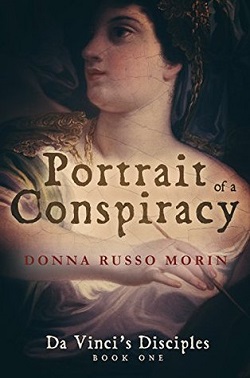
Book Review: Portrait of a Conspiracy by Donna Russo Morin


Portrait of a Conspiracy by Donna Russo Morin
Book 1 in the Da Vinci’s Disciples Trilogy
ARC, Paperback, 290 pages
Diversion Books
May 10, 2016
★★★★☆

Genre: Historical Fiction/Mystery

Source: Received from the publisher for review with Historical Fiction Virtual Book Tours
One murder ignites the powderkeg that threatens to consume the Medici’s Florence. Amidst the chaos, five women and one legendary artist weave together a plot that could bring peace, or get them all killed. Seeking to wrest power from the Medici family in 15th Century Florence, members of the Pazzi family drew their blades in a church and slew Giuliano. But Lorenzo de Medici survives, and seeks revenge on everyone involved, plunging the city into a murderous chaos that takes dozens of lives. Bodies are dragged through the streets, and no one is safe.

Five women steal away to a church to ply their craft in secret. Viviana, Fiammetta, Isabetta, Natasia, and Mattea are painters, not allowed to be public with their skill, but freed from the restrictions in their lives by their art. When a sixth member of their group, Lapaccia, goes missing, and is rumored to have stolen a much sought after painting as she vanished, the women must venture out into the dangerous streets to find their friend and see her safe. They will have help from one of the most renowned painters of their era the peaceful and kind Leonardo Da Vinci. It is under his tutelage that they will flourish as artists, and with his access that they will infiltrate some of the highest, most secretive places in Florence, unraveling one conspiracy as they build another in its place. Historical fiction at its finest, Donna Russo Morin begins a series of Da Vinci’s disciples with a novel both vibrant and absorbing, perfect for the readers of Sarah Dunant.
The story that Donna Russo Morin crafts in Portrait of a Conspiracy is a little bit of a mystery, a little bit of a women’s history lesson, and a little bit of a study of art. Immediately from the first pages of the novel you are sucked into the drama of an assassination and as the pages turn more of the plot behind the assassination unfolds. The five core women of this story get caught up in all of the drama not only because it is happening in their great city and it effects everyone to some extent, but also because one of their own is seemingly implicated in the plot in some manner and they are trying to find and protect their friend before the law does. At this time, women were not in power, so they must find her using the methods available to women, which makes things a little bit trickier. At the same time, they must work to keep their small art group a secret, which is a challenge when the people in power are turning over every stone looking for the perpetrators of the assassination. There is quite a lot going on here!

Overall, I feel that the plot of the novel was well thought-out and well-paced. There was never a sense of the objective being lost even though these characters endure some life events that run alongside the main story of the assassination plot and finding their missing friend. It imitated life in that you can never have a sole focus because life gets in the way – and especially when you are trying to coordinate a group of women it can become a challenge as personalities can get in the way!

There was certainly a lot of attention paid to learning about and detailing the creation of art. These women have their own art studio and we are privy to their creation of their works. In their quest they also study and witness other art being created. It is clear that the author spent a lot of time researching methods of painting and it make the novel that much richer in detail.

Morin is an expert at bringing the setting to life, in this case the city of Florence. I have never been to Florence, or even Italy for that matter, but I felt like I was living and breathing it right along with the characters – from the grimy walls a dark alley, to the smells of death and decay in the plaza, to the plush luxury of the upper class homes.

There is a large cast of characters here – at the very least there are 6 women, their husbands/children, Leonardo da Vinci, and several people of power and influence. Although a dramatis personae is included in the front of the novel, I forgot about this and struggled through most of the novel to remember which name belonged to which woman and from what walk of life she was from. Various sections of the book are told from different perspectives and I found it hard to keep track of who was who – so I recommend you keep the character profiles in front of you! Morin well fleshes out her characters and each is a unique character – I just couldn’t keep them all straight.

There was one thing that kept me from rating this novel higher and this was that at times the narrative became a little bit dense, especially in the first half of it. The most glaring example of this was the inclusion of practically every street that the women covered during their treks around the city; it was something that I began to frequently notice and it slowed down my pace. While I think the author wanted to give a detailed description of their paths through the city I think that it became a little too much and would have benefited from a lighter hand at the street name dropping.

I’m looking forward to seeing how the rest of this series plays out. I am curious if there will be another mystery/thriller angle in the next book or if it will be more focused on their quest to bring women’s art to the fore.

Reviews of this book by other bloggers:
 
Buy the Book: Amazon | Barnes & Noble | RJ Julia

 
Also by Donna Russo Morin:


The Secret of the Glass
[My Review]


The King’s Agent
[My Review]


To Serve a King
[My Review]


The Courtier’s Secret

 
Find Donna Russo Morin: Website | Facebook | Twitter

 
Follow the Tour!

On Twitter: #PortraitofaConspiracyBlogTour


Copyright © 2016 by The Maiden’s Court

Friday, February 19, 2016

Book Review: Isabel the Queen by Peggy K. Liss


Isabel the Queen: Life and Times by Peggy K. Liss
e-Book, 496 pages
University of Pennsylvania Press
December 1, 2004
★★★★☆

Genre: Non-Fiction, Biography

Source: Personal purchase for my Masters class
Queen Isabel of Castile is perhaps best known for her patronage of Christopher Columbus and for the religious zeal that led to the Spanish Inquisition, the waging of holy war, and the expulsion of Jews and Muslims across the Iberian peninsula. In this sweeping biography, newly revised and annotated to coincide with the five-hundredth anniversary of Isabel's death, Peggy K. Liss draws upon a rich array of sources to untangle the facts, legends, and fiercely held opinions about this influential queen and her decisive role in the tumultuous politics of early modern Spain.

"Isabel the Queen" reveals a monarch who was a woman of ruthless determination and strong religious beliefs, a devoted wife and mother, and a formidable leader. As Liss shows, Isabel's piety and political ambition motivated her throughout her life, from her earliest struggles to claim her crown to her secret marriage to King Fernando of Aragon, a union that brought success in civil war, consolidated Christian hegemony over the Iberian peninsula, and set the stage for Spain to become a world empire."
My knowledge of Isabel, Queen of Castile, has been limited to what you learn about her involvement in the “discovery” of the Americas and the Inquisition and the fictional interpretation of her life in The Queen’s Vow by C.W. Gortner. I endeavored to read this book as an assignment from class and selected it from the class syllabus, but I was very pleased to find out that this book was referenced as one of Gortner’s sources in his novel.

Isabel the Queen brings the reader into the world of Isabel by introducing the rule and times of her father, Juan, and half-brother, Enrique. The author includes this information as a means of establishing what Isabel had as her professional examples and to show the differences when Isabel became the Queen. I think that this worked well, but I did get a little tired reading statements like, “and it proved a costly mistake whose lessons would not be lost on Isabel” (Kindle loc. 757). The author makes it VERY clear with these kinds of statements to draw the divisions between Isabel and her brother especially.

This book was chock full of information on not just Isabel as a person, but also the world of Spain and Europe around her. It was very dense and not a book that you finish in a short period of time, believe me, it will take you awhile to read it all; this is certainly more of a research book than a fun reading book. However, you will come away from it with a new knowledge and appreciation of the time.

Any discussion of Isabel inevitably wades in the water of controversy with the portrayal of the Columbus expedition as well as the handling of the Spanish Inquisition and persecution of the Jews and Muslims. Liss doesn’t shy away from these controversial subject and does lay out the information, both positive and negative, but she doesn’t take a firm stance in either direction. As the book was originally published around the 500th anniversary of Columbus’ expedition and then was republished around the 500th anniversary of the death of Isabel it makes sense that she treads carefully around these subjects in order to take advantage of these dates.

I came away from this book with a much more concrete sense of who Isabel was as a person and as a Queen. I would recommend this book, but just know it might be a little denser than you are looking for.

Reviews of this book by other bloggers:

Buy the Book: Amazon | Barnes & Noble | RJ Julia


**Read an Excerpt**

Also by Peggy Liss:
Atlantic Empires


Copyright © 2016 by The Maiden’s Court

Tuesday, July 8, 2014

Book Review: Russka by Edward Rutherfurd

russka

Russka by Edward Rutherfurd
Unabridged, 39 hr. 57 min.
Blackstone Audio, Inc.
Wanda McCaddon (Narrator)
September 13, 2012
★★★★☆

Genre: Family Saga, Historical Fiction

Source: Downloaded from Audible for Personal Collection

“Russka is the story of four families who are divided by ethnicity but united in shaping the destiny of Russia. From a single riverside village situated at one of the country's geographic crossroads, Russia's Slav peasant origins are influenced by the Greco-Iranian, Khazar, Jewish, and Mongol invasions. Unified by this one place, the many cultures blend to form a rich and varied tapestry.

Rutherfurd's grand saga is as multifaceted as Russia itself: harsh yet exotic, proud yet fearful of enemies, steeped in ancient superstitions but always seeking to shape the emerging world. Peter the Great, Ivan the Terrible, Catherine the Great, and Lenin all play their roles in creating and destroying the land and its people.

In Russka, Edward Rutherfurd has transformed the epic history of a great civilization into a human story of flesh and blood.”

Russia is a land with a history that is vast, varied, and lengthy – and Rutherfurd admirably conquers that history in his 960 page, (almost) 40 hour long book. As is the style of Rutherfurd novels, the reader is taken on a historical tour that follows the lives of a few choice families from a cross-section of society. From the early days traveling across Russia’s plains to the post WWII era, the country comes to vivid life. Russia has been a country that has been closed off from much of the world for much of its history – through actions of its own and those of others – making it a land that is rather mysterious to many. Rutherfurd’s writing style makes this region accessible to readers and evokes a feeling of the times.

1,800 years is a lot to cover in a novel, but Rutherfurd hits what appear to be all of the biggest events. There were events that I knew (from history class) as well as those that I did not. Somehow in my listening I seem to have missed the entire section on Catherine the Great, which is a period I am particularly interested in, but rest assured, it is covered!

This novel was everything that I was hoping it would be – making the vague history of Russia accessible and interesting.

audiobookimpressions

★★★☆☆

When you are spending just shy of 40 hours listening to a novel – the narration becomes excessively important. A 12 hour novel I can deal with a so-so narrator, 40 hours, it’s A LOT harder. The narration wasn’t bad, it just wasn’t compelling. The narrator’s voice had a jarring accent that frequently pulled me out of the flow of the story. It also wasn’t the type of accent that fit with the context of the story – which would have made a little easier to accept, even if it wasn’t pleasing to the ear.

I can’t help but compare the experience of listening to Russka to the experience listening to the other Rutherfurd book I have read, New York. In that case, the narrator was marvelous and I even experienced tears and goosebumps from the combination of great narrative and amazing narration. I was hoping for that experience here and that didn’t quite happen.

Edward Rutherfurd has also written several other historical fiction books: The Princes of Ireland, Rebels of Ireland, The Forest, London, New York, Paris, and Sarum. You can visit Rutherfurd’s website for additional information about these books.

My reviews of other books by this author:

Reviews of this book by other bloggers:

Here are some choices for purchasing the book: Amazon, B&N, RJ Julia (my fav indie bookstore).


Copyright © 2014 by The Maiden’s Court

Monday, February 17, 2014

Book Review: The Boleyn Bride by Brandy Purdy

boleynbride

The Boleyn Bride by Brandy Purdy
Paperback, 272 pages
Kensington
February 25, 2014
★★★☆☆

Genre: Historical fiction

Source: Received for review as part of Historical Fiction Virtual Book Tour

“At sixteen, Elizabeth Howard envisions a glorious life for herself as lady-in-waiting to the future queen, Catherine of Aragon. But when she is forced to marry Thomas Boleyn, a wealthy commoner, Elizabeth is left to stagnate in the countryside while her detested husband pursues his ambitions. There, she raises golden girl Mary, moody George, and ugly duckling Anne—while staving off boredom with a string of admirers. Until Henry VIII takes the throne. . .

When Thomas finally brings his highborn wife to London, Elizabeth indulges in lavish diversions and dalliances—and catches the lusty king's eye. But those who enjoy Henry's fickle favor must also guard against his wrath. For while her husband's machinations bring Elizabeth and her children to the pinnacle of power, the distance to the scaffold is but a short one—and the Boleyn family's fortune may be turning. . .”

This book was a mixed bag for me – I liked the story but did not care much for the writing style, which actually made it very difficult for me to finish reading the book. I’m going to first address the storyline (which I liked) before moving into what did not work for me.

The Boleyn Bride follows Elizabeth Howard, wife to Thomas Boleyn and mother of Anne, Mary, and George Boleyn. I was intrigued by the novel because I wanted to know more about this woman who brought these three intriguing historical figures into the world. She has to have had an interesting story?! Right?! Well, sort of. It seems the majority of her time was spent trying to find a way to spite her husband. She was a hands-off mother, even when her daughters were favorites of King Henry VIII. She really wasn’t all that interesting of an individual after all – but I did appreciate her outside looking in storytelling. I actually can’t say that I liked Elizabeth – I found that I did not have any real feelings for her; she just came off as cold, distant, and superficial. I also did not like that the author chose to continue to include the rumors about Anne Boleyn – the sixth finger, growth on her neck, and the belief that Anne bewitched (literally) Henry. These are elements that I cannot stand in Tudor novels, especially these modernly written ones.

With regard to the writing style, I almost did not get through the prologue – it alone was 26 pages of a 272 page novel! It felt way too long. The author also uses very long, extremely descriptive sentences full of semi-colons. These sentences slowed the pace of the narrative down and did not necessarily add anything to the narrative. Early on in the narrative, the author establishes Elizabeth as a complainer, a turnoff to me as a reader when the same complaints are repeated over and over. A perfect example of that is that Elizabeth repeatedly says “Thomas Bullen – I mean Boleyn!”. I get that the character is mocking her husband and the first time or two it worked, but each time after that I actually got angry when I read it. Please give me something new!

Overall, I don’t feel that this novel contributed anything to the Tudor literature collection and could easily be passed over.

Author Brandy Purdy also has written The Tudor Throne, The Queen’s Pleasure, The Queen’s Rivals, Vengeance is Mine, The Boleyn Wife and The Confession of Piers Gaveston. You can visit Purdy’s website for additional information about the book.

Reviews of this book by other bloggers:

Here are some choices for purchasing the book: Amazon, B&N, RJ Julia (my fav indie bookstore).

The Boleyn Bride_Tour Banner _FINALv2

You can follow along with the rest of the blog tour by visiting the HFVBT website or on Twitter with the following hashtag: #BoleynBrideTour.

I also have two copies of the novel to giveaway today to a lucky US resident thanks to HFBRT.  Entries are made through the Rafflecopter below.  Last day to enter is March 2nd.  Good luck!

a Rafflecopter giveaway


Copyright © 2014 by The Maiden’s Court

Tuesday, August 20, 2013

Book Review: The Serpent and the Pearl by Kate Quinn

SerpentPearl_CV.indd

The Serpent and the Pearl by Kate Quinn
Book 1 of A Novel of the Borgia series

Paperback, 432 pages
Berkley Trade
August 6, 2013
★★★★½☆

Genre: Historical fiction

Source: Received from publisher for review

Rome, 1492. The Holy City is drenched with blood and teeming with secrets. A pope lies dying and the throne of God is left vacant, a prize awarded only to the most virtuous--or the most ruthless. The Borgia family begins its legendary rise, chronicled by an innocent girl who finds herself drawn into their dangerous web...

Vivacious Giulia Farnese has floor-length golden hair and the world at her feet: beauty, wealth, and a handsome young husband. But she is stunned to discover that her glittering marriage is a sham, and she is to be given as a concubine to the ruthless, charismatic Cardinal Borgia: Spaniard, sensualist, candidate for Pope--and passionately in love with her.

Two trusted companions will follow her into the Pope's shadowy harem: Leonello, a cynical bodyguard bent on bloody revenge against a mysterious killer, and Carmelina, a fiery cook with a past full of secrets. But as corruption thickens in the Vatican and the enemies begin to circle, Giulia and her friends will need all their wits to survive in the world of the Borgias.

The thing that stands out the most to me when thinking back on my experience with this book is all of the mouthwatering foods that Quinn describes. Even if I just finished dinner, this book made me hungry all over again. I am compelled to look up Renaissance recipes now to try them out.

This was another hit for Kate Quinn – her first step outside the Ancient Romans, but still within the comfort zone of Italy. Her witty style of writing shines through here as I expected; what I didn’t expect was to enjoy the Borgia clan quite so much. When hearing about the Borgia’s we always hear of the poisons, incest allegations, and general debauchery. While we still get a little bit of the debauchery in terms of the Pope’s mistress, the Borgias were relatively real here – and rather mild. I actually liked them!

I was glad that the narrators of this novel were not actually Borgias. The closest we get is Gulia, the Pope’s mistress. We certainly see and hear from Borgia family members, Roderigo, Cesare, Lucrezia and more, but also enjoyed the non-Borgia characters. I loved Leonello, a sort of body-guard for the Borgia ladies. He was so funny and I couldn’t help but picture Peter Dinklage while reading his chapters. Gulia was great – I loved seeing how she dealt with the various hands dealt to her. I started out disliking Roderigo Borgia, but he grew on me as the book wore on.

The book leaves off on a great cliff-hanger and you can’t help but wanting to know what happens next. I have a feeling that the main characters are all going to come out of this a little different than they went into it. I can’t wait for the next book in this duo!

Author Kate Quinn also has written 3 books set in Ancient Rome: Mistress of Rome, Daughters of Rome, and Empress of the Seven Hills. The second book in the Borgia series is expected for release in 2014. You can visit Quinn’s website or blog for additional information about the book. If you would like to preview the story before reading it, why not try out this excerpt of the book?

My reviews of other books by this author:

Reviews of this book by other bloggers:

Here are some choices for purchasing the book: Amazon, B&N, RJ Julia (my fav indie bookstore).


Copyright © 2013 by The Maiden’s Court

Wednesday, November 28, 2012

Book Review: Daughters of the Witching Hill by Mary Sharratt

Daughtersofthewitchinghill

Daughters of the Witching Hill by Mary Sharratt
Hardcover, 352 pages
Houghton Mifflin Harcourt
April 7, 2012
★★★★☆ 
goodreads button 

Genre: Historical fiction

Source: Received from the author for review

“Daughters of the Witching Hill brings history to life in a vivid and wrenching account of a family sustained by love as they try to survive the hysteria of a witch-hunt.

Bess Southerns, an impoverished widow living in Pendle Forest, is haunted by visions and gains a reputation as a cunning woman. Drawing on the Catholic folk magic of her youth, Bess heals the sick and foretells the future. As she ages, she instructs her granddaughter, Alizon, in her craft, as well as her best friend, who ultimately turns to dark magic.

When a peddler suffers a stroke after exchanging harsh words with Alizon, a local magistrate, eager to make his name as a witch finder, plays neighbors and family members against one another until suspicion and paranoia reach frenzied heights.

Sharratt interweaves well-researched historical details of the 1612 Pendle witch-hunt with a beautifully imagined story of strong women, family, and betrayal. Daughters of the Witching Hill is a powerful novel of intrigue and revelation.”

Going in to reading Daughters of the Witching Hill I had never before heard of the Pendle Witches. I of course had heard of, and read widely, about the witch trials in Salem, Massachusetts, and had read some about various witch trials in England, but this particular group was unknown to me. Mary Sharratt does a fabulous job of initiating a novice into the basics of who these Pendle Witches were and what brought about their downfall.

While I found the story of the Pendle Witches to be not nearly as dramatic as those that surround the Salem Witches, I discovered that there seems to be a set of characteristics that typify these witch hunts/trials: they tend to be poor women from the outside of town, usually based on some type of grudge, and more often than not their spells and potions were types of religious prayers and homeopathic cures. One thing I always find interesting is how easily a town will turn on people they had traditionally went to for a cure when their horse was lame or their child was deathly ill. These were people that they obviously trusted and had developed a history as a person who could cure ills - however when bad news comes knocking at your door, the innate nature of self-preservation kicks in.

The first half of Sharratt’s book focuses on developing the characters of her witches and I surprisingly found them easy to make connections with. The second half deals with the unraveling of their life as accusations of witchcraft and their sham trials spiral out of control. This was a very fast read for me – read it in one day – and while it is not a high action novel – the drama of the daily life of these women pulls you in. There was one thing that I did not like about the novel – and I won’t go into much specifics because it might give the ending away – however I think the book would have been overall more enjoyable for me if the last chapter was omitted. It felt very out-of-sync with the rest of the novel and a little contrived. The information it contained would have possibly been better included into the afterward or an epilogue rather than as the last actual chapter.

If you would like to preview the story before reading it, why not try out this excerpt of the book?

You can also watch the book trailer below.

Reviews of this book by other bloggers:

Buy the Book: Amazon | Barnes & Noble | RJ Julia


Also by Mary Sharratt:

illuminations
Illuminations
[My Review]

the vanishing point
The Vanishing Point

the real minerva
The Real Minerva

the dark lady's mask
The Dark Lady’s Mask

summitt avenue
Summit Avenue


Find Mary Sharratt: Website | Facebook | Twitter


Copyright © 2012 by The Maiden’s Court

Tuesday, November 29, 2011

Movie Review: The Messenger: The Story of Joan of Arc


The Messenger: The Story of Joan of Arc
Gaumont
148 mins.
November 12, 1999
Rated: R

This movie takes us from the time Joan is a little girl until shortly after her death. We are privy to her visions and really get the feel of her passion and devotion to the cause. We are really seeing the world as Joan would see it – you get caught up in her revelations. All of the pieces of Joan’s story are here – the visions, the battles, the heresy trial, the burning at the stake. Not being familiar with the intimate details of her story there were some new events brought to my attention here.

Overall I enjoyed this movie more than I thought I would – based on the reviews that I had read. People felt that it was poorly acted – I thought that Mila Jovovich did a good job of portraying a truly passionate woman following what she believed to be the word of God. The movie doesn’t make a determination one way or the other (as to if she was crazy or actually being spoken to by God) but it does go into some self questioning at the end (by a comically funny Dustin Hoffman as her Conscience type person). The movie presents both possibilities. I think this was done to make her more human and less saintly – someone that a wider audience would connect with and someone who still wrestles with her conscience. Others complained that people during this time period would never speak the way they did (or use foul language) – I say, I’m glad they are speaking modern language or I would probably lose interest. And it terms of foul language there is a handful of colorful words and I’m sure that they used similar language back then too!

In terms of cinematography – there are some great wide shots of the people and landscape and I thought the scenery was well done. It was nominated for awards in Best Cinematography and won a Cesar (French equivalent to Academy Awards) for Best Costume Design.

The only thing that I wish had been improved in this film would be the ending – it felt a little rushed. This is a long film and maybe a few minutes could have been sacrificed from the battle scenes to leave time for a longer ending – since it really is the climax – without making the film longer.

I know that the concept of Joan of Arc can still spark controversy among people today – however if you look at the movie on its own, it’s relatively decent – I very much enjoyed it. If you are someone who is interested in the life of Joan of Arc I would recommend this movie – despite its detractors. If you are someone who is passionate about her story one way or the other – I might caution you against watching it.

I want to point out that although this movie is rated R I didn’t find it to be as bad as many other movies with that rating. Most of it is due to the war scenes – which can be brutal but are certainly not the worst I have seen. There is also one scene involving a rape – however you don’t directly see it happening – it is more alluded to and you are on the other side of the wall with a peephole view. For more on the rating check out this page.

Also, while this is a Foreign film – it is presented in English – I was thrilled that I did not need to turn on subtitles!

Check out this trailer:


Copyright © 2011 by The Maiden’s Court

Monday, October 10, 2011

Two Sides to Every Story: Christopher Columbus - Hero or Brute?


Christopher Columbus: Hero or Brute

I have wanted to write this post for over a month now after having a conversation with a coworker about Christopher Columbus, however I decided to wait for much better timing – and what could be better than Columbus Day! This post is designed to look at the two sides of the mythic man of Christopher Columbus – was he this hero who “found” America and should be celebrated every October? or was there more to this man than meets the eye? There are two distinct versions of Columbus – the one we celebrate and the one that we do not learn about even in history classes.

Hero of Myth
Columbus Discovers America
John Vanderlyn [Public domain], via Wikimedia Commons

The man we celebrate is the one who persevered to get this expedition to the Indies funded by the Spanish monarchs, sailed his three ships across a lethal Atlantic Ocean, and who ultimately found the island of Hispanola (thinking it was the Indies) and claimed it for Spain. He is celebrated as a great explorer and someone whom we should remember with a day off from work or school.  He is the man of our "Creation Story".


Brute
Cutting off the hands of the natives
Theodor de Bry [Public domain], via Wikimedia Commons

When we look a little closer at the real contributions of Columbus and his voyages we get to the grittier side. He didn’t really discover America – explorers had been dropping by for a long time before he arrived. He brought widespread death and destruction to the native populations from diseases, enforced slavery, and other brutal changes brought to their island. It is also believed that he was not even well liked by his own crews.

So how do we rectify these two very different men? If any of you are teachers, do you teach Columbus in class, and if so how? I’m just curious (when I was in grade school it was all celebrations and learning the rhymes and stories of the Nina, Pinta, and Santa Maria sailing across the ocean to discover America. I think the only other thing I got was in high school when we had a new history teacher who actually talked of bringing over small pox). Does it make sense that we have a national holiday to celebrate the contributions of Columbus? We currently only have federal holidays that celebrate individuals in honor of Martin Luther King Jr. and Christopher Columbus – should we maybe substitute someone in place of Columbus to celebrate with an individual day? Who would you suggest?

If you are interested in a book that examines how textbooks teach about Columbus, you should check out Lies My Teacher Told Me: Everything Your American History Textbook Got Wrong by James Loewen. He has a great chapter on Columbus and his voyages. This was one of the things that prompted this post. I do think that Columbus is someone that we should certainly teach about, however I think that we should give a better rounded lesson.


Copyright © 2011 by The Maiden’s Court

Friday, June 3, 2011

Book Review: Queen by Right by Anne Easter Smith

Queen by Right by Anne Easter Smith
ARC, Paperback, 528 pages
Touchstone
May 10, 2011
★★★★★
goodreads button

Genre: Historical Fiction

Source: Received from publisher for review as part of Historical Fiction Virtual Book Tours
“In Cecily Neville, duchess of York and ancestor of every English monarch to the present day, she has found her most engrossing character yet. History remembers Cecily of York standing on the steps of the Market Cross at Ludlow, facing an attacking army while holding the hands of her two young sons. Queen by Right reveals how she came to step into her destiny, beginning with her marriage to Richard, duke of York, whom she meets when she is nine and he is thirteen. Raised together in her father’s household, they become a true love match and together face personal tragedies, pivotal events of history, and deadly political intrigue. All of England knows that Richard has a clear claim to the throne, and when King Henry VI becomes unfit to rule, Cecily must put aside her hopes and fears and help her husband decide what is right for their family and their country. Queen by Right marks Anne Easter Smith’s greatest achievement, a book that every fan of sweeping, exquisitely detailed historical fiction will devour.”

I have read a couple of books that took place during the Wars of the Roses and dealing with the battle between King Henry VI and Edward of York. This was the first book that I have read that takes place during the events that actually ignite this battle of wills. The book begins almost at the end – Cecily, Duchess of York is looking back at the events that led up to the death of her dear husband and son five short weeks ago. We go back and look at her life from the early days when she was the Rose of Raby and the light of her father’s eye, we see her grow to love her husband, Richard, Duke of York, and we endure all of the triumphs and tragic events that they endure. Throughout this retelling we get glimpses of the present and understand what Cecily is thinking now after the fact. It is a look into her soul and the decisions that they made.

There is no doubt what side of the argument that the author writes from and I enjoyed reading the York perspective of events that I had only previously read from a Lancastrian viewpoint. With every book I read set during the Wars of the Roses I am persuaded to switch my loyalties and this book was no different. One of my favorite parts of this novel was the development of the love between Richard and Cecily. They were friends as children and grew to respect and encourage each other and truly find a love match. It felt so realistic and organic to the characters. This was the first book that truly made me like Richard of York – until about the last 50ish pages when I felt like his character took a complete turn around and was back to what I did not like about him. Cecily on the other hand I absolutely admired and thought that she was so brave in the midst of what was going on around her.

A unique angle that I did not expect was the inclusion of the storyline of Joan of Arc and her connection throughout the novel to Cecily. While the author admits in the historical note that there is no evidence showing that these two women ever met they were certainly in each other’s vicinity and it did add to the weighty-ness of the novel and filled out Cecily’s character. I had never really thought of Joan of Arc set historically and this novel certainly helped solve that issue for me. Another thing that I found interesting (don’t quote me on this because I don’t have Daughter of York on hand) was that the beginning of this novel seemed very similar to the beginning of Daughter of York. I recollect Cecily coming to the rescue of her daughter Margaret’s nightmare following the death of Richard in both books. This would make sense with both of these novels taking off from the same point in history (one on the mother and one on the daughter) and it ties both of them together.

Overall I thought that this was a wonderful novel – not overly vilifying the Lancasters – and telling this wonderful story.

If you would like to preview the story before reading it, why not try out this excerpt of the book?

Reviews of this book by other bloggers:

Buy the Book: Amazon | Barnes & Noble | RJ Julia


Also by Anne Easter Smith

daughter of york
Daughter of York
[My Review]

a rose for the crown
A Rose for the Crown

royal mistress
Royal Mistress

the king's grace
The King’s Grace


Find Anne Easter Smith: Website | Facebook | Goodreads

Follow the Tour

Historical Fiction Virtual Book Tours site.


Copyright © 2011 by The Maiden’s Court

Saturday, February 5, 2011

Book Review: Pale Rose of England by Sandra Worth

Pale Rose of England by Sandra Worth
ARC, Paperback, 464 pages
Berkley Trade
February 1, 2011
★★★★☆
goodreads button

Genre: Historical Fiction

Source: Received from publisher for review for HFBRT February event
From the award-winning author of The King's Daughter comes a story of love and defiance during the War of the Roses.

It is 1497. The news of the survival of Richard Plantagenet, Duke of York, has thundered across Europe, setting royal houses ablaze with intrigue and rocking the fledgling Tudor dynasty. Stepping finally onto English soil, Catherine arrives at the island of Saint Michael’s Mount, along with her husband and young son Dickon, their second child already on the way. With the keen support of Scotland’s King James IV,
Richard—known in England as Perkin Warbeck—has come to reclaim his rightful crown from Henry Tudor. Based on a prophecy given Catherine by a seer that she would be loved by a king, she has no doubt Richard will succeed in his quest. But rather than assuming the throne she believed was their destiny, Catherine would soon be prisoner of King Henry VII, and her beloved husband would, unimaginably, be stamped as an imposter.

Nothing could shake Catherine’s belief in Richard and her loyalty to the man she loved. She became a favored lady-in-waiting to the queen, Elizabeth of York, but her dazzling beauty only brought her unwanted affections from a jealous king and enmeshed her in a terrifying royal love triangle. With her husband facing execution for treason, Catherine, alone in the glittering but deadly Tudor Court, finds the courage to spurn a cruel monarch and shape her own destiny, winning the admiration of a nation.”
This story takes on a unique subject in the genre of historical fiction – that of the quest of Richard, Duke of York to reclaim his throne, but he is known to the world as Perkin Warbeck, the pretender to the throne. I love when authors take on a subject that has very rarely been written about. In my opinion, Sandra Worth does Richard much justice. He was just waiting for the right author to come along and write his story. Her writing style really allows you to connect with Richard and uncover his thoughts and feelings and motivations. The author also presents and very convincing case that suggests the person known as Perkin Warbeck was really Richard. Honestly Richard was a character you could easily fall in love with. I haven’t encountered one of those since William Marshall and Roger Bigod from The Greatest Knight and For the King’s Favor respectively.

At the same time, this book is a story of Catherine Gordon and the adversity that she faces being married to Richard and then later having to live in the court of Henry VII, the great enemy of her husband. Her and Richard really were fighting an uphill battle throughout the whole book and I just kept thinking, “could they ever catch a break!?”.

All of the books I have read where Henry VII was involved, he played a minor character and I was never really given enough information to even have an opinion about him. In Pale Rose of England Henry is very much a key player in the story and I really came to despise him – he just caused problem after problem for our protagonists. Another thing that I really enjoyed about the characters in this book was that it wasn’t your typical Tudor cast of characters. You had Catherine and Richard, as well as King James of Scotland, James Strangeways (courtier to Henry and her eventual second husband), and Matthew Craddock (her eventual third husband) as well as several of the sisters of Elizabeth of York (Cecily, Anne, Catherine and Bridget). It was great to see a little more of who was who in this time period.

A truly wonderful read that will pull on your heartstrings.

If you would like to preview the story before reading it, why not try out this excerpt of the book?

You can also watch the book trailer below.


Reviews of this book by other bloggers:

Buy the Book: Amazon | Barnes & Noble | RJ Julia


Also by Sandra Worth

the kings daughter
The King’s Daughter

the rose of york
The Rose of York: Love & War (Book 1)

crown of destiny

The Rose of York: Crown of Destiny
(Book 2)

fall from grace
The Rose of York: Fall From Grace (Book 3)

lady of the roses
Lady of the Roses


Find Sandra Worth: Website | Facebook 


Also as part of the HFBRT event, check out:

A guest post by Sandra Worth at Historical-Fiction.com
A highlight on Sandra Worth at HFBRT


Copyright © 2011 by The Maiden’s Court