*UPDATE*

I have updated my review and giveaway policies page (now just titled Policies above). If you are entering a giveaway, please read and abide by the applicable policy.

Attention Authors! If you arrived here looking for information on the Two Sides to Every Story guest post series, see the tab at the top of the page for more info!


Search This Blog

Showing posts with label 1920's. Show all posts

Tuesday, April 3, 2018

Book Review: Radium Girls by Kate Moore

radium girls
Radium Girls
by Kate Moore
ARC, e-Book, 496 pages
Sourcebooks
April 18, 2017
★★★★ ½☆
goodreads button

Genre: Non-Fiction

Source: Received via Netgalley for review

The incredible true story of the women who fought America's Undark danger

The Curies' newly discovered element of radium makes gleaming headlines across the nation as the fresh face of beauty, and wonder drug of the medical community. From body lotion to tonic water, the popular new element shines bright in the otherwise dark years of the First World War.

Meanwhile, hundreds of girls toil amidst the glowing dust of the radium-dial factories. The glittering chemical covers their bodies from head to toe; they light up the night like industrious fireflies. With such a coveted job, these "shining girls" are the luckiest alive — until they begin to fall mysteriously ill.

But the factories that once offered golden opportunities are now ignoring all claims of the gruesome side effects, and the women's cries of corruption. And as the fatal poison of the radium takes hold, the brave shining girls find themselves embroiled in one of the biggest scandals of America's early 20th century, and in a groundbreaking battle for workers' rights that will echo for centuries to come.

Written with a sparkling voice and breakneck pace, The Radium Girls fully illuminates the inspiring young women exposed to the "wonder" substance of radium, and their awe-inspiring strength in the face of almost impossible circumstances. Their courage and tenacity led to life-changing regulations, research into nuclear bombing, and ultimately saved hundreds of thousands of lives...

As soon as I saw Radium Girls up on the Netgalley platform I knew I NEEDED to read it. While I had never done extensive reading on these girls I had heard of them in passing while reading various other non-fiction works, especially when taking a class on social reform and women’s rights. However, after having received the book, life happened and like so many other things, it quite literally was shelved for awhile. But I still knew I WANTED to read this. So when a weekend arrived where I wasn’t feeling great and was going to be spending my time on the couch, it was time, finally, to pick up the book! And I absolutely devoured the pages in the course of the weekend!

What immediately caught my attention in this book was the girls themselves. The author doesn’t focus on just one of two key players, but quite the handful of women who endured a lot at the expense of radium. These women were fleshed out and their reasons for working at the various radium dial painting factories and the effects of the radium on their lives and bodies were detailed in full. Each woman had different reasons and different ailments and this book gave the full picture. Not something you want to be reading while eating, it can be gross at times as the author pulls no punches, but it was very appreciated because I could truly identify with these women and the pain they endured even while fighting their battle legally.

Even the companies themselves, the author dug under the covers and we are treated to what they knew and the lengths they went to in order to hide what they knew about the effects of the radium. What shocked me was how these women underwent exams by the company doctors, but were not given access to the results and the company men already knew they were suffering from radium’s effects early on.

I also appreciated the legal process that the author took us through as the women struggled to find anyone that would be willing to go up against the industry or assist them with their case. These were women who suffered some horrible workplace injustices, but at the time the jobs they were doing were considered to be top of the heap and THE jobs to be had, which made for considerable backlash. This reminded me to some extent of some of the garment workers in NYC, how those jobs were better than many others that women could have and there was high competition for the jobs, and the only way that their workplace situations were improved was unfortunately through a major fire that killed many women (at the Triangle Shirtwaist Factory).

Oh and let me not forget to mention, that although this is a non-fiction book, it certainly doesn’t read like one. While the material might be heavy in concept, the writing style is fluid and reads more like a novel, seamlessly moving from one thing to the next. An excellent book that I would highly recommend.

Reviews of this book by other bloggers:

Buy the Book: Amazon | Barnes & Noble | RJ Julia


Also by Kate Moore:

felix the railway cat
Felix the Railway Cat


Find Kate Moore:
Website | Twitter


Copyright © 2018 by The Maiden’s Court

Monday, June 5, 2017

Book Review: Becoming Bonnie by Jenni L Walsh

becoming bonnie
Becoming Bonnie
by Jenni L. Walsh
Book 1 in the Bonnie Series
ARC, e-Book, 304 pages
Forge Books
May 9, 2017
★★★★ ½☆
goodreads button

Genre: Historical Fiction

Source: Received from publisher for review

From debut historical novelist Jenni L. Walsh, Becoming Bonnie is the untold story of how wholesome Bonnelyn Parker became half of the infamous Bonnie and Clyde duo!

The summer of 1927 might be the height of the Roaring Twenties, but Bonnelyn Parker is more likely to belt out a church hymn than sling drinks at an illicit juice joint. She’s a sharp girl with plans to overcome her family's poverty, provide for herself, and maybe someday marry her boyfriend, Roy Thornton. But when Roy springs a proposal on her and financial woes jeopardize her ambitions, Bonnelyn finds salvation in an unlikely place: Dallas's newest speakeasy, Doc’s.

Living the life of a moll at night, Bonnie remains a wholesome girl by day, engaged to Roy, attending school and working toward a steady future. When Roy discovers her secret life, and embraces it—perhaps too much, especially when it comes to booze and gambling—Bonnie tries to make the pieces fit. Maybe she can have it all: the American Dream, the husband, and the intoxicating allure of jazz music. What she doesn't know is that her life—like her country—is headed for a crash.

She’s about to meet Clyde Barrow.

Few details are known about Bonnie's life prior to meeting her infamous partner. In Becoming Bonnie, Jenni L. Walsh shows a young woman promised the American dream and given the Great Depression, and offers a compelling account of why she fell so hard for a convicted felon—and turned to crime herself.

This book had me right from the description (and the cover too). I’ve always been interested in Bonnie and Clyde and there have been a few television shows about the duo recently, but they never really explored the backstory, just focusing on the flashy bank robbing crime spree. Bonnie is such a fascinating character and it is a fascinating time in history too (which I hadn’t really thought about combined with the characters). I’m pleased to say that Walsh met my every expectation with her debut, Becoming Bonnie, and I’m even more thrilled to hear that there will be a sequel coming out hopefully next year that takes us into the crime spree time.

Walsh creates a fantastically believable Bonnelyn in her high school years. She has grown up tight on funds, but with a relatively happy life. She anticipates marrying the man that she has grown up alongside, Roy, and has big dreams of becoming a teacher with a real income. She is a “good girl” and someone that I could identify with, despite coming from different circumstances. Beset with family problems and the economy downturn that happens with the crash of Wall Street, Bonnelyn finds herself doing things that she never would have thought about doing before – bootlegging, interested in someone other than Roy, changing her thoughts about completing school. You can truly believe that the growing uncertainly in her family situation could lead her to make some of these choices, but she is also conflicted about her choices. You feel that inner struggle. The other characters here are fully fleshed too and equally as interesting as Bonnelyn (I won’t spoil how the name Bonnie comes about as it is sweet). Her best friend Blanche is a hoot! She makes up her own words (which I do a lot) and is always up for a good time and pushing at the rules a bit, however she is a good egg and really there when she is needed. Oh and Clyde! The author just keeps stringing the reader along awaiting when he will actually show up on the page – and it was a very appreciated tactic. I think I would have been less interested in him had he been present from the start and this just built the anticipation.

While Walsh brings her characters to vivid life, her settings are even more fantastically endowed. The speakeasies were pulsating with music, big personalities, and the air of constant anticipation of a bust. The depression of Cement City was palpable and in stark contrast to the bigger setting of Dallas. Walsh excelled at world creating in a place I have never been that made me feel as if I was there.

After a few slow or stalled books that I had read recently it was extremely refreshing to pick up Becoming Bonnie. I always wanted to read one more chapter or thought of all the little times that I could find to pick up the book and read further. Bonnie ends on a positive note and leaves the reader wanting to find out what happens when the crime spree begins!

Reviews of this book by other bloggers:

Buy the Book: Amazon | Barnes & Noble | RJ Julia


Also by Jenni L. Walsh:

image coming soon
Being Bonnie
(Book 2)
Coming in 2018!!!


Find Jenni L. Walsh:
Website | Facebook | Twitter


Copyright © 2017 by The Maiden’s Court

Wednesday, November 9, 2016

Audiobook Review: The Light Between Oceans by M.L. Stedman

light between oceans

The Light Between Oceans by M.L. Stedman
Unabridged, 10 hr. 41 min.
Simon & Schuster Audio
Noah Taylor (Narrator)
August 31, 2012
★★★½☆☆
goodreads button

Genre: Historical Fiction

Source: Purchased from Audible

After four harrowing years on the Western Front, Tom Sherbourne returns to Australia and takes a job as the lighthouse keeper on Janus Rock, nearly half a day’s journey from the coast. To this isolated island, where the supply boat comes once a season and shore leaves are granted every other year at best, Tom brings a young, bold, and loving wife, Isabel. Years later, after two miscarriages and one stillbirth, the grieving Isabel hears a baby’s cries on the wind. A boat has washed up onshore carrying a dead man and a living baby.

Tom, whose records as a lighthouse keeper are meticulous and whose moral principles have withstood a horrific war, wants to report the man and infant immediately. But Isabel has taken the tiny baby to her breast. Against Tom’s judgment, they claim her as their own and name her Lucy. When she is two, Tom and Isabel return to the mainland and are reminded that there are other people in the world. Their choice has devastated one of them.

M. L. Stedman’s mesmerizing, beautifully written novel seduces us into accommodating Isabel’s decision to keep this “gift from God.” And we are swept into a story about extraordinarily compelling characters seeking to find their North Star in a world where there is no right answer, where justice for one person is another’s tragic loss.

The Light Between Oceans is exquisite and unforgettable, a deeply moving novel.

This was quite the interesting novel and there were a whole lot of things about it that I enjoyed, however I had a couple quibbles with elements of it as well. Certainly right from the start, there is a gripping cover and blurb. All the covers that I have seen are excellent representations of events of this novel, but I like this one with just a silhouette of the lighthouse; it reminds us of the desolation that is a very big part of the novel as well as the obvious storyline that revolves around the lighthouse.

The novel is broken roughly into three sections: that time spent on Janus, the events that unfold when they return to the mainland, and then about 20 or so years later. For me, it was the first third that held my interest which then slowly slipped away the further on I went. I loved the events on Janus Rock because it was very different that many other settings in novels because they are alone with only the occasional boat arrival bringing supplies. It is a little bit of a psychological drama of how different people process events when outside the boundaries of society. The line of right and wrong is a little less clear and I felt so much for these characters during this point in the story. I loved learning about the care and maintenance of the light and how seriously Tom takes his responsibilities to it. After Tom, Isabel, and Lucy return to the mainland where everything that was kept secret comes to the fore – this should have been the time where the drama ramps up, and I just didn’t feel that – it actually felt like a little bit of a slide backward. I felt the emotion for sure, but I just wasn’t super convinced and honestly didn’t care what would happen. Then once we move to the 20 years later, it was a major let down.

I have said this before with other novels set in and around Australia – I want more. I loved seeing the connection to WWI and how it even affected areas located physically far from the fighting. The mental impact of the war that Tom brought home with him certainly played into the decisions he made regarding Lucy and his family. It was a fascinating element to explore. We also deal with the psychological issues that Isabel experiences in living on a desolate island and the loss of several children. There is a lot of psychological experiences going on here that I found interesting.

This is a book that I had mixed feelings about, and certainly about the outcome of the fate of Lucy. Ultimately it came full circle and should have been somewhat satisfying, at least as much as it could be given their circumstances, but I didn’t like it.

audiobookimpressions 
★★★★ ½☆

The audio production here was fantastic, even given my quibbles with the story. The narrator, Noah Taylor, carried off a few different accents throughout the novel – of particular note was his German accent. He even sang a song – in German! I was impressed with the singing in general, but in another language it provided an even greater authenticity to the story. The pace of narration was perfect – at times it was calm and soothing and at others it spun up as certain characters felt frantic or the time was chaotic. The narration here helped make the story more enjoyable even when I wasn’t as into the story being told.

You can check out a sample of this audio production below:


Reviews of this book by other bloggers:


Buy the Book:
Amazon | Barnes & Noble | RJ Julia


Light Between Oceans
is the debut novel of M.L. Stedman

I think that this book would be a fabulous for discussion in a book club – there are so many elements that are ripe for various perspectives and opinions. So, if you have a book club, here are some resources you might want to check out.

Find M.L. Stedman: Publisher’s Website


Copyright © 2016 by The Maiden’s Court

Monday, July 11, 2016

Book Review: The Tea Planter's Wife by Dinah Jefferies


The Tea Planter’s Wife by Dinah Jefferies
ARC, E-Book, 418 pages
Crown Publishers
September 13, 2016
★★½☆☆☆

Genre: Historical Fiction

Source: Requested for review from the publisher via Edelweiss
Nineteen-year-old Gwendolyn Hooper is newly married to a rich and charming widower, eager to join him on his tea plantation, determined to be the perfect wife and mother.
But life in Ceylon is not what Gwen expected. The plantation workers are resentful, the neighbours treacherous. And there are clues to the past - a dusty trunk of dresses, an overgrown gravestone in the grounds - that her husband refuses to discuss.
Just as Gwen finds her feet, disaster strikes. She faces a terrible choice, hiding the truth from almost everyone, but a secret this big can't stay buried forever . . .
Oh where to start with this one…

So, this book started out as a “buddy read” with my fellow blogger friends Erin, Stephanie, and Magdalena, it ended for all of us as a solo read because about two-thirds of the way through it bogged us down so much that no one really wanted to read any further. What was once a promising read at the very beginning and generated much discussion at the possibilities of what the resolution would be to the mystery that is introduced in the first pages, lost its way entirely somewhere around half-way. I hung on through the end because I really wanted to see how the mystery would play out and was left disappointed by the anticlimactic answer.

Let me start with a discussion of what I think the author succeeded in with this book. Prior to reading this book the most I knew about tea planting/harvesting was from a Snapple commercial where a little old man told me that “you pluck” tea leaves not pick them. I didn’t even have any idea where Ceylon was – that was the first thing that I needed to go look up with this book! By the end, I had a fairly clear idea of how a tea plantation would have been run during this time, some of the problems that they would have faced with the native laborers and their growing demands for change, and how they might have been effected by the Great Depression. I could envision how a plantation might look and to some extent draw the lines between the way the laborers/natives would have lived and how the British colonizers would have lived (although the native took less of a robust shape).

I have the idea that the author wanted to flesh out these divisions between the British and the natives as well as the civil unrest occurring between the Sinhalese and the Tamil, but this was less successfully done. The most significant takeaway that stands out in my mind was the upheaval over which language would be taught in school – which didn’t have anything to do with the story. We hear a lot about the improvements that are needed for the laborers or the demands their unions are making through conversations between Laurence and his overseer, but it never means a lot to the reader as we don’t experience it – tell less, show more. The only time we witness anything related to these issues are when two riots happen and out main cast just happens to be there, for the most part. We are left very distant from these issues and thus they don’t feel all that important.

My biggest struggles with this book were with regard to the characters and the basic forward movement of the plot in general. I literally found every character infuriating, especially the main character Gwen. She moves through most of the book in a distant state or at other times so overwrought and in her own world that I just could absolutely not connect with her in any way. Her sister-in-law, Verity, I wanted to smack several times. I wanted to shout for her to grow up and let go of her brother. Verity and Laurence (Gwen’s husband) always felt a little off to me – that something was being hidden was obvious and I changed my mind as to what it was many times.

The plot was boring and I hate saying that because based on the book blurb and the earliest chapters I didn’t think it would be that way. Right off the start we find out about the deaths which occurred earlier of two people close to Laurence, but everything is cloaked in mystery regarding what happened. No one wants to talk to Gwen about it, but she keeps finding little reminders of these people throughout the house and its grounds. There are so many questions and possibilities of what happened to these people and if someone had anything to do with their deaths (directly or indirectly) – but the author only briefly touches on these elements, it’s never a main plot point, which I think was a missed opportunity. Instead, we have Gwen existing at this plantation home, fighting off the sister-in-law who doesn’t know her place, trying to raise a son (sort of), and keep the attention of her husband who may or may not have a wandering eye. But the problem is, my description in the last sentence comes off even as more exciting than that plot actually was. Even with super short chapters, I was often bored to tears and would put the book down for days (and even weeks!) at a time before picking it back up. Our read-along came to feel as a chore to get the chapters done because we had nothing to discuss!!! At 98% of the way done with the book, I was sure that we had totally lost track of that mystery that began on page 1 and that I was not going to get any kind of resolution (which by that point was the only reason I was even still reading). Well, it had a resolution – a nice, quick, tied-with-a-bow resolution, that left we thinking, “that’s it?!? That’s what I read 418 pages for?!” I wanted SO much more from this plot – it felt like a husk that was missing the meat of the storyline.

Overall, I don’t think that I can comfortably recommend this book to others – I would hate to have them upset over the resolution as I was and to be blamed for sending them after the book in the first place. I only have myself to blame at this point. We quit reading this as a group somewhere around the two-thirds mark; to date 3 of the 4 of us have finished reading the book – you can read their take on the book at their sites, linked below.

Reviews of this book by other bloggers (The ladies that I “buddy read” this with):

Buy the Book:
Amazon | Barnes & Noble | RJ Julia


Also by Dinah Jefferies:


The Silk Merchant’s Daughter


The Separation


Find Dinah Jefferies
: Website | Facebook | Twitter


Copyright © 2016 by The Maiden’s Court

Friday, May 20, 2016

Book Review: Indiana Belle by John A. Heldt


Indiana Belle by John A. Heldt
Book 3 in American Journey Series
ARC, e-book, 295 pages
John A. Heldt
April 14, 2016
★★★★☆

Genre: Historical Fiction/Time Travel

Source: Received from Author for Review at Romantic Historical Reviews
Providence, Rhode Island, 2017. When doctoral student Cameron Coelho, 28, opens a package from Indiana, he finds more than private papers that will help him with his dissertation. He finds a photograph of a beautiful society editor murdered in 1925 and clues to a century-old mystery. Within days, he meets Geoffrey Bell, the "time-travel professor," and begins an unlikely journey through the Roaring Twenties. Filled with history, romance, and intrigue, Indiana Belle follows a lonely soul on the adventure of a lifetime as he searches for love and answers in the age of Prohibition, flappers, and jazz.

**This Review was Previously Posted at Romantic Historical Reviews**

Indiana Belle has so many things going for it that it really defies a distinct categorization. It has a romance thread that runs throughout. It is packed with a little mystery, intrigue, and adventure from the earliest pages. There is the historical setting and some significant events. Oh, and let’s not forget the very critical element of time travel!

I have been a fan of Heldt’s works since I first read back-to-back The Mine and The Journey in 2013 (both are from his other book series, The Northwest Passage). All of his books include an element of time travel and that was one of the elements that originally drew me to them. In Indiana Belle the time travel element involves some tunnels, some gypsum crystals, and some scientific formulas. While time travel does require some level of suspension of reality, and maybe it’s presentation here isn’t what most would expect for a method time travel, I found it creative, possible, and achieved the point of bringing Cameron back to 1925. The novel also tackles the age old idea that if you travel back in time you must be careful to not change the past or it could affect the future. Cameron wrestles with this premise as he does not wish to let a historical murder happen on his watch. Seeing how he struggles with this and what decision he ultimately makes is one of the central concepts of this novel. Some of the best scenes of this book were with Cameron making continuity mistakes while back in 1925 – some were things that I would never have even thought of.

The romance element is a very light, but critical, part of the story. What happens if you fall in love with someone who isn’t from your time? It served as more of another obstacle to time travel and the completion of Cameron’s mission than anything else. The scenes were sweet and grew from a natural place.

Heldt does an excellent job here of bringing to life the Roaring Twenties; from the quiet mid-west town, to the speakeasy parties, to the big church revivals, it has it all. Cameron sees it as a simpler time initially, but it is full of its own problems, like the KKK and women’s struggle for rights. Some of these elements are obvious while others are atmospheric, but all contribute to a well-formed time. Heldt also tends to cover an event of significance in most of his novels and here we get a little bit of the Tri-State Tornado of 1925. Having survived a tornado myself, it felt very real.

There was only a small element that I questioned while reading, and I thought that it might resolve at some point in the novel, but ultimately wasn’t…Cameron comes from 2017. I wondered at the choice to set it in the near future at the time of publication instead of the current year. Additionally, how the difference in perception of that being a future date for us now, but come a couple years the entire novel will occur in the past. After reading, the resulting analysis: It didn’t seem to have an obvious purpose to me.

While Indiana Belle is the third book in the American Journey’s series, it certainly is successful as a standalone novel. I have not read the first two books yet (September Sky and Mercer Street) and did not feel like I was missing out on anything. I have a feeling Geoffrey Bell, the professor referenced in the book description, probably has connections to the first two books based on some allusions to other time travelers and maybe we learn more about him there, but you still come away with a full understanding and appreciation of Indiana Belle on its own.

There is a little something for everyone here and would appeal widely to both men and women!

Reviews of this book by other bloggers:
 
Buy the Book: Amazon

 
Also by John A. Heldt:


September Sky (American Journey #1)


Mercer Street (American Journey #2)


The Mine (Northwest Passage #1)
[My Review]


The Journey (Northwest Passage #2)
[My Review]


The Show (Northwest Passage #3)


The Fire (Northwest Passage #4)


The Mirror (Northwest Passage #5)


Find John A. Heldt:
Blog | Facebook | Twitter


Copyright © 2016 by The Maiden’s Court

Tuesday, February 11, 2014

Book Review: The Paris Wife by Paula McLain

the paris wife

The Paris Wife by Paula McLain
Unabridged, 11 hr. 27 min.
Random House Audio
Carrington MacDuffie (Narrator)
February 22, 2011
★★★★★

Genre: Historical Fiction

Source: Downloaded the audio from my local library

“Chicago, 1920: Hadley Richardson is a quiet twenty-eight-year-old who has all but given up on love and happiness—until she meets Ernest Hemingway and her life changes forever. Following a whirlwind courtship and wedding, the pair set sail for Paris, where they become the golden couple in a lively and volatile group—the fabled “Lost Generation”—that includes Gertrude Stein, Ezra Pound, and F. Scott and Zelda Fitzgerald.

Though deeply in love, the Hemingways are ill-prepared for the hard-drinking and fast-living life of Jazz Age Paris, which hardly values traditional notions of family and monogamy. Surrounded by beautiful women and competing egos, Ernest struggles to find the voice that will earn him a place in history, pouring all the richness and intensity of his life with Hadley and their circle of friends into the novel that will become The Sun Also Rises. Hadley, meanwhile, strives to hold on to her sense of self as the demands of life with Ernest grow costly and her roles as wife, friend, and muse become more challenging. Despite their extraordinary bond, they eventually find themselves facing the ultimate crisis of their marriage—a deception that will lead to the unraveling of everything they’ve fought so hard for.

A heartbreaking portrayal of love and torn loyalty, The Paris Wife is all the more poignant because we know that, in the end, Hemingway wrote that he would rather have died than fallen in love with anyone but Hadley.”

This was one of those books that grabbed my attention right from the very start and I did not want to put it down. Then after I finished read it, I couldn’t get it out of my head. I have not liked Hemingway’s work or what I have read about the man himself, but boy was this a compelling novel. I had to take some time to let my emotions cool before tackling this review – and it turned into a good six months or more.

The Hemingways relationship was very reminiscent of that of the Fitzgeralds. Not only because they existed relatively within the same sphere, but because they had very similar relationships. Both of the men were unable to really control themselves in the crazy world of the Roaring Twenties; monogamy and family were not their primary focus. Both of the relationships crumbled in the face of that adversity, although these would be the women who would be in their hearts forever.

Hadley had a very difficult relationship with a very difficult man; however she isn’t really a woman to be idolized. I find Hadley and the Hemingways interesting because watching their relationship was like waiting for a train wreck that you knew was coming. You know it just isn’t going to last. Their bad times seemed to just edge out the good ones. She wasn’t a strong woman. Had she been, she might have been able to get the relationship under control, but alas that wasn’t meant to be.

The writing style here was very intriguing. There was an equal amount of introspection on Hadley’s behalf, as well as exciting events such as the running of the bulls. I could feel all of Hadley’s emotions – especially the heartbreak as the relationship really began to head south. I feel that I had a solid perception of Hadley. I don’t think we get a round perspective of Hemingway; we see it from Hadley’s perspective and of course it is just a little biased. One of the strengths of McLain is how she is able to truly bring the world alive – whether it is Chicago, Paris, or a small mountain town – it was palpable. This was definitely more of a character novel than action packed novel.

audiobookimpressions

★★★★★

I thought that the narrator did a fantastic job with the narration of this novel. I could always tell who was speaking or being spoken about and her reading really helped set the tone of the novel.

Author Paula McLain also has written A Ticket to Ride as well as some works of poetry and a memoir. You can visit the website for The Paris Wife for additional information about the book. If you would like to preview the story before reading it, why not try out this excerpt of the book?

Reviews of this book by other bloggers:

Here are some choices for purchasing the book: Amazon, B&N, RJ Julia (my fav indie bookstore).


Copyright © 2014 by The Maiden’s Court

Wednesday, July 31, 2013

Caught on Tape: Zelda & Scott Fitzgerald

caught on tape

This episode of Caught on Tape is focused on our first couple featured in this series – Zelda and Scott Fitzgerald. We will not be looking at movie versions of any of their works, but instead films and such that are about the Fitzgeralds. I have always been interested in their relationship – and their life and times were certainly ripe for a drama! I can’t wait to see how they are portrayed on the screen.

Midnight in Paris (2011)

“Midnight in Paris is an American 2011 romantic comedy fantasy film written and directed by Woody Allen. Taking place in Paris, the film follows Gil Pender, a screenwriter, who is forced to confront the shortcomings of his relationship with his materialistic fiancée and their divergent goals, which become increasingly exaggerated as he travels back in time each night at midnight.” (from Wikipedia)

Ok, so the premise of the film sounds ridiculous, and come to think of it, I do not remember seeing it promoted anywhere (and it was only 2 years ago)! And the Fitzgeralds are not the main characters in the film, but they are an important aspect. Owen Wilson’s character, Gil, travels back to the 1920’s in Paris and he encounters, among others, Zelda and Scott who have an impact on his writing. From the small scenes I watched, I’m not sure the acting is that great, but the characters look pretty good. Zelda is played by Allison Pill (noted for her role in HBO’s The Newsroom) and Scott is played by Tom Hiddleston (Loki from Thor). The scene here is when Gil meets Zelda, Scott, and Ernest Hemingway for the first time.

Beloved Infidel (1959)

“Toward the end of his life F. Scott Fitzgerald is writing for Hollywood studios to be able to afford the cost of an asylum for his wife. He is also struggling against alcoholism. Into his life comes the famous gossip columnist.” (from Neflix).

Alright, I don’t really think that Zelda has a physical role in this film – but Scott does – and he is one side of this couple. While Scott and Zelda were married until Scott’s early death – toward the end of his life he was in Hollywood and Zelda was in an institution. Scott found a relationship with Sheila Graham. The film is based on the memoir written by Graham following Scott’s death. Gregory Peck plays Fitzgerald and Deborah Kerr is Sheila. Very typical style for the 1950’s/1960’s films – very dramatic.

Fitzgerald (2002)

AKA: Last Call

“Renowned writer F. Scott Fitzgerald is living the last months of his life with his youthful secretary, confidant, and protégé who later wrote a memoir of their time together” (from IMDB).

This is a Showtime presentation of (again) the later life of F. Scott Fitzgerald – however this time Zelda is in it. Scott is played by Jeremy Irons and Zelda is played by Sissy Spacek. From the preview – I think Zelda is more of an apparition of Scott’s mind – as he hadn’t seen her since he went to Hollywood. I think this was important to show how Scott was going down a mentally unstable path fueled by his alcohol usage. I’m not sure I like Irons and Spacek as these two – of all the actors who have played them I think they look least like the historical figures. Older than I would expect.

If you are interested in other films – those characterizing Zelda and Scott as well as those based on their works – you can check out the Scott and Zelda page. I wish I had been able to find more clips – but these were the best I could locate. There is another one that I wished I had been able to find the clip of, Zelda, a TV movie starring the late Natasha Richardson as Zelda, however, I couldn’t find any clips. Have you seen any of these films? I was impressed by the fact that a man of Peck’s caliber had played Fitzgerald.


Copyright © 2013 by The Maiden’s Court

Tuesday, July 30, 2013

Book Review: Z by Therese Anne Fowler

Z

Z: A Novel of Zelda Fitzgerald by Therese Anne Fowler
E-book (kindle), 384 pages
St. Martin’s Press
March 26, 2013
★★★★☆

Genre: Historical Fiction

Source: Received for review from publisher via Netgalley request

“When beautiful, reckless Southern belle Zelda Sayre meets F. Scott Fitzgerald at a country club dance in 1918, she is seventeen years old and he is a young army lieutenant stationed in Alabama. Before long, the “ungettable” Zelda has fallen for him despite his unsuitability: Scott isn’t wealthy or prominent or even a Southerner, and keeps insisting, absurdly, that his writing will bring him both fortune and fame. Her father is deeply unimpressed. But after Scott sells his first novel, This Side of Paradise, to Scribner’s, Zelda optimistically boards a train north, to marry him in the vestry of St. Patrick’s Cathedral and take the rest as it comes.

Everything seems new and possible. Troubles, at first, seem to fade like morning mist. But not even Jay Gatsby’s parties go on forever. Who is Zelda, other than the wife of a famous—sometimes infamous—husband? How can she forge her own identity while fighting her demons and Scott’s, too? With brilliant insight and imagination, Therese Anne Fowler brings us Zelda’s irresistible story as she herself might have told it.”

I have to say that I was interested in this book from the first time I had heard about it. Zelda Fitzgerald was someone that I had heard mentioned on the periphery of my literature classes, but wasn’t someone that I knew much about beyond that she had some sort of mental issue. As with most historical figures – especially women – I have learned to expect that there is more than what is typically reported. This novel certainly explored the lesser known side of Zelda and showed her as a real person.

This story is told by Zelda looking back on her life after Scott passed away. Written this way, we get all of her hopes, fears, dreams, and a sense of who she was beyond the stylized flapper of the “lost generation”. While I didn’t always agree with the things she did, you could understand her motivations for the things she did. I also could really draw parallels between Zelda and Scott and Jay Gatsby and Daisy Buchannan – which is the only Fitzgerald book I have read so far (although I intend to rectify that soon. This book also furthered my dislike of Earnest Hemingway – more than just disliking his writing.

I have always loved the time period in which this book is set and Fowler really evoked the wild lifestyle that the Fitzgerald’s and company engaged in: the drinking, the partying, and the carefree, entitled life. We spend time in Alabama, Paris, New York, Michigan, among other locales and each felt real and distinct.

I think the one thing that kept me from loving this book was the earlier chapters of Zelda’s life in Alabama. I felt that maybe there was too much time spent there and nothing really happened. I know that it was meant to show the stark difference between her early life and later life. It was just a little boring.

This is the author’s first published novel. You can visit Therese’s website for additional information about the book. If you would like to preview the story before reading it, why not try out this excerpt of the book? If you want to check out an audio preview, try this out.

You can also watch the book trailer below.

Reviews of this book by other bloggers:

Here are some choices for purchasing the book: Amazon, B&N, RJ Julia (my fav indie bookstore).


Copyright © 2013 by The Maiden’s Court

Friday, March 1, 2013

Angel Island: The Experience and Virtual Tour

island

Until recently, I did not know anything about Angel Island and its role in the immigration story of the United States. After reading Shanghai Girls by Lisa See I learned a lot about the experience at Angel Island and wanted to know more and to share some of it with you.

angel island

Angel Island served as the initial stopping point for immigrants who wanted to enter the US from the west. The Immigration Center was active from 1910 to 1940. The experience there was much different than that at Ellis Island in New York. Angel Island’s purpose was to determine those who were coming under legal reasons and deport those back to their country of origin who could not answer the interview questions adequately.

barracks

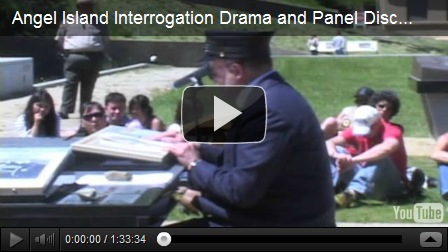
Upon arriving at Angel Island the immigrants would be subjected to a series of interviews where they would need to correctly answer ever increasingly obscure questions about their families and hometowns. Their answers would be compared with others who had come over with them or who had come over previously and look for discrepancies. You can watch this video I have included below which shows a recent recreation of a couple of these immigration interviews. It is quite long but you can watch a portion to get an idea of how ridiculous these interviews would have been. I don’t think I could have passed these interviews myself.

Reenactment of a series of Angel Island Interrogations

While waiting to pass the interview process the immigrants would have to stay in the dormitories – sometimes for as little as a week, or sometimes for as much as a year. These were not the most comfortable arrangements. In the video below you can take a tour of the dormitories as they would have been during the active years of Angel Island.

Virtual Tour of Angel Island Immigration Station and Museum

If you happen to be traveling to the San Francisco area or live in that area, you can visit Angel Island today. It has a great number of opportunities for hiking, biking etc as well as a little historical tour. The Immigration Station now houses a museum. The museum is open on Saturdays and Sundays from 11-3 and is $5 admission for adults and $3 for youths. There are 1 hour lecture tours available for an additional $7. You can learn more about the state park here.

Most people who know of Angel Island know of it as the immigration center – but it had a history both before and after that period. It served as a military center, a quarantine station, camp for prisoners during WWII, and as a state park. Here is a timeline of Angel Island history.

If you want to hear first-hand stories of the Angel Island experience you can read or listen to some of these interviews.

Or if you are looking for some reading recommendations, check out some of these:

  • Barde, Robert Eric. Immigration at the Golden Gate: Passenger Ships, Exclusion, and Angel Island. Westport: Praeger, 2008.
  • Fanning, Bramwell and Wong, William. Images of America: Angel Island. Arcadia Publishers, 2007.
  • Lee, Erika and Judy Yung. Angel Island: Immigrant Gateway to America. New York: Oxford University Press, 2010.

Or you can get a more complete listing here.

Have any of you been here before? Do you know anyone that had to pass through Angel Island to immigrate here?


Copyright © 2013 by The Maiden’s Court

Thursday, August 23, 2012

Book Review: Ellis Island by Kate Kerrigan

Ellis Island

Ellis Island by Kate Kerrigan
Book 1 in the Ellis Island series
ARC, Paperback, 368 pages
William Morrow Paperbacks
June 28, 2011
★★★★☆
goodreads button

Genre: Historical Fiction

Source: Received from publisher for review

Sweethearts since childhood, Ellie Hogan and her husband, John, are content on their farm in Ireland—until John, a soldier for the Irish Republican Army, receives an injury that leaves him unable to work. Forced to take drastic measures in order to survive, Ellie does what so many Irish women in the 1920s have done and sails across a vast ocean to New York City to work as a maid for a wealthy socialite.

Once there, Ellie is introduced to a world of opulence and sophistication, tempted by the allure of grand parties and fine clothes, money and mansions . . . and by the attentions of a charming suitor who can give her everything. Yet her heart remains with her husband back home. And now she faces the most difficult choice she will ever have to make: a new life in a new country full of hope and promise, or return to a life of cruel poverty . . . and love.

Ellis Island was quite the enjoyable read, but for an entirely different reason than I anticipated when I set out to read it. Before I started reading I thought that the general focus of the book would be the time on Ellis Island for Ellie between leaving Ireland and arriving at New York City. I was looking forward to the Ellis Island immigrant experience; however I arrived as something entirely different. A story of love, torn desires, dreams of the future, and still the immigrant experience.

Kerrigan gives the reader a solid feel for both Ireland and America in the 1920’s. The contrast between the two is shocking – rural, extremely close, farming community vs. big, noisy, city life. I grew to enjoy Ellie’s life in both Ireland and New York – while extremely different, still the same in some ways. I myself was torn between which sections of the novel I enjoyed more, America or Ireland – but for different reasons.

The story was fast paced and the characters really suck you right into their lives and loves. The end of each chapter pulls you right into the start of the next – always needing to know what will happen on the next page.

The one thing that I would have liked to have more of was time at the titular Ellis Island. There were two small, very short scenes taking place on this island. I would have liked it to have been more central to the story. There was a moment when I thought it might have been a game changing moment, however that was not the case and I was left a little disappointed in the end.

If you would like to preview the story before reading it, why not try out this excerpt of the book?


Reviews of this book by other bloggers: 

Buy the Book: Amazon | Barnes & Noble | RJ Julia


Also by Kate Kerrigan:

city of hope
City of Hope (Ellis Island #2)
[My Review]

land of dreams
Land of Dreams (Ellis Island #3)

fall of poppies
Fall of Poppies
[My Review]

the dress
The Dress

it was only ever you
It Was Only Ever You

the miracle of grace
The Miracle of Grace

the lost garden
The Lost Garden


Find Kate Kerrigan: Website | Facebook | Twitter


Copyright © 2012 by The Maiden’s Court